

Key filing points
Registering a company with the Registrar of Joint Stock Companies and Firms (RJSC) is not the end of corporate compliance.
After incorporation, a Bangladeshi company has continuing obligations to keep its RJSC record updated through:
1. Annual filings, linked mainly with the Annual General Meeting (AGM); and 2. Event-based filings, triggered when something changes—for example directors, registered office, share capital, allotment of shares, special resolutions or registered charges.
For an ordinary company with share capital, one of the most important annual filings is Schedule X, containing the annual summary of share capital and list of members. Under section 36 of the Companies Act, 1994, it must be completed and filed within 21 days after the relevant general meeting. Audited financial statements are subject to a separate 30-day filing period under section 190.
Select a topic to read the detailed guidance
Why RJSC Return Filing Matters Even After Incorporation
A company may have a valid Certificate of Incorporation and still have an outdated corporate record.
RJSC filings create the official record of matters such as:
- shareholders and share capital;
- directors and management;
- registered office;
- annual financial information;
- special and extraordinary resolutions;
- new share allotments;
- mortgages and charges; and
- certain major corporate changes.
That record becomes important when the company seeks investment, enters a major transaction, applies for financing, undergoes legal due diligence, transfers ownership or needs certified corporate records.
In practice, a common corporate problem is that the company's internal documents show one position while its RJSC record shows another.
The purpose of proper return filing is therefore not simply “avoiding a late fee”; it is keeping the company's legal corporate record aligned with reality.
The Legal Basis for RJSC Return Filing
The principal law is the Companies Act, 1994 (Act No. XVIII of 1994).
Among the most important provisions are:
| SubjectCompanies Act provision | |
|---|---|
| Annual list of members and summary | Section 36 |
| Annual General Meeting | Sections 81–82 |
| Special/Extraordinary resolutions | Sections 87–88 |
| Director/manager particulars | Section 115 |
| Return of allotment | Section 151 |
| Registration of mortgages/charges | Section 159 onwards |
| Annual balance sheet and accounts | Section 183 |
| Filing financial statements with Registrar | Section 190 |
| Appointment of auditors | Section 210 |
The Companies Act currently published through Bangladesh Laws confirms these provisions and their continuing application.
First Understand the AGM—Because Most Annual Filing Deadlines Start There
A company should not calculate its annual-return deadline without first determining when its AGM was legally required to be held.
Under section 81 of the Companies Act, 1994:
- every company must hold an AGM in each English calendar year;
- normally no more than 15 months may pass between two AGMs; and
- the first AGM may be held within 18 months from incorporation.
For an AGM other than the first AGM, the Registrar has a limited statutory power to extend the time, subject to the requirements of section 81.
This creates the basic compliance sequence:
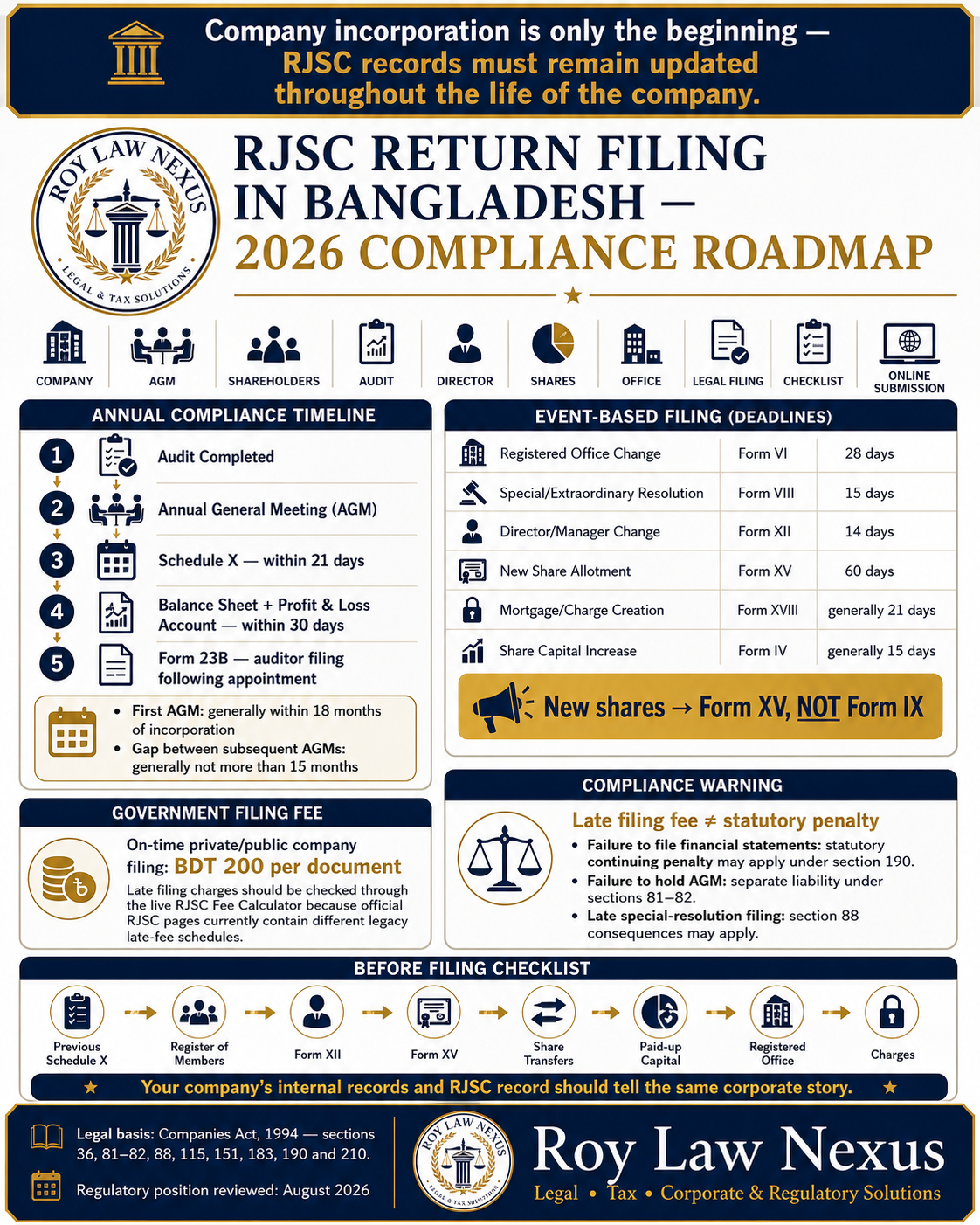
Financial year → Audit → AGM → Schedule X → Financial-statement filing
What Must a Private Limited Company File Every Year?
RJSC's official guidance identifies four principal annual-return documents for a private company.
| Annual FilingMain Legal BasisDeadline | ||
|---|---|---|
| Schedule X – Annual summary of share capital, shareholders and related information | Section 36 | Within 21 days of AGM |
| Balance Sheet | Sections 183 & 190 | Within 30 days of AGM |
| Profit & Loss Account | Sections 183 & 190 | Within 30 days of AGM |
| Form 23B – Notice by Auditor | Section 210(2) | Auditor files within 30 days after receiving notice of appointment |
These deadlines should not be merged into a single “30-day annual return deadline.”
1. Schedule X: The Core Annual Company Return
For a company having share capital, Schedule X is one of the most important annual filings.
It is formally titled:
“Annual Summary of Share Capital and List of Shareholders”
and is expressly linked to section 36 of the Companies Act, 1994.
Schedule X includes information relating to matters such as:
- authorised/nominal share capital;
- shares issued and taken up;
- calls and amounts paid or unpaid;
- existing shareholders;
- persons who ceased to be members;
- share transfers;
- directors and relevant officers;
- registered mortgages and charges; and
- other statutory share-capital information.
Section 36 requires the annual list and summary to be completed within 21 days following the relevant general meeting and filed with the Registrar within that period.
Schedule X Is More Than a Shareholder List
A frequent mistake is to treat Schedule X simply as a list of current shareholders.
It is broader than that.
The information should reconcile with:
- the Register of Members;
- share-transfer records;
- allotment records;
- paid-up capital;
- previous Schedule X;
- director records; and
- registered charges where applicable.
If these records do not reconcile, the annual return may effectively preserve an incorrect corporate history.
2. Audited Financial Statements: 30 Days After AGM
Under section 183, the directors must place before the AGM the company's balance sheet and profit-and-loss account—or income-and-expenditure account where applicable—and the accounts must be audited in accordance with the Companies Act.
Under section 190, the relevant financial statements and documents required to accompany them must be filed with the Registrar within 30 days from the date they were laid before the AGM.
Therefore:
Schedule X deadline = 21 days after AGM Financial statements deadline = 30 days after AGM
These are separate statutory deadlines.
What If the AGM Was Not Held?
Not holding an AGM does not automatically remove the financial-statement filing obligation.
Section 190 specifically addresses this situation. Where no AGM was held, the filing is generally required within 30 days after the last date on which the AGM should legally have been held, together with the appropriate statement concerning the failure to hold or approve the accounts.
3. Form 23B: The Auditor's Filing
Form 23B is often incorrectly treated as a document the company itself files along with every annual return.
RJSC's official guidance describes Form 23B as a notice filed by the auditor following appointment. The stated period is 30 days after the auditor receives information of the appointment from the company.
Section 210 also requires a company appointing an auditor at the AGM to notify the appointed auditor of the appointment within seven days.
Annual Return Is Different From a Return for Change
This distinction is essential.
Suppose a company files its Schedule X and audited accounts every year but:
- appoints a new director without filing Form XII;
- changes its registered office without filing Form VI; or
- issues new shares without filing Form XV.
The company may still have an inaccurate RJSC record even though the annual return is up to date.
RJSC itself classifies filings into annual returns and returns for change.
Important Event-Based RJSC Filings Every Company Should Know
| Corporate EventMain FormStatutory Filing Period | ||
|---|---|---|
| Increase in share capital | Form IV | Generally 15 days |
| Change/establishment of registered office | Form VI | 28 days |
| Special or extraordinary resolution | Form VIII | 15 days |
| Consent to act as director | Form IX | Relevant statutory filing after appointment |
| Appointment/change of director, manager or managing agent | Form XII | 14 days under section 115 |
| Allotment of new shares | Form XV | 60 days |
| Creation of registrable mortgage/charge | Form XVIII | Generally 21 days |
The official Companies Act states 14 days for the particulars or changes governed by section 115. Some older RJSC informational pages describe this as 15 days; where there is such a discrepancy, the safer legal approach is to follow the 14-day statutory period.
Important Correction: Form XV, Not Form IX, Is the Return of Allotment
This is one of the most important corrections to many online articles.
Under section 151 of the Companies Act, 1994, where a company having share capital makes an allotment, the company must file the prescribed return of allotment within 60 days.
RJSC's live system identifies Form XV as “Return of Allotment – Ref Section 151.”
Form IX, by contrast, relates to consent to act as a director.
Therefore:
New shares allotted → Form XV
not Form IX.
Director Appointment or Resignation: Do Not Wait Until the Next Annual Return
Section 115 requires the company to maintain particulars of its directors, managers and managing agents and notify the Registrar of changes.
The statute provides a 14-day period from the appointment/change.
This means a director appointed or resigning in January should not simply be reflected in the following year's Schedule X.
The event-based filing should be completed within the statutory period.
Registered Office Change: Form VI
A company's registered office is its formal statutory address.
Form VI is the prescribed notice concerning the situation of the registered office or a change in it.
The official RJSC Form VI itself states that notice must be filed within 28 days of incorporation or the change, as applicable.
An outdated registered office at RJSC can create obvious practical problems with formal notices, due diligence and corporate records.
Special and Extraordinary Resolutions: Form VIII
Certain major corporate decisions require a special or extraordinary resolution.
Section 88 requires a certified copy of every special or extraordinary resolution to be filed with the Registrar within 15 days after it is passed.
RJSC uses Form VIII for this purpose. The live electronic system expressly describes it as the Special Resolution/Extraordinary Resolution filing.
This may be relevant to matters such as amendments to constitutional documents and other changes requiring a statutory resolution.
Step-by-Step RJSC Annual Return Filing Process in 2026
Step 1: Review the Company's Existing RJSC Record
Before preparing a return, compare the current records with:
- incorporation documents;
- latest Schedule X;
- latest Form XII;
- share register;
- allotment records;
- share-transfer records;
- registered office;
- authorised and paid-up capital; and
- registered mortgages/charges.
Do not start with last year's return and blindly copy the information forward.
Step 2: Complete the Audit and AGM Process
The annual financial statements should be prepared and audited, and the AGM must be held in accordance with the Companies Act.
The accounts laid before the AGM form the basis of the subsequent financial-statement filing.
Step 3: Prepare Schedule X Carefully
Ensure that:
opening share position + allotments − transfers/cessations = current shareholder position
and that the capital figures agree with the company's statutory records.
Step 4: File Through the RJSC Online Return-Filing System
RJSC operates an online Returns Filing system through which registration details are entered and the appropriate returns are selected and submitted.
RJSC's guidance states that applications/returns are initiated online. However, the live system can also show a requirement to submit signed pending hard-copy documents at an RJSC counter for particular submissions. Businesses should therefore follow the instructions generated for the actual filing rather than assume every stage is necessarily paperless.
Step 5: Pay the Applicable Filing Fee
RJSC's live fee information currently states that filing a document within its scheduled time for private and public companies costs BDT 200 per document.
What About Late Filing Fees?
This requires caution.
Different official RJSC pages currently display inconsistent late-fee descriptions, and older published schedules do not provide a safe basis for quoting one universal current amount.
Accordingly, for an overdue return, the safest practice is:
use RJSC's live Fee Calculator/system-generated payable amount at the time of filing rather than relying on a fixed late-fee amount quoted in an older article.
Step 6: Check Filing Status and Preserve Evidence
After submission, retain:
- submission number;
- payment evidence;
- accepted filed return;
- signed originals;
- system acknowledgement; and
- any later RJSC query or acceptance record.
A filing should not be considered complete merely because information was typed into the portal.
Penalties: Late Fee and Statutory Liability Are Not the Same Thing
This is another distinction often missed in online guides.
Schedule X Default
Section 36 creates statutory liability for failure to comply with the annual-list and summary requirements, including continuing liability while the default remains.
Failure to File Financial Statements
Under section 190(3), the company may be liable to a fine of up to BDT 100 for every day the default continues, and officers who knowingly and wilfully authorise or permit the default may face the same liability.
Failure to Hold AGM
Section 82 provides a separate penalty framework for failure to comply with the AGM requirement, including a fine of up to BDT 10,000 and further continuing fines in the circumstances specified by the Act.
Special Resolution Filing
Section 88 also contains a continuing statutory fine for failure to file a special or extraordinary resolution within the required period.
These statutory consequences are separate from administrative/portal filing fees.
What If a Company Has Not Filed Returns for Several Years?
This is common, but it should not be ignored.
A sensible regularisation exercise normally begins with a compliance audit, rather than immediately uploading forms.
The company should reconstruct, year by year:
AGMs → audited accounts → shareholders → transfers → allotments → directors → registered office → resolutions → charges
This is particularly important where one missed filing affects another.
For example, if shares were allotted three years ago but Form XV was never filed, simply showing those shareholders in the latest Schedule X does not necessarily cure the historical filing problem.
Can an Old Company With No Business Ignore RJSC Returns?
No safe assumption should be made that a company has no compliance obligations merely because it is dormant or has stopped trading.
A company remains a legal entity until it is properly dissolved, wound up or otherwise removed in accordance with applicable law.
Simply stopping commercial activity does not by itself erase statutory corporate obligations.
Where an old company is no longer needed, the better approach is to review whether:
- overdue filings should first be regularised; and
- the company should then be legally closed through an appropriate winding-up/striking-off route.
Why Accurate RJSC Records Matter in Due Diligence
Before a share acquisition, investment or major financing, lawyers and investors commonly examine:
- incorporation documents;
- Schedule X;
- Form XII;
- share allotments;
- share transfers;
- resolutions;
- charges;
- audited accounts; and
- certified copies from RJSC.
If the documents do not tell the same corporate story, the discrepancy usually has to be resolved before the transaction can safely proceed.
Examples include:
“The shareholder owns 40% internally, but RJSC does not show the allotment.”
or:
“The current director has operated the company for two years, but Form XII was never updated.”
Those are not merely clerical issues—they can become transaction and governance issues.
RJSC Compliance in 2026: What the Official Statistics Show
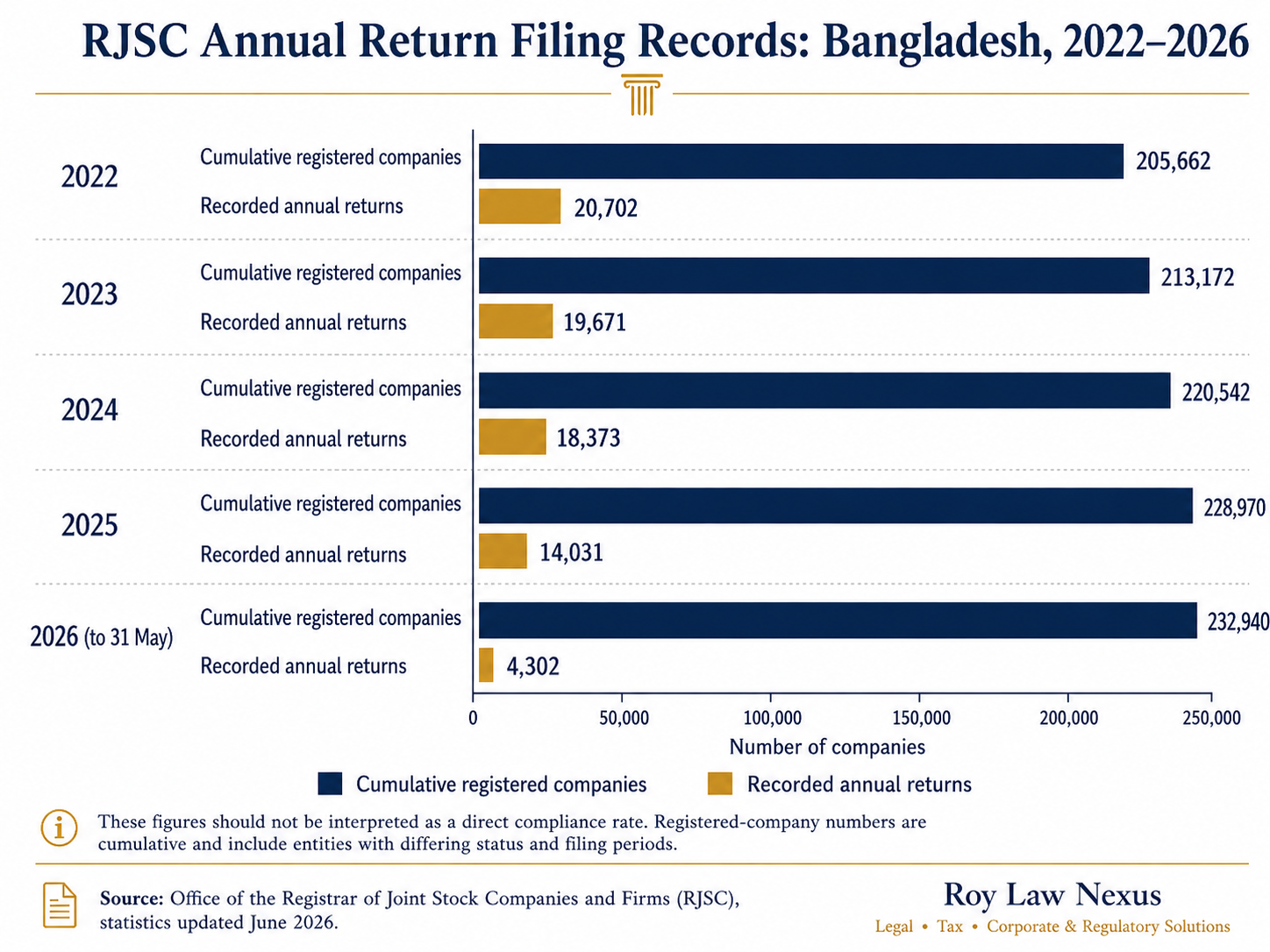
RJSC's latest published annual-return statistics, updated in June 2026, show the following figures:
| YearCumulative Registered CompaniesRecorded Annual Return Filings | ||
|---|---|---|
| 2022 | 205,662 | 20,702 |
| 2023 | 213,172 | 19,671 |
| 2024 | 220,542 | 18,373 |
| 2025 | 228,970 | 14,031 |
| 2026 – up to 31 May | 232,940 | 4,302 |
These figures should not be treated as a direct non-compliance percentage, because the registered-company figure is cumulative and may include companies of different status and return periods.
They nevertheless demonstrate why annual-return compliance remains a significant practical issue.
RJSC's live entity counter also currently lists more than 225,000 private companies, along with public companies, OPCs, foreign companies, societies and partnership firms under its registry.
Do Partnerships and Societies File the Same Annual Return?
No.
“RJSC return filing” is a broad expression, but different entities are governed by different laws.
For example, RJSC's official guidance states that a registered society files its annual managing-body list within 14 days of the AGM, or in January where its rules do not provide for an AGM.
A partnership firm, meanwhile, does not follow the company Schedule X system; relevant changes are recorded through partnership forms such as Form II, V and VI under the applicable partnership framework.
This article therefore primarily addresses companies registered under the Companies Act, 1994.
Common RJSC Return Filing Mistakes
The most common problems are not simply “missing the deadline.”
They include:
Using the wrong form — such as confusing Form IX and Form XV.
Waiting for the annual return to report a director change — when Form XII is event-based.
Preparing Schedule X without checking the Register of Members.
Showing shares in Schedule X when the historical allotment filing was never completed.
Using inconsistent names, addresses or share figures across different filings.
Ignoring old outstanding returns until a bank, investor or buyer requests due diligence.
Assuming an online submission is complete without checking its final status.
How Roy Law Nexus Can Assist With RJSC Compliance
Roy Law Nexus can assist local companies, founders, shareholders and investors with:
- annual RJSC compliance review;
- Schedule X preparation and filing;
- financial-statement filing coordination;
- overdue return regularisation;
- Form VI registered-office changes;
- Form VIII special/extraordinary resolutions;
- Form IX and Form XII director-related filings;
- Form XV return of allotment;
- share-transfer and capital restructuring documentation;
- mortgage and charge filings;
- corporate record reconciliation;
- certified-copy and RJSC record review;
- legal due diligence before investment or acquisition;
- shareholder/director restructuring; and
- winding-up and corporate closure planning.
For a company with several years of missing returns, the safer approach is usually to reconstruct the corporate history first and file second, rather than uploading disconnected forms without checking their legal sequence.
Discuss Your RJSC Compliance →Frequently Asked Questions About RJSC Return Filing
What is an RJSC annual return?
For a company having share capital, Schedule X is the statutory annual list and summary under section 36. Annual compliance also includes the relevant financial-statement filings and auditor-related filing requirements.
How many days after AGM must Schedule X be filed?
21 days.
How many days after AGM must the Balance Sheet and Profit & Loss Account be filed?
Generally 30 days under section 190.
Is Form XII an annual return?
Not in the ordinary sense. Form XII is used for particulars of directors, managers and managing agents and changes in those particulars.
How quickly must a director change be notified?
Section 115 provides 14 days from the relevant appointment or change.
Which form is used when a company issues new shares?
Form XV – Return of Allotment.
How long does a company have to file Form XV?
60 days after allotment, under section 151.
Which form is used for a registered-office change?
Form VI, generally within 28 days.
How quickly must a special resolution be filed?
Within 15 days after it is passed under section 88.
What is the normal RJSC filing fee?
The current live RJSC fee page states BDT 200 per document when a private or public company files within the scheduled period.
Can an overdue company file old returns now?
Overdue filings can generally require regularisation, but the appropriate sequence depends on what was missed. A multi-year compliance review is advisable before filing.
Does not holding an AGM remove the annual-account filing requirement?
No. Section 190 expressly provides for the situation where the AGM was not held.
Is RJSC return filing completely paperless?
The return process is online, but the current system may require submission of duly signed hard copies for particular pending filings. Applicants should follow the instructions generated for the specific submission.
Key Legal References
Companies Act, 1994 (Act No. XVIII of 1994) The principal statute governing Bangladeshi companies and their corporate filings.
Section 36 Annual list of members and summary / Schedule X.
Sections 81–82 Annual General Meeting and consequences of default.
Section 88 Filing of special and extraordinary resolutions.
Section 115 Director, manager and managing-agent particulars and changes.
Section 151 Return of allotment.
Sections 183 and 190 Annual accounts and filing with the Registrar.
Section 210 Appointment of auditors.
Current RJSC forms, return-filing guidance and fee instructions should also be checked at the time of a particular filing because administrative procedures may change.
Official online sources checked for this guide
- Companies Act, 1994 — Bangladesh Laws (opens in a new tab)
- RJSC Returns Filing business-process guidance (opens in a new tab)
- RJSC official FAQ (opens in a new tab)
- RJSC official filing-fee information (opens in a new tab)
- RJSC live Fee Calculator (opens in a new tab)
- Official Form XV — Return of Allotment (opens in a new tab)
- RJSC portal and official statistics (opens in a new tab)
Final Takeaway
For a Bangladeshi company, incorporation is only the beginning.
A sound corporate-compliance cycle looks like:
Maintain company records → Complete audit → Hold AGM → File Schedule X → File financial statements → File event-based changes immediately → Reconcile RJSC records every year.
The biggest mistake is waiting until a bank, investor, buyer or regulator identifies years of missing or inconsistent filings.
Good corporate compliance means the company's internal records and its RJSC record tell the same story.
This article provides general legal and regulatory information based on the position reviewed on 29 August 2026. Specific company structures, public-interest entities, listed companies, foreign companies, OPCs and regulated industries may have additional requirements. Current RJSC portal instructions and applicable law should be checked for the particular filing.
About the Author

Sawdip Roy Sajib
Advocate, Supreme Court of Bangladesh
Member, Dhaka Bar Association and Dhaka Taxes Bar Association
Legal Disclaimer: This article provides general corporate-law and regulatory information based on official materials reviewed to 29 August 2026. It is not advice for a particular company and does not create a lawyer-client relationship. Current RJSC portal instructions, fees and the applicable law should be checked before filing.