

Key points
Last legally reviewed: 27 August 2026
Starting a company in Bangladesh involves much more than obtaining a Certificate of Incorporation. Founders must choose the correct corporate structure, determine shareholding and capital, prepare legally appropriate constitutional documents, complete registration with the Registrar of Joint Stock Companies and Firms (RJSC) and then obtain the tax, trade and sector-specific approvals required for the proposed business.
For most entrepreneurs, startups and foreign investors establishing a locally incorporated business, a private limited company remains the most practical corporate structure.
This guide explains the company-registration process in Bangladesh in 2026, including the legal requirements, RJSC documents, current government fees, foreign investment rules and post-incorporation compliance requirements.
Select a topic to read the detailed guidance
Company Registration in Bangladesh — Key Facts at a Glance
| Issue | Private Limited Company |
|---|---|
| Main regulator | Registrar of Joint Stock Companies and Firms (RJSC) |
| Principal law | Companies Act, 1994, as amended |
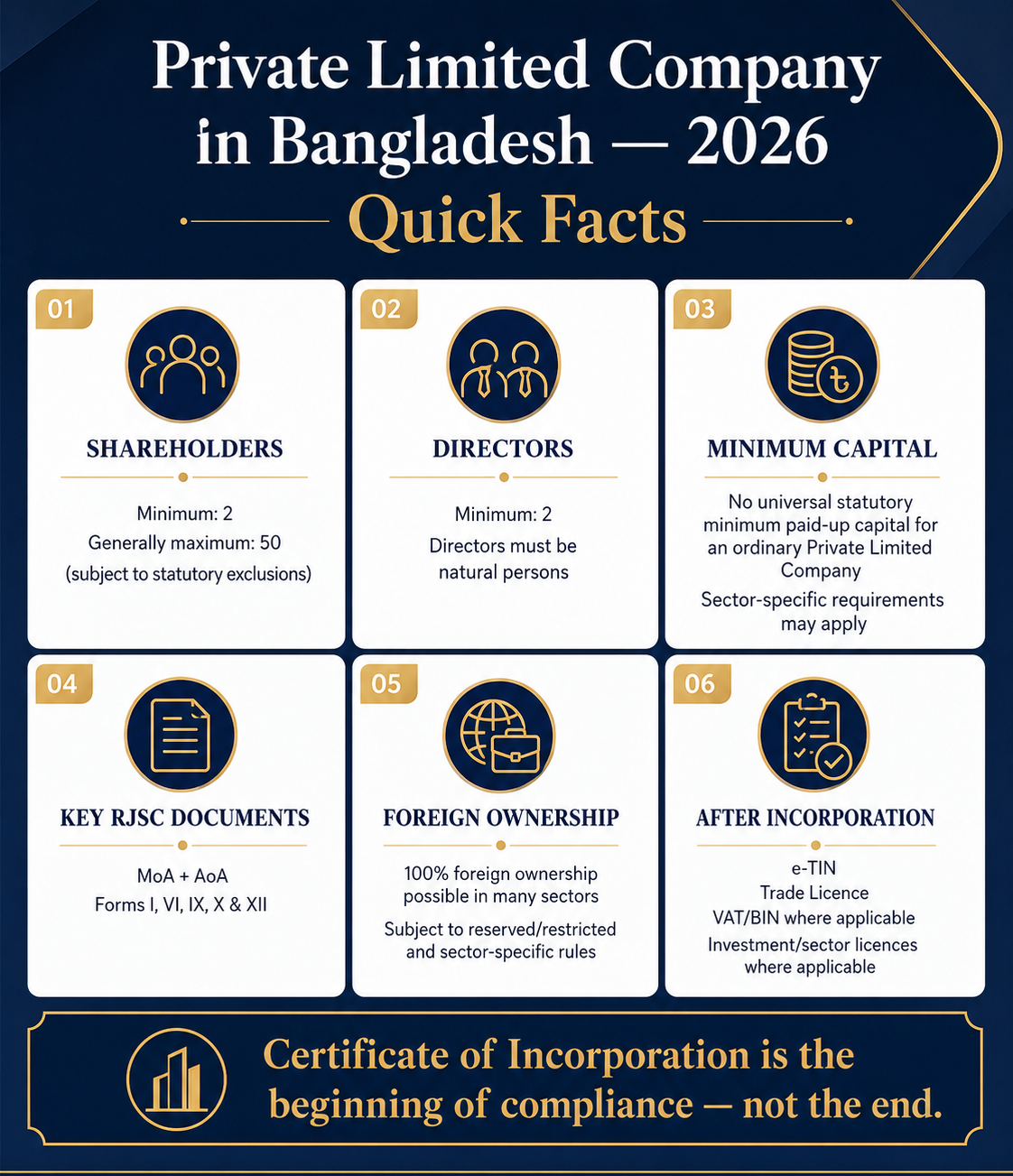
| Minimum members/shareholders | 2 |
| Maximum members | 50, subject to statutory exclusions |
| Minimum directors | 2 |
| Who can be a director? | Natural persons only |
| General statutory minimum paid-up capital | No fixed general minimum for an ordinary private company |
| Constitutional documents | Memorandum of Association (MoA) and Articles of Association (AoA) |
| Main incorporation forms | Forms I, VI, IX, X and XII |
| Registered office | Required in Bangladesh |
| Name suffix | “LTD.” for a limited private company |
| Foreign ownership | Wholly foreign-owned investment is possible in many sectors, subject to restricted/reserved activities and sectoral rules |
| Post-registration requirements | Usually e-TIN, trade licence and, where applicable, VAT/BIN, BIDA registration and sector-specific licences |
The Companies Act provides that two or more persons may form a private company and seven or more may form a public company. A private company must restrict share transfers through its Articles, prohibit invitations to the public to subscribe for shares or debentures and generally limit its membership to 50. Section 90 requires at least two directors for an ordinary private company and at least three for a public company or a private subsidiary of a public company; directors must be natural persons.
1. What Law Governs Company Registration in Bangladesh?
The principal legislation is the Companies Act, 1994 (Act No. XVIII of 1994), as amended. The official consolidated legislation available through Bangladesh Laws was checked for this guide in its 2026 version. Company incorporation and statutory filings are administered by the RJSC.
Important provisions include:
| Legal issue | Companies Act provision |
|---|---|
| Formation of private/public companies | Section 5 |
| Company name | Section 11 |
| LTD./PLC./OPC identification | Section 11A |
| Articles of Association | Section 19 |
| Registration/compliance declaration | Section 25 |
| Annual list and summary | Section 36 |
| Registered office | Section 77 |
| Annual General Meeting | Section 81 |
| Minimum number of directors | Section 90 |
| Director consent | Sections 92–93 |
| Director/manager particulars | Section 115 |
| Financial statements | Sections 181–190 |
| Auditors | Section 210 |
| Foreign companies operating in Bangladesh | Part dealing with foreign companies, including Section 379 |
Incorporation is only one layer of regulation. Depending on the business, the Income Tax Act, 2023, Value Added Tax and Supplementary Duty Act, 2012, foreign-exchange rules, investment regulations and sector-specific laws may also apply.
2. Which Business Structure Should You Choose?
Choosing the right legal structure before filing is important because shareholding, liability, investment, succession and regulatory obligations differ significantly.
| Structure | Best suited for | Important features |
|---|---|---|
| Private Limited Company | Startups, SMEs, family businesses, foreign subsidiaries and joint ventures | Separate legal entity; 2+ members; minimum 2 directors; generally maximum 50 members |
| Public Limited Company | Larger businesses seeking wider capital participation | Minimum 7 members and 3 directors; additional securities/corporate requirements apply |
| One Person Company (OPC) | Eligible sole entrepreneurs | One natural-person shareholder; governed by special OPC provisions and eligibility requirements |
| Branch Office | Foreign company extending its existing overseas business into Bangladesh | Not a newly incorporated Bangladeshi subsidiary; requires BIDA/Invest Bangladesh approval and foreign-company filings |
| Liaison/Representative Office | Foreign businesses maintaining a limited non-commercial presence | Operates under BIDA permission and specified restrictions; not the same as incorporating a local company |
A branch, liaison or representative office should not be confused with a locally incorporated private limited company. Invest Bangladesh treats approval of these foreign commercial offices as a separate process, and Section 379-related RJSC filing follows approval.
3. Requirements for a Private Limited Company in Bangladesh
For an ordinary private company limited by shares, founders should ordinarily settle the following before incorporation:
Shareholders
At least two members/shareholders are required. Under the Companies Act, a private company generally limits its membership to 50, with certain statutory exclusions relating to employees and joint holders.
A corporate body may also participate as a subscriber/shareholder. RJSC's current online registration interface specifically accommodates body-corporate subscribers.
Directors
At least two directors are required for an ordinary private company. Importantly, Section 90(3) provides that only a natural person may be appointed as a director.
Registered Office
The company must maintain a registered office in Bangladesh. Under Section 77, the registered office must exist from the earlier of commencement of business or the 28th day following incorporation, and notice of its location or change must be submitted to the Registrar within the statutory period. Form VI is the prescribed notice.
Share Capital
For an ordinary private limited company, the Companies Act does not prescribe a universal minimum paid-up capital figure.
This is important because statements such as “BDT 100,000 is required for a private company” should not be treated as law.
However:
- each subscriber must subscribe for the required shares under the Memorandum;
- sufficient commercial capital should be chosen for the proposed business;
- authorised capital affects RJSC fees; and
- banking, insurance, financial services, regulated industries and certain investment/visa situations may have separate minimum-capital or investment requirements.
The appropriate capital therefore depends on the company's actual business rather than an arbitrary registration figure.
4. Step-by-Step Company Registration Process in Bangladesh — 2026
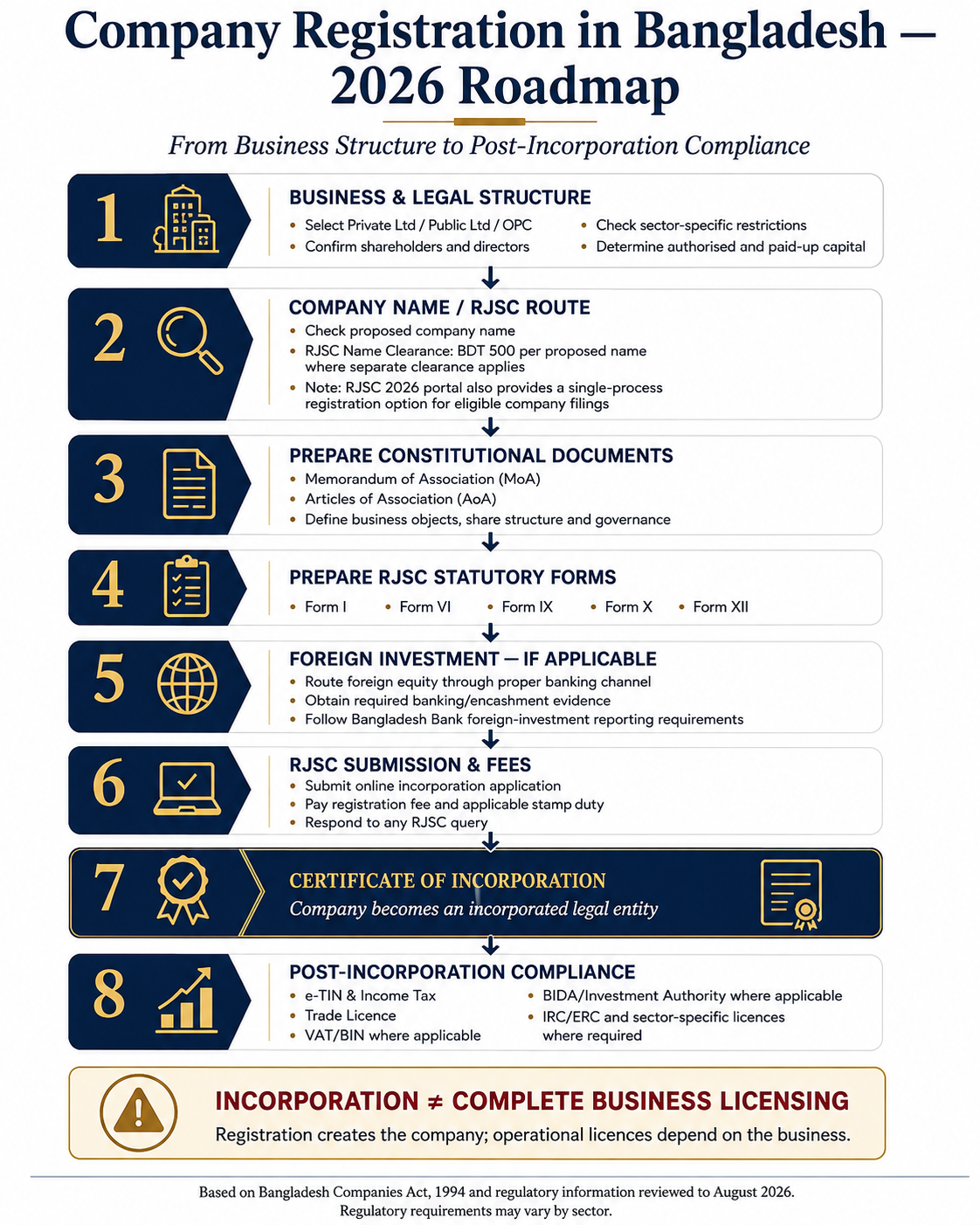
Step 1 — Decide the Business Structure and Regulatory Route
Before submitting anything to RJSC, determine:
- proposed business activities;
- shareholders and their percentage ownership;
- directors;
- authorised and paid-up capital;
- registered office;
- whether any shareholder is non-resident;
- whether the sector requires prior approval, NOC or minimum capital; and
- whether the business will operate under BIDA, BEZA, BEPZA, BHTPA or another specialised regulator.
This preliminary legal review is especially important for foreign investment and regulated sectors.
Step 2 — Select and Clear the Company Name
Section 11 restricts registration of a company under a name identical or deceptively similar to an existing company and permits restrictions on undesirable names.
Under the traditional RJSC process, applicants obtain name clearance before incorporation. RJSC's current fee schedule states:
Name-clearance fee: BDT 500 for each proposed name Extension application: BDT 200
Important 2026 update
The current Invest Bangladesh FAQ (opens in a new tab) distinguishes between the filing routes: it directs foreign-company applicants to seek name clearance through OSS, while stating that a local company's name will be validated at incorporation. RJSC nevertheless continues to publish a separate name-clearance service and fee schedule.
Applicants should therefore follow the live RJSC/OSS workflow applicable to their filing rather than assuming that every applicant follows an identical preliminary step. Where a separate clearance is issued, check the validity date stated in the actual clearance letter.
5. Draft the Memorandum and Articles of Association Carefully
The Memorandum of Association (MoA) and Articles of Association (AoA) are not merely registration formalities.
Memorandum of Association
The MoA establishes key constitutional matters including the company's:
- name;
- registered-office jurisdiction;
- objects/business purposes;
- liability structure;
- authorised share capital; and
- subscriber/shareholding information.
Articles of Association
The AoA regulates the company's internal governance, including matters such as:
- issue and transfer of shares;
- shareholder rights;
- directors and board powers;
- meetings and quorum;
- voting;
- dividends;
- bank operations;
- transfer/transmission;
- management powers; and
- other internal corporate procedures.
RJSC's current filing interface requires applicants to enter MoA information by reference to the Bangladesh Standard Industrial Classification 2020 and allows use of a model or customised AoA.
Practical legal point: Do not simply copy another company's MoA and AoA. Poorly drafted objects or shareholder-control provisions can later create problems with banking, licences, investment, share transfers and corporate disputes.
6. Documents and RJSC Forms Required
For a conventional private-company incorporation, the principal statutory documents include:
| Document/Form | Purpose |
|---|---|
| Memorandum of Association | Constitutional objects, capital and subscribers |
| Articles of Association | Internal corporate governance |
| Form I | Declaration on registration/compliance under Section 25 |
| Form VI | Registered-office information under Section 77 |
| Form IX | Director's consent to act under Section 92 |
| Form X | List of persons consenting to become directors |
| Form XII | Particulars of directors/manager etc. |
| Subscriber information/signatures | Ownership and subscription details |
| Name-clearance information | Where applicable |
| Foreign-remittance/encashment evidence | Where non-resident equity is introduced and required by the applicable process |
RJSC's live company-registration interface refers to Forms VI, IX, X and XII, and Form I is the statutory declaration of compliance under Section 25. Official RJSC copies of Forms I, IX and XII are also currently published.
This is one area where abbreviated online guides frequently cause confusion: Forms IX, X and XII alone do not represent the complete statutory incorporation package.
8. How Much Does Company Registration Cost in Bangladesh in 2026?
RJSC fees depend partly on authorised capital.
According to RJSC's current official fee schedule:
Name Clearance
| Item | Current RJSC Fee |
|---|---|
| Name clearance | BDT 500 per proposed name |
| Extension | BDT 200 per extension application |
Private Company — Stamp Duty
| Instrument | Stamp |
|---|---|
| Memorandum of Association | BDT 1,000 |
| AoA where authorised capital is up to BDT 10 lakh | BDT 2,000 |
| AoA where authorised capital exceeds BDT 10 lakh up to BDT 3 crore | BDT 4,000 |
| AoA where authorised capital exceeds BDT 3 crore | BDT 10,000 |
Filing Fee
RJSC currently states BDT 1,200 for filing six incorporation documents—five prescribed forms plus the MoA/AoA filing unit.
Authorised-Capital Fee
RJSC presently imposes no additional authorised-capital registration fee up to BDT 10 lakh. Above that level:
- more than BDT 10 lakh up to BDT 50 lakh: BDT 80 for every BDT 1 lakh or part thereof above the relevant threshold;
- above BDT 50 lakh: an additional BDT 130 for every BDT 1 lakh or part thereof above the first BDT 50 lakh.
Example — Private Company with Authorised Capital up to BDT 10 Lakh
On the current RJSC schedule, the core government incorporation/stamp components would ordinarily be:
MoA stamp BDT 1,000 + AoA stamp BDT 2,000 + filing fee BDT 1,200 = BDT 4,200
If one separately cleared proposed name is charged at BDT 500, the total becomes approximately BDT 4,700, excluding payment-channel charges, professional fees and any other regulatory/licensing costs.
2026 fee caution: RJSC maintains an online fee calculator. Applicants should check the live calculator immediately before filing because government fees and portal procedures can change.
9. Certificate of Incorporation — What Does It Actually Mean?
Once RJSC is satisfied with the application, it issues the Certificate of Incorporation.
The certificate establishes the company as an incorporated legal entity. But incorporation should not be confused with permission to conduct every proposed business activity immediately.
A company may still need tax registration, a trade licence, VAT/BIN and sector-specific approvals before commencing the relevant operations.
10. What Must Be Done After Company Registration?
10.1 Obtain e-TIN and Maintain Income-Tax Compliance
A company should obtain taxpayer registration/e-TIN.
More importantly, under Section 166(1)(c) of the Income Tax Act, 2023, a company is specifically included among persons required to file an income-tax return. This obligation is not dependent merely on the company making a profit.
10.2 Obtain a Trade Licence
A trade licence is issued by the appropriate City Corporation, Paurashava or Union Parishad, depending on location.
Invest Bangladesh confirms that trade licensing remains a local-government function, with several city-corporation services also integrated into its OSS platform.
10.3 VAT Registration or Turnover-Tax Enlistment — Where Applicable
Do not assume that incorporation automatically means every new company must immediately take the same VAT status.
Current NBR guidance states:
| Taxable turnover during a 12-month period | General NBR threshold treatment |
|---|---|
| Above BDT 30 lakh up to BDT 80 lakh | Turnover-tax enlistment threshold |
| Above BDT 80 lakh | VAT-registration threshold |
Where liability arises, NBR states that registration/enlistment should be obtained within 15 days. Certain activities may nevertheless be subject to specific mandatory registration rules, so the nature of the business must also be checked.
Caution: Some older pages on NBR's website still display historical thresholds. The current FAQ and VAT compliance guidance state the BDT 30 lakh / BDT 80 lakh thresholds.
10.4 BIDA/Invest Bangladesh Registration — Where Applicable
BIDA registration should not be described as a universal post-incorporation requirement for every company.
Invest Bangladesh itself currently states that domestic, foreign and joint-venture investment projects may register and specifically notes that Invest Bangladesh registration is not required for commercial and trading activities.
Manufacturing, service and investment projects seeking BIDA facilities, investment services or regulatory support should assess whether project registration is applicable.
Businesses in economic zones, export processing zones or hi-tech parks may instead fall under BEZA, BEPZA or BHTPA jurisdiction, as applicable. Bangladesh Bank's foreign-investment guidance also recognises these separate investment-promotion jurisdictions.
10.5 IRC/ERC and Other Sector-Specific Licences
Depending on the business, additional approvals may include:
- Import Registration Certificate (IRC);
- Export Registration Certificate (ERC);
- environmental clearance;
- fire licence;
- factory-related approvals;
- sectoral regulator approval;
- drug/pharmaceutical licences;
- telecommunications/technology approvals;
- financial-services approvals; or
- other operational licences.
The exact licensing map should be determined from the company's actual business objects and operations rather than using a generic checklist.
11. Annual RJSC Compliance After Registration
Company compliance does not end when the Certificate of Incorporation is issued.
| Compliance | General statutory timing |
|---|---|
| First AGM | Within 18 months of incorporation |
| Subsequent AGM | Every calendar year; normally not more than 15 months between AGMs |
| Schedule X / annual list and summary | Within 21 days after the relevant AGM |
| Balance Sheet and Profit & Loss Account filing | Generally within 30 days after AGM |
| First auditor | Board to appoint within one month of registration |
| Registered-office change — Form VI | Within 28 days |
| Director consent following appointment | Statutory filing requirements apply under Sections 92–93 |
| Change in directors/manager particulars | Form XII/statutory filing required |
Section 81 expressly permits the first AGM to be held within 18 months of incorporation and generally limits the interval between successive AGMs to 15 months. Section 36 requires the annual member list and summary initially within the statutory first period and then annually; the Schedule X return is completed/filed following the AGM within the applicable 21-day period. Company accounts are also subject to statutory audit and filing requirements.
RJSC's current fee schedule also provides filing fees and late fees for delayed statutory filings, making timely compliance financially as well as legally important.
12. Common Company-Registration Mistakes in Bangladesh
Using an unsuitable shareholding structure
Ownership percentages, control rights and future investment should be planned before incorporation.
Choosing arbitrary authorised capital
Very high authorised capital can unnecessarily increase RJSC fees, while unrealistically low capital may not suit the company's operations, licences or investment requirements.
Copying another company's MoA and AoA
The constitutional documents should match the actual business and shareholder arrangement.
Treating the Certificate of Incorporation as a complete business licence
RJSC incorporation creates the company. It does not replace trade, tax, VAT, environmental, import/export or sector-specific licences.
Mixing foreign investment with immigration requirements
Equity investment, BIDA registration, Bangladesh Bank reporting, investor visas and expatriate work permits are related but separate regulatory issues.
Ignoring annual filings
A dormant or low-revenue company is not automatically free from corporate, tax and filing obligations.
13. Foreign Investor Checklist Before Incorporation
For a foreign-owned or joint-venture company, it is advisable to answer the following before filing:
- Is the proposed activity open to foreign investment?
- Is 100% foreign ownership permitted for that specific activity?
- Is sectoral approval or local participation required?
- Which investment authority has jurisdiction—BIDA, BEZA, BEPZA, BHTPA or another regulator?
- How will foreign equity be remitted?
- What banking evidence will be required?
- Will foreign personnel require PI/E/E1 visas or work permits?
- Does the company intend to repatriate dividends or future sale proceeds?
- Does the MoA properly cover all proposed operations?
Bangladesh Bank confirms that foreign investors may establish wholly owned industrial ventures outside reserved sectors and that foreign investment should be routed under the applicable banking and foreign-exchange framework. Its current FDI portal also explains reporting and repatriation mechanisms for non-resident investment.
14. Frequently Asked Questions
How many people are required to register a private limited company in Bangladesh?
Ordinarily, at least two members/shareholders and two directors are required. The same two natural persons may, depending on the structure, be both shareholders and directors.
Can a foreigner own 100% of a company in Bangladesh?
In many sectors, yes. Bangladesh Bank's foreign-investment guidance expressly recognises wholly foreign-owned industrial ventures, subject to reserved/restricted sectors and applicable sectoral rules.
Does a Bangladeshi citizen have to be a shareholder?
There is no general Companies Act rule requiring an ordinary private company to have a Bangladeshi shareholder merely because it is incorporated in Bangladesh. Sector-specific requirements must, however, be checked.
Is there a mandatory minimum capital of BDT 100,000?
No general statutory BDT 100,000 minimum applies to every ordinary private limited company. Capital should instead be structured according to the Companies Act, RJSC fees, business requirements and any applicable sectoral regulation.
Is name clearance mandatory?
RJSC continues to provide and charge for name-clearance services. The current Invest Bangladesh FAQ states that a local company's name will be validated at incorporation, while directing foreign-company applicants to seek name clearance through OSS. Applicants should therefore follow the live RJSC/OSS route applicable at the time of filing.
Does company incorporation automatically provide a trade licence?
No. A Certificate of Incorporation and a trade licence are different approvals. Trade licences are issued by the relevant local government authority.
Does every company need VAT registration?
Not necessarily in exactly the same way or at the same time. VAT registration/enlistment depends on the VAT law, turnover thresholds, nature of the economic activity and any specific mandatory-registration rule. Current NBR general thresholds are BDT 30 lakh for enlistment and BDT 80 lakh for registration.
Does every foreign-owned trading company have to register with BIDA?
Not necessarily. Invest Bangladesh currently states that its registration is not a requirement for commercial and trading activities, although investment-project, immigration, incentive and sector-specific considerations may create separate requirements.
How long does company registration take?
There is no single legally guaranteed incorporation period that should be promised to every applicant. Actual timing depends on the portal route, document accuracy, name issues, regulatory approvals, foreign-investment documentation and any query raised by RJSC. A professional website should therefore avoid advertising an unqualified “24-hour” or “3-day” registration guarantee.
15. How Roy Law Nexus Can Help with Company Registration
Company formation should be structured around the client's future business—not simply around obtaining an RJSC certificate.
Roy Law Nexus's Corporate & Commercial Legal Team can provide coordinated assistance with:
- choosing the appropriate corporate structure;
- shareholder and director structuring;
- foreign-investment legal review;
- name and business-object review;
- drafting customised MoA and AoA;
- preparing and reviewing RJSC forms;
- company incorporation;
- shareholder agreements and investment documentation;
- e-TIN, VAT/BIN and tax-registration coordination;
- trade licence and operational licensing;
- BIDA and other investment-authority matters;
- foreign-investment and Bangladesh Bank compliance;
- IRC/ERC and sector-specific approvals;
- share allotment and transfer;
- changes in directors, registered office and capital;
- annual RJSC returns and corporate compliance; and
- corporate restructuring and regulatory advisory.
Proper structuring at incorporation can prevent expensive shareholder, tax, banking and regulatory problems later.
Discuss Your Company Registration →Conclusion
Registering a company in Bangladesh in 2026 is increasingly digital, but the legal issues behind the online forms remain important.
For a typical private limited company, the central process involves determining the correct ownership and capital structure, preparing the MoA and AoA, completing the applicable RJSC online process and prescribed forms, paying the relevant registration fees and obtaining the Certificate of Incorporation.
But incorporation is the beginning—not the end—of business compliance.
A company should immediately assess its requirements for e-TIN, income-tax returns, trade licence, VAT/BIN, investment registration, foreign-exchange reporting, import/export registration and other sectoral licences.
For foreign investors in particular, corporate incorporation, inward remittance, share issuance, BIDA/other investment-authority registration and immigration/work-permit requirements should be planned together—but treated as legally distinct processes.
Key Legal and Regulatory References
- Companies Act, 1994 (Act No. XVIII of 1994), as amended (opens in a new tab) — particularly Sections 2, 5, 11, 11A, 19, 25, 36, 77, 81, 90, 92–93, 115, 181–190, 210 and relevant foreign-company provisions.
- RJSC official registration portal (opens in a new tab), forms (opens in a new tab) and fee schedule (opens in a new tab).
- Income Tax Act, 2023 (opens in a new tab), particularly Section 166 regarding mandatory company returns.
- Current NBR VAT guidance (opens in a new tab) under the Value Added Tax and Supplementary Duty Act, 2012.
- Bangladesh Bank Foreign Investment and Financing Portal (opens in a new tab).
- Invest Bangladesh guidance and FAQ (opens in a new tab) and its OSS framework.
Legal notice: This article provides general legal information based on legislation and regulatory materials reviewed up to 27 August 2026. Company, tax, foreign-investment and licensing requirements may vary according to the proposed activity, ownership, location and subsequent regulatory changes. Specific legal advice should be obtained before acting on a particular transaction.
About the Author

Sawdip Roy Sajib
Advocate, Supreme Court of Bangladesh
Member, Dhaka Bar Association and Dhaka Taxes Bar Association
Legal Disclaimer: This article provides general legal, tax and regulatory information based on official materials reviewed to 27 August 2026. It is not transaction-specific advice and does not create a lawyer-client relationship. RJSC procedures, fees, investment rules and sector-specific approvals should be rechecked before filing.