

Key points
A foreign or joint-venture industrial project in Bangladesh will ordinarily be registered only after the Bangladeshi operating entity has been incorporated and the essential project records—such as its trade licence, TIN, business premises, foreign-capital evidence and sector approvals—are ready.
The application is currently made online through the existing investment One-Stop Service route, which remains operational during the transition to Invest Bangladesh. The published registration fee ranges from BDT 5,000 to BDT 100,000, plus 15% VAT, according to proposed project investment. The published service standard is one day after a complete application, but a shortfall, inconsistent project figures or a missing sectoral approval will extend the practical timeline.
Project registration is not the same as company incorporation, a trade licence or approval to establish a foreign branch, liaison, representative or project office. It also does not replace environmental clearance, fire-safety approval, import registration, tax and VAT registration, work permits or sector-specific licences.
Select a topic to read the detailed guidance
Important legal update: BIDA has been replaced
The institutional framework for investment approval in Bangladesh changed on 20 August 2026. The Invest Bangladesh Act, 2026 (Act No. 104 of 2026) brought the new Invest Bangladesh Authority into operation by merging the former Bangladesh Investment Development Authority (BIDA), Bangladesh Economic Zones Authority (BEZA) and Public-Private Partnership Authority (PPPA).
Accordingly, an application commonly searched for as “BIDA registration” is now legally an Invest Bangladesh service. During the transition, however, existing investor services continue and some online forms, certificates and guidance may still display the former BIDA or BEZA branding. Applicants should therefore use the live portal description available on the filing date and retain every electronic acknowledgement.
This guide uses the expression “Invest Bangladesh (formerly BIDA)” where necessary so that investors can identify both the current legal authority and the familiar service name.
1. What is foreign investment project registration?
Foreign investment project registration is the regulatory registration of a 100% foreign-owned or foreign-local joint-venture manufacturing or service project with Bangladesh's investment authority.
The registration records the principal features of the project, including its ownership, location, proposed activity, investment, financing, machinery, production or service capacity and employment. It then functions as an important reference document when the enterprise applies for connected investment services and regulatory recommendations.
Registration may support applications for:
- industrial Import Registration Certificate (IRC) recommendations;
- permission or recommendation for importing capital machinery;
- investor or employment visa recommendations;
- expatriate work permits;
- foreign-loan or supplier-credit approvals where required;
- approval or processing of royalty, technical assistance, technical know-how and franchise remittances;
- applicable investment incentives, facilities and aftercare support.
The registration certificate is therefore an important part of an industrial project's compliance architecture. It is not, however, a substitute for the separate approvals required to build, import, manufacture, employ, remit or operate.
2. First determine the correct regulatory route
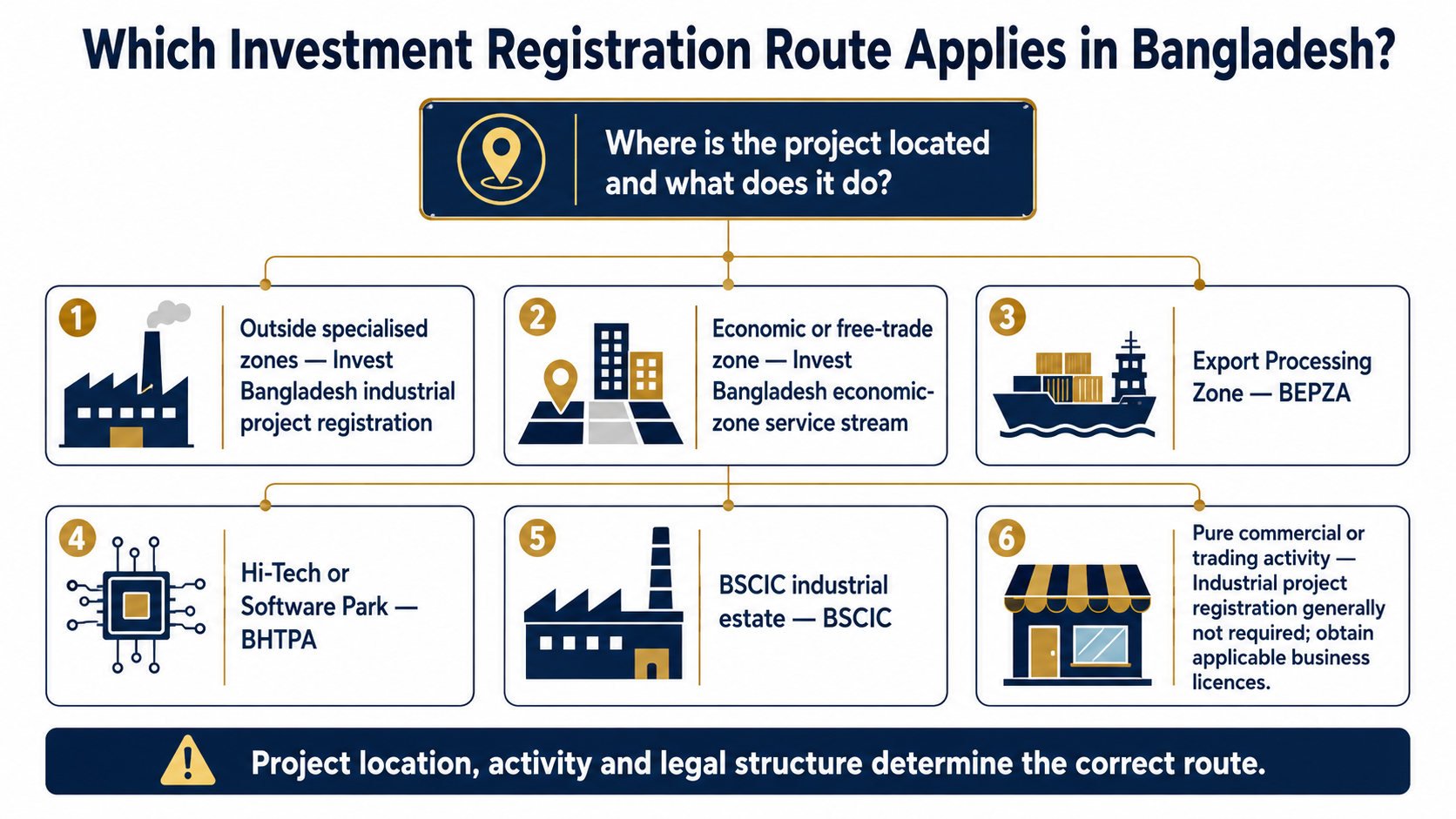
The first legal question is not “Which form should we file?” It is “Which authority and service stream apply to this project?” The answer depends on the project's location, activity and legal structure.
Current route-selection guide
| Project or business profile | Appropriate route as at 25 August 2026 |
|---|---|
| Manufacturing or eligible service project outside a specialised estate or park | Invest Bangladesh industrial project registration, currently accessed through the continuing investment OSS route |
| Project inside an economic zone or free-trade zone | Invest Bangladesh economic-zone service stream; legacy BEZA procedures may continue during migration |
| Export-oriented project inside an Export Processing Zone | Bangladesh Export Processing Zones Authority (BEPZA) |
| Project inside a Hi-Tech or Software Technology Park | Bangladesh Hi-Tech Park Authority (BHTPA) |
| Project inside a BSCIC industrial estate | Bangladesh Small and Cottage Industries Corporation (BSCIC) |
| Public-private partnership project | Invest Bangladesh PPP service stream |
| Pure commercial or trading activity | Industrial project registration is generally not required, but incorporation, trade, tax, VAT, import/export and sector licences may still apply |
3. Do not confuse three different legal processes
A. Company incorporation
Incorporation creates the Bangladeshi company as a separate legal person under the Companies Act, 1994. It is completed through the Registrar of Joint Stock Companies and Firms (RJSC).
B. Industrial project registration
Project registration records and recognises the industrial or eligible service project with Invest Bangladesh. It normally follows incorporation and preparation of the principal project documents.
C. Permission for a foreign office
A branch, liaison, representative or project office is an extension of a company incorporated outside Bangladesh. It is not a Bangladeshi subsidiary, and it requires a different permission process with different documents, restrictions, fees and timelines.
4. Who should register—and who generally does not need industrial registration?
Invest Bangladesh's current guidance permits registration of:
- domestic investment projects;
- 100% foreign-owned investment projects;
- joint-venture projects; and
- both manufacturing and eligible service industries.
Pure commercial and trading activities are generally outside the industrial project registration requirement. This exception does not mean that a trading company is unregulated. Depending on its activities, it may still need:
- incorporation or foreign-office permission;
- trade licence;
- company TIN and income-tax compliance;
- VAT registration or enlistment;
- commercial Import Registration Certificate (IRC) or Export Registration Certificate (ERC);
- sectoral licence, approval or membership;
- lawful foreign-exchange and banking arrangements;
- work permits for foreign personnel.
Where a business combines trading, assembly, manufacturing, processing, logistics or technology services, its actual operational model should be reviewed before deciding whether project registration is required.
5. Principal legal and regulatory framework
The main legal instruments relevant to a foreign investment project include:
- Invest Bangladesh Act, 2026 — establishes the current authority and unified investment framework. It replaced the institutional laws governing BIDA, BEZA and the PPP Authority and repealed the One Stop Service Act, 2018.
- Companies Act, 1994 — governs incorporation, share capital, directors, statutory filings and foreign-company filings.
- Foreign Exchange Regulation Act, 1947, Bangladesh Bank circulars and the Guidelines for Foreign Exchange Transactions (GFET), 2018, as amended — govern inward investment, share issuance reporting, foreign loans and outward remittances.
- Foreign Private Investment (Promotion and Protection) Act, 1980 — provides statutory protections for qualifying foreign private investment.
- National Industrial Policy, 2022 — identifies sector classifications, priority areas and controlled activities for which prior NOC or approval may be required.
- Income Tax Act, 2023 and annual Finance Act measures — govern company taxation, withholding, returns, incentives and remittances.
- Value Added Tax and Supplementary Duty Act, 2012 and applicable rules — govern VAT registration and transaction compliance.
- Environmental, fire-safety, labour, factory, building, land-use, import-export and sector-specific laws applicable to the particular project.
The project should be designed against the entire regulatory map, not only the investment-registration form.
6. Pre-registration setup for a foreign-owned or joint-venture company
The following sequence is generally appropriate for a locally incorporated company with foreign shareholding.
Step 1: Confirm that foreign investment is permitted in the proposed sector
Most sectors permit foreign investment, but some activities are reserved, restricted or controlled. A controlled activity may require an NOC or approval from the relevant ministry, directorate or regulator under the National Industrial Policy, 2022 and the sector's governing law.
Examples of sectors requiring additional scrutiny may include banking, insurance, telecommunications, power and energy, aviation, pharmaceuticals, healthcare, education, explosives, security-related activities and certain natural-resource projects.
Step 2: Choose the legal structure
For a continuing business operation, a private limited company incorporated in Bangladesh is often the preferred structure. A branch, liaison or project office may be suitable in particular circumstances, but it is subject to a separate permission regime and operational limits.
Step 3: Obtain name clearance and arrange the investment bank account
Foreign investors may open a Temporary Non-Resident Taka Account (NRTA) with an authorised dealer bank in the name of the proposed venture. Bangladesh Bank states that prior Bangladesh Bank permission is not required for this temporary account.
Capital should be remitted through a formal banking channel. The bank's encashment certificate and remittance records should identify the foreign investor and the proposed Bangladeshi company accurately.
Step 4: Incorporate the company with RJSC
The incorporation package ordinarily includes the memorandum and articles of association, prescribed forms, subscriber and director information and the applicable fees and stamp duty. The objects clause should accurately cover the proposed project activities.
Step 5: Complete essential post-incorporation records
The company should obtain or prepare, as applicable:
- corporate bank-account documentation;
- e-TIN;
- trade licence showing the appropriate business activity and address;
- VAT registration or enlistment;
- office and factory land or lease documents;
- RJSC Form VI and Form XII records;
- foreign equity and encashment evidence;
- controlled-sector NOC or licence, if applicable.
7. Documents required for industrial project registration
The current published checklist for a 100% foreign or joint-venture industrial project includes the following core documents:
- Certificate of Incorporation;
- Memorandum and Articles of Association;
- up-to-date Trade Licence;
- up-to-date TIN Certificate;
- land purchase deed or rental/lease agreement for the project office and factory;
- encashment certificate for foreign investment;
- RJSC-approved Form VI and Form XII;
- NOC from the relevant ministry, directorate or department for a controlled sector under the National Industrial Policy, 2022;
- any additional document or company explanation requested during scrutiny.
Additional project documents to prepare
Although the exact upload list may vary by the live portal and project, a well-prepared applicant should also keep ready:
- board resolution authorising the investment and application;
- authorisation letter for the person filing the application;
- list of directors and shareholders with nationality and address;
- detailed local and imported machinery list, including HS codes, quantity and value where relevant;
- project profile or feasibility report, particularly for a larger project;
- proposed product or service description and annual capacity;
- implementation schedule and expected commercial operation date;
- employment plan separating local and expatriate positions;
- project-cost and means-of-finance statement;
- source-of-funds evidence;
- environmental, land-use, fire or building documents already obtained;
- sector-specific approval, licence or NOC.
Document consistency matters more than volume
The company name, address, project activity, investment amount, shareholder identity and ownership percentages must be consistent across the application, RJSC records, bank certificates, trade licence, TIN, lease, machinery list and project profile.
A single inconsistency—such as a factory address missing from the trade licence or an investor name recorded differently in the encashment certificate—may generate a shortfall and delay the registration.
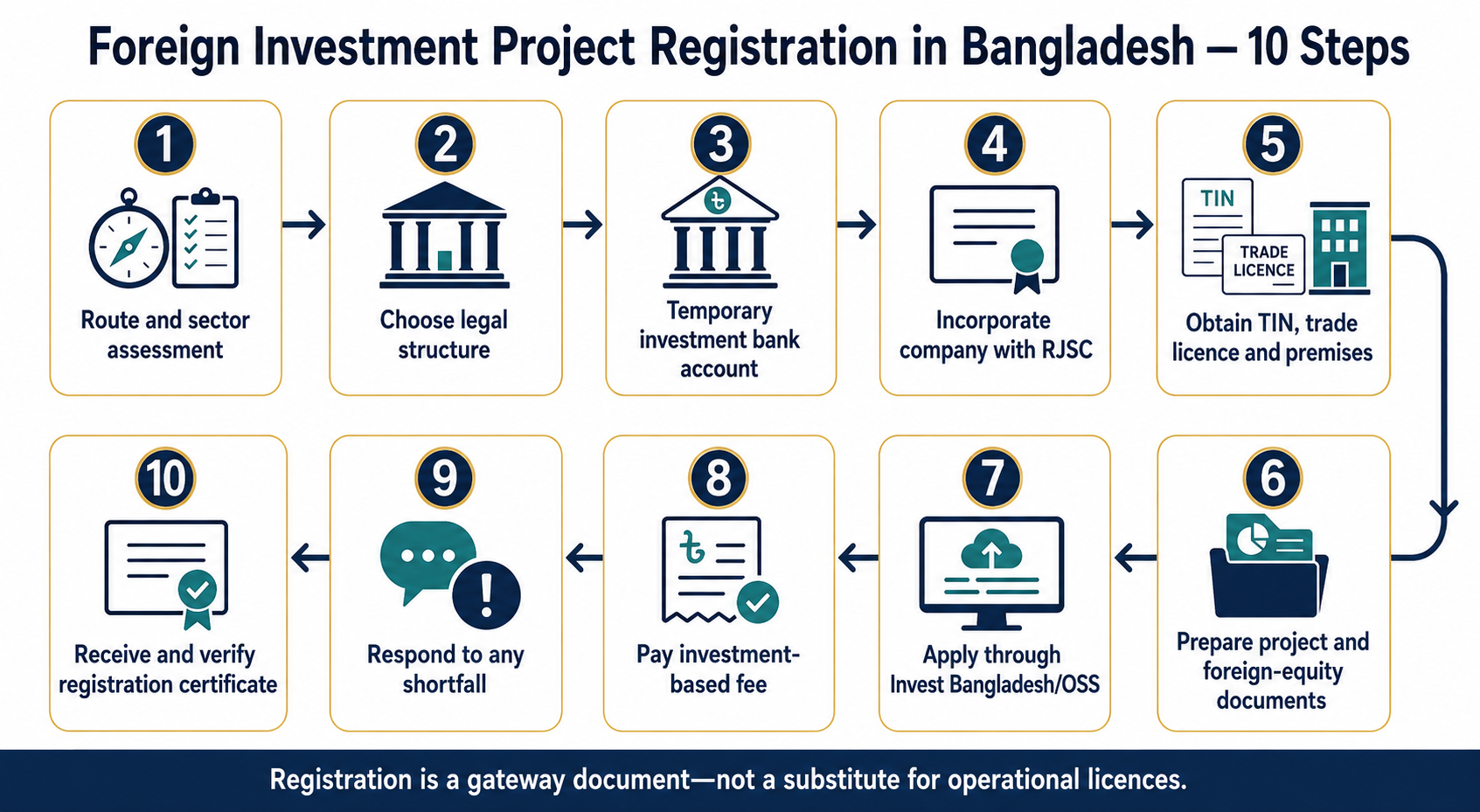
8. Step-by-step registration process
Step 1: Complete the route and sector assessment
Confirm the correct service stream, project location, foreign-ownership position and any controlled-sector approval before preparing the application.
Step 2: Complete incorporation and core registrations
Ensure the company is incorporated and has its TIN, trade licence, project premises and foreign-equity evidence. Obtain VAT registration where applicable.
Step 3: Create or access the online investor account
Use BanglaBiz or the continuing investment OSS portal and follow the live link for industrial project registration. During the institutional transition, the interface may continue to carry former BIDA terminology.
Step 4: Select the correct service
Select industrial project registration for a 100% foreign-owned or joint-venture project. Do not select the foreign branch, liaison, representative or project office permission service unless that is the actual legal structure.
Step 5: Complete the project particulars
Enter the company, ownership, location, products or services, machinery, production capacity, employment, project cost, equity, loan and implementation information. Use one consistent unit and currency methodology throughout.
Step 6: Upload clear and current supporting documents
Upload legible documents in the required format and size. Where a document is not self-explanatory, include a concise cover note instead of leaving the reviewing officer to infer the connection.
Step 7: Submit and retain the tracking record
Review the declaration carefully, submit the application and retain the application ID, payment acknowledgement, uploaded set and every portal notification.
Step 8: Pay the prescribed fee
Follow the payment request generated through the portal. The registration fee is based on the proposed project investment and is subject to VAT.
Step 9: Respond promptly to any shortfall
If Invest Bangladesh requests clarification or additional evidence, answer the specific point, attach the corrected document and explain any change. Do not upload conflicting versions without a reconciliation note.
Step 10: Receive and verify the registration certificate
After approval, download the registration certificate and check the company name, location, activity, investment, machinery, ownership and other recorded conditions. Seek correction or amendment before relying on an inaccurate certificate for another regulatory application.
9. Government fee and published processing time
Industrial project registration fee
| Proposed project investment | Base registration fee | Total including 15% VAT |
|---|---|---|
| Up to BDT 10 crore | BDT 5,000 | BDT 5,750 |
| Above BDT 10 crore and up to BDT 25 crore | BDT 10,000 | BDT 11,500 |
| Above BDT 25 crore and up to BDT 50 crore | BDT 25,000 | BDT 28,750 |
| Above BDT 50 crore and up to BDT 100 crore | BDT 50,000 | BDT 57,500 |
| Above BDT 100 crore | BDT 100,000 | BDT 115,000 |
The published service time is one day, subject to submission of all required documents.
This is a service standard, not an unconditional guarantee. The practical timeline may be longer where:
- the application is incomplete;
- a sectoral NOC is pending;
- the project profile and portal figures conflict;
- the land, lease or trade-licence address is unclear;
- foreign-equity evidence is incomplete;
- the authority requests clarification or additional documents;
- the portal or institutional transition affects processing.
10. What the registration certificate does—and does not do
It can provide
- formal recognition of the registered investment project;
- access to investment facilitation and aftercare;
- a foundation for connected recommendations, approvals and incentive applications;
- a recorded baseline for the project's ownership, investment, machinery and capacity.
It does not automatically provide
- title to or permission to use land;
- building or construction approval;
- environmental clearance;
- fire licence or factory licence;
- import or export registration;
- customs or bonded-warehouse approval;
- VAT or income-tax exemption;
- permission to employ a foreign national;
- permission for a foreign loan;
- permission to remit royalty, technical fees or franchise fees;
- a sectoral operating licence.
This distinction is essential. Project registration is a gateway document, not a universal licence.
11. Foreign investment banking and Bangladesh Bank compliance
The legal and banking trail of foreign equity should be planned before the investment is remitted.
Bangladesh Bank's current FDI guidance states that:
- a foreign investor may open an NRTA for the proposed venture without prior Bangladesh Bank permission;
- foreign equity may be remitted through formal banking channels;
- prior Bangladesh Bank permission is generally not required merely to issue shares against qualifying foreign investment;
- after shares are issued to a non-resident and RJSC formalities are completed, the Foreign Exchange Investment Department of Bangladesh Bank must be informed through the authorised dealer bank within 14 days, under the GFET reporting framework;
- cash dividends, net of applicable tax, may generally be remitted to non-resident shareholders through an authorised dealer without prior Bangladesh Bank approval, subject to the governing rules and records.
Public-awareness warning
An encashment certificate proves receipt and conversion of foreign currency; it does not by itself complete company-law allotment or Bangladesh Bank reporting. The company should align:
- the inward-remittance record;
- the board and shareholder approvals;
- the share allotment and RJSC filing;
- the authorised dealer's Bangladesh Bank reporting; and
- the project-registration records.
If these steps describe different investors, values or dates, future dividend or capital repatriation may become difficult.
12. Protection and repatriation of foreign investment
The Foreign Private Investment (Promotion and Protection) Act, 1980 provides qualifying foreign private investment with statutory protection, including fair and equitable treatment, protection against expropriation or nationalisation except for a public purpose against compensation, and protection for the transfer of capital and returns, subject to applicable law.
These protections should not be read as a waiver of tax, company, foreign-exchange, licensing or documentation requirements. Repatriation remains dependent on the lawful investment trail, corporate approvals, tax compliance, valuation where applicable and authorised-dealer documentation.
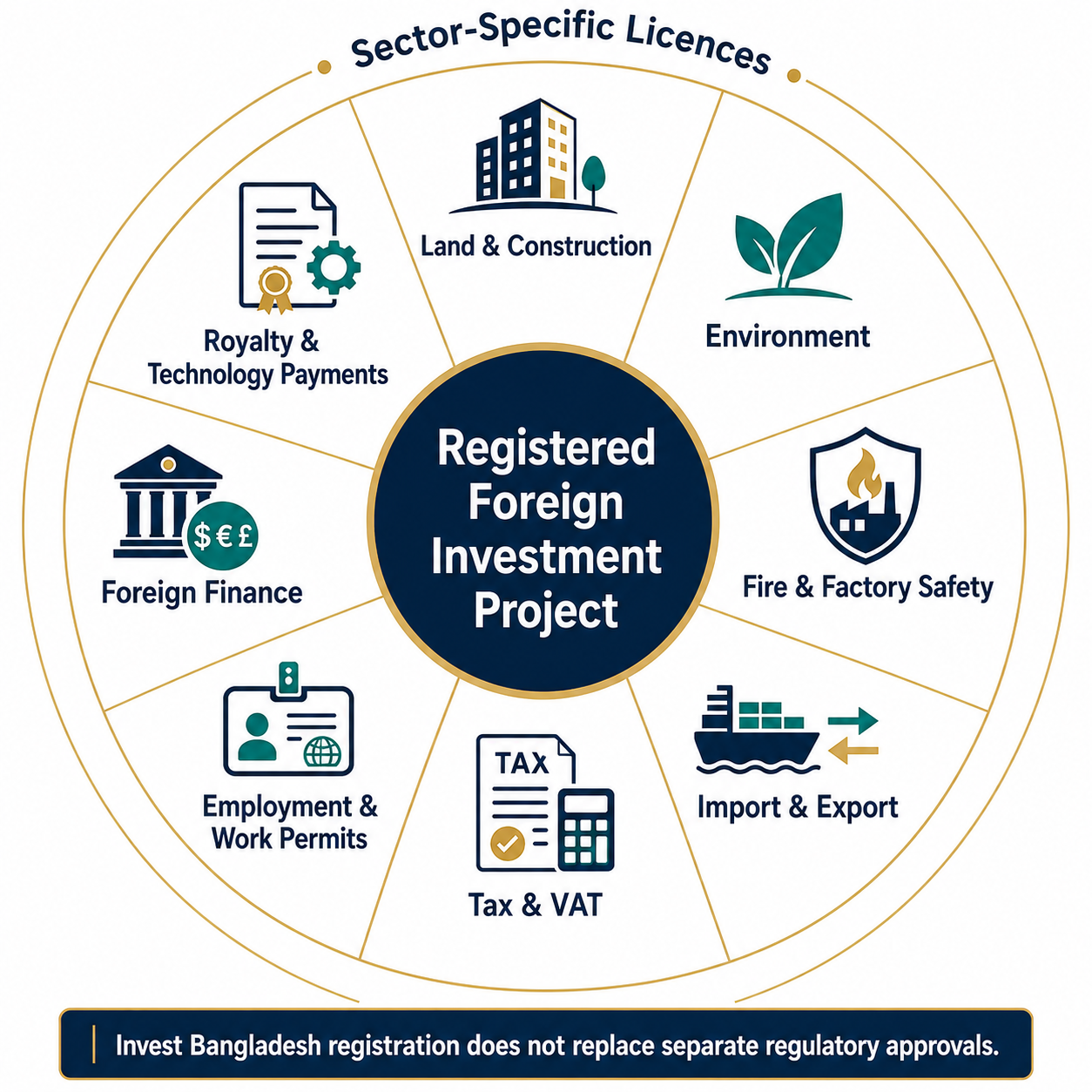
13. Post-registration approvals and compliance roadmap
Depending on the project, the next steps may include:
| Area | Common approval or compliance |
|---|---|
| Land and construction | land-use clearance, mutation/lease compliance, building plan or construction permit |
| Environment | site or environmental clearance, EIA/TOR approval where applicable |
| Fire and factory safety | fire NOC/licence, factory registration or licence and safety compliance |
| Import and export | industrial IRC, ERC, capital-machinery permission and customs compliance |
| Tax and VAT | e-TIN, BIN, returns, withholding, transfer-pricing and remittance tax compliance |
| Employment | employment contracts, labour compliance, expatriate visa recommendation, work permit and security clearance |
| Foreign finance | foreign-loan or supplier-credit approval/reporting where required |
| Technology and brand payments | royalty, technical assistance, technical know-how or franchise remittance process |
| Sector regulation | operating licence from the relevant ministry, commission, directorate or professional regulator |
14. Amendment of a registered project
The registration should be amended where a material recorded fact changes, including, where applicable:
- company name;
- office or factory address;
- nature of investment or shareholding;
- investing country or investor details;
- type of industry;
- project investment or equity;
- machinery list;
- production or service capacity;
- commercial operation date;
- employment figures;
- merger or amalgamation.
The published amendment fee is BDT 1,000 plus 15% VAT, and the published service standard is three working days, subject to a complete application. The supporting documents depend on the amendment and may include a board resolution, updated RJSC form, revised trade licence, lease, machinery invoice, explanation and previous registration certificates.
Do not continue using a certificate that materially differs from the project's actual structure. The mismatch may affect import entitlement, work permits, financing, incentives or remittances.
15. Common mistakes that delay or weaken an application
1. Applying before choosing the correct route
A locally incorporated subsidiary, a foreign branch and an economic-zone unit do not follow identical approval routes.
2. Treating company incorporation as project registration
An RJSC Certificate of Incorporation proves that the company exists. It does not register its industrial project.
3. Treating project registration as an operating licence
Environmental, fire, factory, import-export, tax and sector licences remain separate.
4. Using an objects clause that does not cover the proposed activity
The project description should be legally supported by the memorandum and the relevant trade and sector licences.
5. Remitting foreign capital without a reporting plan
Using the wrong account, unclear remittance narration or inconsistent investor identity can complicate share allotment and repatriation.
6. Submitting inconsistent project cost
The investment figure should reconcile with land, building, machinery, pre-operating expenses, working capital, equity, loans and any project profile.
7. Ignoring controlled-sector approval
An application cannot cure a missing NOC that the governing policy or sector law requires.
8. Using stale corporate documents
The trade licence, TIN, RJSC forms, lease and director/shareholder information should reflect the current position.
9. Failing to amend the registration
A company may lawfully change its shareholding or address but still face regulatory difficulty if its investment certificate remains outdated.
16. Practical example
Example: Foreign-owned food-processing plant outside an economic zone
A Singapore investor proposes a food-processing factory in Gazipur through a 100% foreign-owned Bangladeshi private limited company.
The investor should ordinarily:
- confirm that the products and production process are permitted and identify any food, environment or other sector approvals;
- open the appropriate temporary investment account and remit equity through an authorised dealer bank;
- incorporate the Bangladeshi company with an objects clause covering food processing, packaging and related permitted activities;
- obtain TIN, trade licence, VAT registration and lawful office/factory premises;
- collect the encashment certificate and complete the share-allotment and reporting trail;
- prepare the machinery list, project cost, capacity, employment and implementation plan;
- apply for industrial project registration through the current Invest Bangladesh/legacy OSS route;
- after registration, obtain the required environment, fire, factory, food-safety, import and other operational approvals.
If the same factory were located inside an Export Processing Zone or Hi-Tech Park, the authority and service stream would be different. If the investor intended only to import and trade finished food products, industrial project registration might not be the correct service at all.
17. Pre-filing checklist
Before submission, confirm that:
- the current authority and correct service route have been identified;
- the proposed activity is open to foreign investment;
- any controlled-sector NOC is available;
- the company has been incorporated and its objects cover the project;
- the shareholder names and percentages match all corporate and bank records;
- the foreign-capital remittance and encashment evidence are complete;
- the TIN and trade licence are current;
- the office and factory addresses match the lease, trade licence and application;
- Form VI and Form XII reflect the current RJSC position;
- project investment and financing figures reconcile;
- the machinery list, capacity and project profile are internally consistent;
- every uploaded file is clear, complete and correctly labelled;
- a complete copy of the application and payment record will be retained;
- a post-registration licensing plan has been prepared.
18. How Roy Law Nexus can assist
Roy Law Nexus—Legal & Tax Solutions assists local and international investors with an integrated legal and regulatory approach rather than treating investment registration as an isolated form-filing exercise.
Our support may include:
- entry-route and foreign-ownership assessment;
- company incorporation and constitutional-document review;
- foreign-investment banking and documentation coordination;
- industrial project registration and amendment;
- preparation or review of project profiles, board resolutions and supporting documents;
- controlled-sector and regulatory approval mapping;
- tax, VAT, import-export and post-registration compliance planning;
- expatriate visa and work-permit support;
- review of royalty, technical-assistance, franchise and foreign-financing arrangements;
- legal due diligence and ongoing corporate compliance.
A coordinated filing strategy reduces contradictory records and protects the project's ability to import, employ, finance, operate and repatriate lawfully.
Discuss Your Investment Project →Conclusion
Foreign investment project registration in Bangladesh is not merely an online application. It is the point at which company law, foreign-exchange evidence, land and location, sector regulation, project finance and operational licensing are brought into one official record.
The creation of Invest Bangladesh on 20 August 2026 is a major institutional change. It has legally replaced BIDA and BEZA, while existing investor services continue during the transition to a more unified system. Investors should therefore use the current authority's legal name, follow the live digital route and remain alert to legacy BIDA terminology that may still appear on forms and guidance.
The strongest application is not the one with the largest bundle of documents. It is the one in which every document tells the same legal and financial story.
Frequently Asked Questions
1. Does BIDA still exist in 2026?
No. The Invest Bangladesh Act, 2026 came into operation on 20 August 2026 and merged the former BIDA, BEZA and PPP Authority into Invest Bangladesh Authority. Existing services continue during the institutional transition, and some portals may temporarily retain legacy BIDA branding.
2. Is industrial project registration mandatory for every foreign-owned company?
No. It is relevant to manufacturing and eligible service projects. Invest Bangladesh's guidance states that project registration is not required for pure commercial and trading activities, although such businesses remain subject to incorporation, trade, tax, VAT, import-export, foreign-exchange and sectoral requirements.
3. Must the Bangladeshi company be incorporated first?
For registration of a foreign-owned or joint-venture project operated through a Bangladeshi company, yes. The published checklist requires the Certificate of Incorporation, Memorandum and Articles of Association and other post-incorporation records.
4. Is project registration the same as RJSC company registration?
No. RJSC incorporation creates the company. Investment project registration records the industrial or eligible service project with the investment authority.
5. Is a branch office registered through the same process?
No. A branch, liaison, representative or project office requires a separate foreign-office permission process and is not the same as registering a project operated by a Bangladeshi subsidiary.
6. What is the government fee?
The published base fee ranges from BDT 5,000 to BDT 100,000 according to proposed project investment, plus 15% VAT. Applicants should verify the live portal before payment.
7. How long does registration take?
The published service standard is one day after submission of all necessary documents. Shortfalls, missing NOCs, inconsistent records and transition-related issues may extend the actual time.
8. Is an encashment certificate enough to prove completed foreign investment?
No. It is important evidence of inward foreign currency, but the company must also complete the corresponding company-law share allotment, RJSC filing and Bangladesh Bank reporting through its authorised dealer.
9. Does the registration automatically grant tax incentives?
No. Registration may support eligibility or an application, but every tax, customs or investment incentive is governed by its own law, SRO, eligibility condition and approval process.
10. Can the project import machinery immediately after registration?
Not solely because it is registered. The project may require an industrial IRC, import permission or recommendation, customs documentation and sector-specific compliance.
11. Does a registered project need environmental and fire approvals?
Yes, where the applicable environmental, fire, factory, building or sector laws require them. Investment registration does not replace these approvals.
12. What happens if the project changes its address, ownership or investment?
A material change should be reflected through the appropriate amendment of the investment registration and corresponding updates at RJSC, the bank, tax/VAT authorities and other regulators.
13. Can dividends be repatriated to foreign shareholders?
Bangladesh Bank's FDI guidance permits remittance of cash dividends, net of applicable tax, through an authorised dealer without prior Bangladesh Bank approval, provided the underlying investment, corporate, tax and banking records are compliant.
14. Where should an investor apply during the transition?
Begin with BanglaBiz or the continuing investment OSS portal, select the live service that matches the project's structure and location, and retain all electronic records. The interface may still use the former BIDA name while systems are migrated to Invest Bangladesh.
About the Author

Sawdip Roy Sajib
Advocate, Supreme Court of Bangladesh
Member, Dhaka Bar Association and Dhaka Taxes Bar Association
Legal Disclaimer: This article provides general legal information based on official materials available on 25 August 2026. It is not legal, tax, investment or foreign-exchange advice for a specific project and does not create a lawyer-client relationship. Transitional forms, portals, fees and procedures should be rechecked before filing.