

Contents
1. Quick Answer
Rental income is not always monthly cash received multiplied by twelve. The correct computation begins with the statutory gross rental value, subtracts only the deductions allowed for the relevant property type, and then adds any special rental income. Tax deducted by a qualifying tenant is claimed separately as tax credit—it does not reduce the gross rent to be reported.
| Issue | Current practical position |
|---|---|
| Residential House Property | 25% statutory deduction from gross rental value for specified collection, utility, service, repair and maintenance expenditure. |
| Commercial House Property | 30% statutory deduction from gross rental value for the same statutory expense group. |
| Other Property | No 25%/30% shortcut; apply section 38(2), sections 49–55 and applicable bank-transfer conditions. |
| Refundable/adjustable deposit | 10% of the year-end outstanding balance is special rental income under the 2026 rule. |
| Rent TDS | 10% only where section 109 applies to a statutory specified-person tenant and listed property. |
2. Rental Income: Calculation, TDS and e-Return Flow
Use this sequence for every property. It separates income computation from source-tax credit and keeps the return traceable to the lease, bank and tenant records.
Classify the asset
Choose House Property or Other Property; separate any own-business portion.
Compute gross rental value
Include statutory annual value and tenant-paid charges; support vacancy with electricity bills.
Apply lawful deductions
Use the house-property list or Other Property rules—not both.
Add special rental income
Review deposits, advances, salami, premium, unspent claims and disallowed expenses.
Reconcile section 109 TDS
Confirm the tenant’s status, gross rent, deduction, government deposit and certificate.
Enter each property in e-Return
Use House Property or Other Property and add separate records where needed.
Claim credit and retain evidence
Claim eligible source tax separately; keep the return, acknowledgement and property file.
3. Legal Framework and Property Classification
Sections 35–39 of the Income Tax Act, 2023, as amended for 2026–27, govern the classification and computation of income from rent. Section 36 generally keeps property rent under this head irrespective of the commercial character of the letting, subject to the statutory exceptions and the owner’s own-business use.
House Property and Other Property
| Category | Typical assets | Main consequence |
|---|---|---|
| House Property | Building or structure, integral furniture/fixtures/fittings, appurtenant land and a structure used as a warehouse | Section 38(1) house-property deductions and residential/commercial statutory percentage |
| Other Property | Land, machinery, non-integral furniture, factory building let with plant, business premises, personal vehicle and other rentable tangible capital assets | Section 38(2) deduction framework; no 25%/30% statutory shortcut |
Rent or business income?
The label in the agreement is not decisive. A hotel, motel, hostel or resort and certain statutory economic-zone/high-tech-park developer arrangements require separate analysis. A portion used in the owner’s own business is not computed under this rent chapter when its income is properly computed as business or professional income.
4. Gross Rental Value and Allowable Deductions
The current section 37 formula is: gross rental value = annual value + tenant-paid service, repair or maintenance charges − vacancy allowance. Vacancy allowance requires electricity-bill evidence. Section 38 then permits deductions according to the property category.
House Property deductions
- Insurance premium against damage or destruction of the house property.
- Interest or profit on qualifying capital loans from a bank or finance company for acquisition, construction, renovation or reconstruction.
- Non-capital tax, fee or annual charge paid on the property.
- Qualifying pre-rental loan interest in three equal instalments starting with the first rental income year.
- The statutory 25% or 30% deduction for collection, utilities, service charge, repair and maintenance, proportionately limited for partial or part-year letting.
Residential and commercial comparison
| Use of House Property | Statutory deduction | Example on Tk 12,00,000 gross rental value |
|---|---|---|
| Non-commercial/residential | 25% | Tk 3,00,000 |
| Commercial | 30% | Tk 3,60,000 |
Other Property deductions
For property other than House Property, section 38(2) imports the relevant business-deduction rules in sections 49–55, subject to their limits and conditions. Except for Third Schedule allowances, the other deductions must be paid by bank transfer. Unsupported, personal, capital or non-compliant expenditure can be disallowed and may create special rental income.
Worked computation
| Residential apartment example | Amount |
|---|---|
| Annual value | Tk 12,00,000 |
| Tenant-paid service/maintenance charges | Tk 96,000 |
| Vacancy allowance supported by electricity bills | (Tk 1,00,000) |
| Gross rental value | Tk 11,96,000 |
| 25% statutory deduction | (Tk 2,99,000) |
| Balance before other admissible deductions and special rental income | Tk 8,97,000 |
5. Security Deposits, Salami and Special Rental Income
Finance Act 2026 materially changed special rental income. Lease receipts must be analysed by legal character rather than by the name used in the agreement or receipt voucher.
Refundable or adjustable deposit
If Tk 20,00,000 was received and Tk 7,20,000 was adjusted or returned before year-end, the outstanding balance is Tk 12,80,000; 10%—Tk 1,28,000—is special rental income for the year. Reconcile the balance with the Assets & Liabilities Statement.
Non-refundable salami or premium
The full non-refundable and non-adjustable amount is special rental income in the year received. The taxpayer may elect to spread it over the lease term or five years, whichever is shorter, subject to the statutory conditions. A later repayment is deductible in the relevant later year.
Other special rental income triggers
- Any part of the section 38(1)(e) statutory deduction claimed as unspent.
- Disallowed Other Property deductions, except accounting adjustments.
- Other Property expense for which required source tax was not deducted under Part 7.
- No Third Schedule allowance against special rental income; regular rates apply.
6. Section 109 Rent TDS, Banking and Refunds
Section 109 requires a statutory specified person renting listed property to deduct 10% from the rent when paying it. It does not impose deduction on every ordinary residential tenant. The payer must determine its legal status and follow the current withholding rules and NBR process.
How the 10% TDS works
| Office-rent example | Amount |
|---|---|
| Gross monthly rent | Tk 1,00,000 |
| Section 109 TDS at 10% | Tk 10,000 |
| Cash paid to landlord | Tk 90,000 |
| Gross rent reported by landlord | Tk 1,00,000 |
No-deduction certificate and refund route
On a prescribed application, the Deputy Commissioner of Taxes may certify that the owner has no taxable income for the year or that the income is exempt; section 109 deduction then stops only while that certificate remains effective. After tax determination, section 109 and section 163 allow full or excess deduction to be refunded or lawfully adjusted, subject to outstanding dues and the statutory refund process.
Banking-channel discipline
NBR’s 2026–27 Guide directs a house owner receiving total monthly rent above Tk 25,000 from one or more tenants to maintain the rental receipt through the required bank-account route. Failure to comply with a section 72(3) order or rule can attract the section 267 penalty framework. Business and Other Property deductions may also fail where the Act requires bank transfer.
Landlord–tenant evidence trail
- Lease, rent schedule, tenant identity and specified-person analysis.
- Gross rent invoice/receipt and bank statement—not only the net amount after TDS.
- Government deposit/challan or electronic reference and TDS certificate.
- Source-tax credit entry in e-Return and any refund/adjustment application.
7. e-Return Reporting, Documents and Common Errors
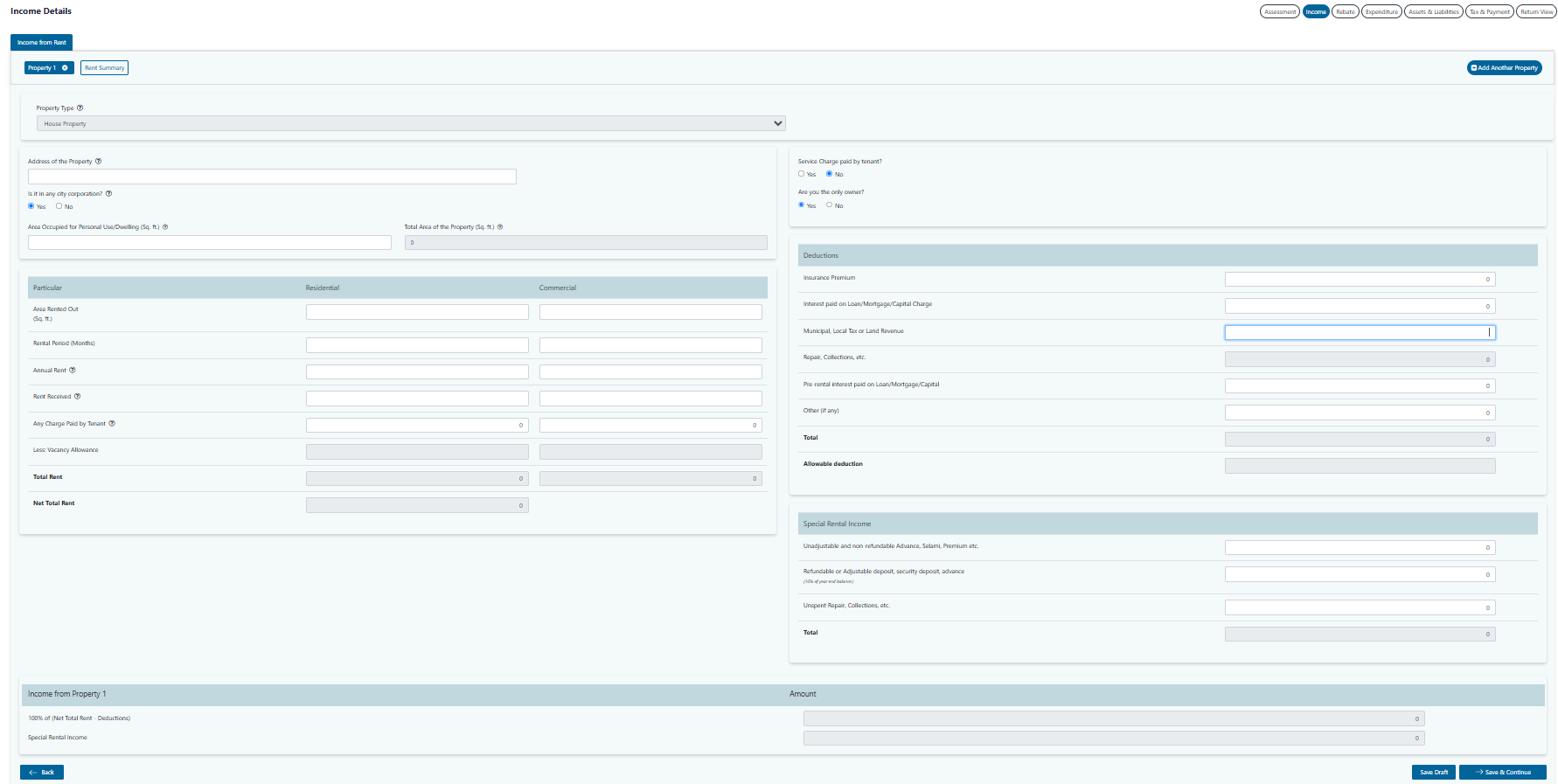
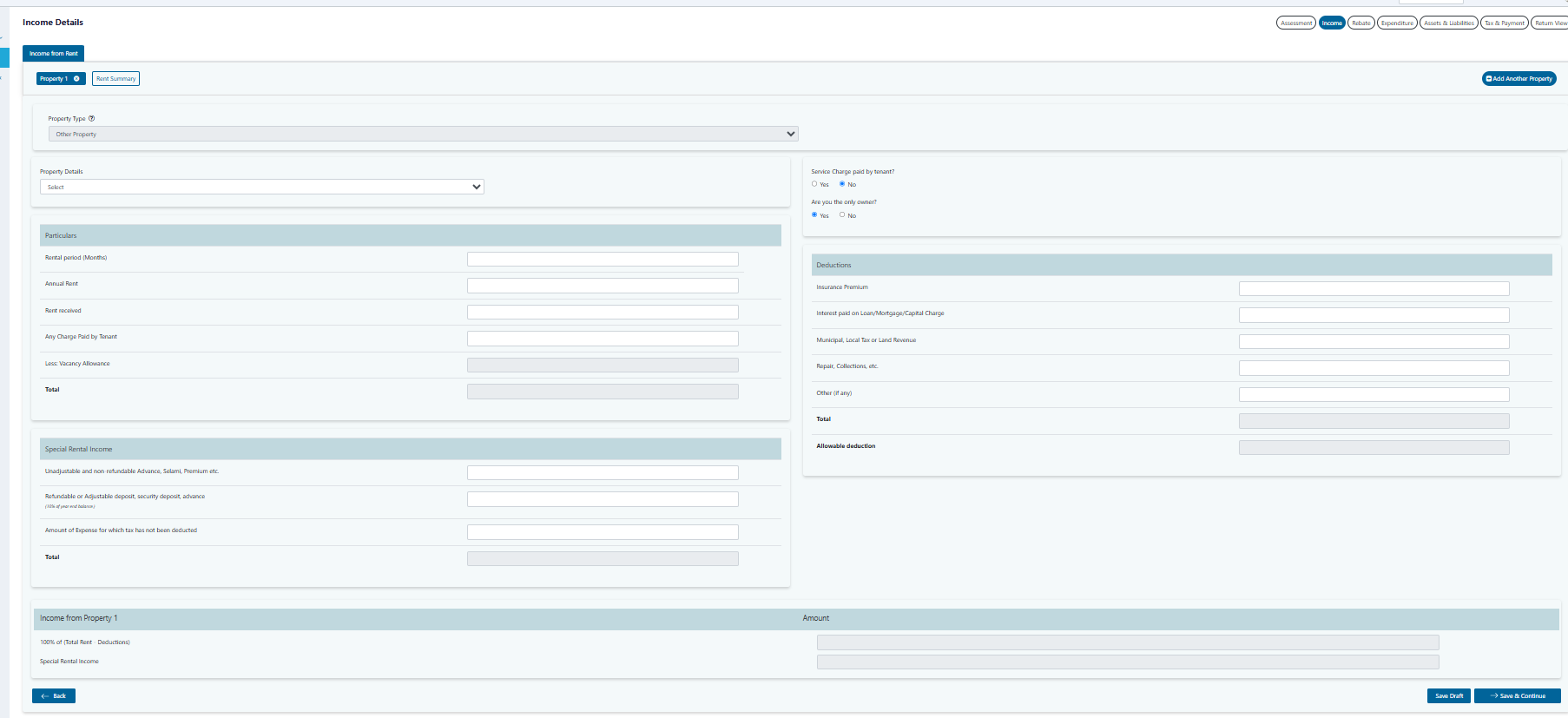
Use the e-Return property type that matches the legal classification. Add each property separately, complete the rental period and tenant-paid charges, and review the Rent Summary before moving to Tax & Payment for source-tax credit.
House Property entry
- Select House Property and enter the address, ownership and total/personal-use areas.
- Separate residential and commercial rented areas, periods, annual rent and rent received.
- Enter tenant-paid charges, vacancy and only admissible deductions.
- Enter deposits, salami/premium and other special rental income in the designated fields.
Other Property entry
- Select the correct property detail, rental period, annual rent and rent received.
- Record tenant-paid charges and vacancy where supported.
- Enter qualifying deductions under the Other Property framework.
- Review the field for expenses on which required tax was not deducted.
Documents to retain
| Document | Purpose |
|---|---|
| Title/ownership papers, lease and rent schedule | Establish the property, right to rent and contractual amounts |
| Bank statements and rent receipts | Reconcile gross receipts, deposit and banking compliance |
| Electricity bills for vacancy | Support the statutory vacancy allowance |
| Insurance, tax, fee and loan-interest records | Support section 38 deductions |
| Deposit/advance ledger and repayment evidence | Compute year-end balance and Assets & Liabilities consistency |
| TDS certificate and government-deposit reference | Support source-tax credit or refund/adjustment |
Common filing errors
- Reporting net cash after TDS instead of gross rent.
- Using the 30% commercial deduction for residential property or applying either percentage to Other Property.
- Ignoring tenant-paid service or maintenance charges.
- Claiming vacancy without electricity-bill evidence.
- Omitting the 10% year-end deposit rule or failing to reconcile the liability statement.
- Claiming TDS without matching certificate and government-deposit information.
8. Landlord’s Filing Checklist
- List every rented asset and classify House Property versus Other Property.
- Separate own-use, residential, commercial and part-year portions.
- Reconcile annual value, gross rent, tenant-paid charges and vacancy evidence.
- Apply only deductions permitted for that property category.
- Review security deposit, adjustable advance, salami and premium balances.
- Confirm whether each tenant is a specified person for section 109.
- Match the TDS certificate and government-deposit reference before claiming credit.
- Complete Assets & Liabilities consistency and keep the final return file.
9. How Roy Law Nexus Can Help
Roy Law Nexus provides integrated legal and tax support for landlords, property investors, tenants with withholding obligations and businesses using rented premises or equipment.
Property and lease classification
Review the asset, ownership, use, bundled services and lease terms to determine House Property, Other Property or another lawful treatment.
Rental-income computation
Calculate gross rental value, vacancy, 25%/30% deductions, loan interest and property-specific admissible expenses.
Deposit and premium review
Analyse refundable or adjustable deposits, advances, salami, premium and Assets & Liabilities reconciliation under the 2026 rules.
Rent TDS compliance
Advise tenants and landlords on section 109, withholding records, government deposit, certificates and no-deduction applications.
e-Return and refund support
Prepare or review property entries, source-tax credits and lawful refund, adjustment or carry-forward requests.
Assessment and dispute representation
Assist with notices, audit, assessment, appeal, Taxes Appellate Tribunal and legally available Income Tax Reference proceedings.
10. Frequently Asked Questions
Is taxable rental income simply monthly rent multiplied by twelve?
No. Apply the statutory gross-rental formula, admissible deductions and special-rental-income rules.
What is the statutory deduction for a residential house?
25% of gross rental value for the listed collection, utility, service, repair and maintenance expense group, subject to the Act.
What is the statutory deduction for a commercial house?
30% of gross rental value for that statutory expense group.
Can I use 25% or 30% for rented machinery or land?
No. Other Property uses section 38(2), including relevant sections 49–55 and bank-transfer conditions.
Is a refundable security deposit completely tax-free?
Not under the current 2026 rule. Ten percent of the year-end outstanding refundable/adjustable balance is special rental income.
Does every tenant deduct 10% rent TDS?
No. Section 109 applies where the payer is a statutory specified person renting listed property.
Can a landlord ask a company tenant not to deduct TDS?
A statement is insufficient. Section 109(3) requires a valid prescribed certificate from the Deputy Commissioner of Taxes.
What if rent TDS exceeds the final tax liability?
The excess may be refundable or adjustable under sections 109, 163 and the refund provisions, subject to assessment, outstanding dues and procedure.
How do I report several rented properties?
Create a separate e-Return property record for each asset and review the consolidated Rent Summary.
11. Key Legal Sources
Income Tax Act, 2023—sections 35–39
Current rental-income definitions, computation, deductions and special rental income, including the 2026 amendments.
Income Tax Act, 2023—section 109
10% rent TDS for specified-person tenants, full/excess refund and no-deduction certificate.
Income Tax Act, 2023—TDS certificate and credit provisions
Certificate, deposit and source-tax credit framework.
Income Tax Act, 2023—section 163
Refund, prior-demand adjustment and carry-forward options for excess tax.
Income Tax Act, 2023—sections 224–226
Right to refund and statutory adjustment/payment process.
Income Tax Act, 2023—section 267
Penalty framework for non-compliance with a section 72(3) order or rule.
NBR Income Tax Guide 2026–27
Official rental-income examples, banking guidance and e-Return instructions.
Finance Act 2026
Official NBR copy of the amendments effective for the current year.
NBR Income Tax Rules
Current official withholding and procedural rules.
NBR e-Return FAQ
Official online-filing and source-tax-credit guidance.
12. Conclusion
A reliable rental-income return begins with property classification and a complete evidence trail. Compute gross rental value, use only the deductions permitted for that property, identify special rental income, reconcile section 109 tax separately and enter every property in the correct e-Return category. Complex mixed-use, deposit or withholding arrangements should be reviewed before filing.
About the Author

Sawdip Roy Sajib
Advocate, Supreme Court of Bangladesh
Member, Dhaka Bar Association and Dhaka Taxes Bar Association
Legal Disclaimer: This article provides general legal and tax information based on primary official sources reviewed on 6 October 2026. Treatment may vary with ownership, use, lease terms, residency, accounting method, tenant status, records and later official changes. It is not case-specific advice and does not create a lawyer-client relationship.