

Contents
1. Quick Answer
Employment income is broader than basic salary. Salary, allowances, bonuses, overtime, commission, arrears, accommodation, motor-car benefits, employee shares and other employment-related amounts may need to be considered before the correct exclusion or exemption is applied.
| Question | Practical answer |
|---|---|
| Is only basic salary taxable? | No. Review the complete remuneration and benefit package. |
| Are all allowances tax-free? | No. An exemption or statutory exclusion must apply. |
| Does every Government-owned employer use Government Pay Order treatment? | No. Confirm the Pay Order that legally applies to the employee. |
| Does salary TDS replace income disclosure? | No. Report the income and reconcile the tax credit. |
2. Employment Income: Calculation and e-Return Flow
Use this sequence before entering salary in e-Return. It keeps classification, valuation, exemption and tax credit in the correct order.
Confirm the employment relationship
Separate employment income from independent professional or business income.
Identify the legal regime
Check whether a specified Government Pay Order/SRO applies.
Collect every receipt and benefit
Include salary, allowances, bonus, arrears and non-cash benefits.
Remove specific statutory exclusions
Apply section 32 exclusions only when their conditions are met.
Value benefits and employee shares
Apply sections 33 and 34 to accommodation, vehicles and ESOPs.
Apply one exemption regime
Use the Pay Order/SRO route or the general Sixth Schedule route—not both.
Select e-Return type and reconcile TDS
Match the return with certificates, salary records and source-tax credit.
3. What Counts as Employment Income and What Is Excluded
Section 32 of the Income Tax Act, 2023 includes monetary receipts, salary, benefits, employee-share income, untaxed arrear salary and specified amounts or benefits from a past or future employer.
Common receipts and benefits
| Item | General treatment |
|---|---|
| Basic salary, wages and remuneration | Employment income |
| Allowance, leave allowance and leave encashment | Employment income unless a specific exclusion/exemption applies |
| Bonus, commission, fees and overtime | Employment income |
| Advance salary and untaxed arrears | Employment income |
| Employer-provided accommodation or vehicle | Value under section 33 |
| Employee shares or rights | Apply section 34 |
| Termination or contract-change compensation | May fall within employment income |
Specific statutory exclusions
- Qualifying specified medical-treatment payments to an employee who is not a shareholder-director.
- Travel, conveyance and daily allowance received and wholly and exclusively spent in performing employment duties.
- Qualifying employer-paid group-insurance premium and medical reimbursement under a group-insurance policy under the current 2026 wording.
Employment income or professional income?
A salaried person working under the employer’s direction ordinarily has employment income. An independent advocate, doctor, engineer or consultant generally considers the business or professional income head. The actual legal relationship matters more than the label on the payment voucher.
4. Government Pay Order vs Other Employees
NBR’s Income Tax Guide 2026–27 treats specified Government Pay Order employees separately from employees outside that framework.
Core comparison
| Issue | Government Pay Order-covered employee | Other employee |
|---|---|---|
| Exemption basis | Applicable Pay Order/SRO | General Sixth Schedule rule |
| Basic salary and festival bonus | Taxable under the SRO 225 framework | Included in gross employment income |
| Specified allowances | May be exempt if the applicable Pay Order covers them | Included unless a separate exclusion applies |
| General employment exemption | Not available where SRO 225 exemption is used | Lower of one-third of employment income or Tk 5,00,000 |
Official NBR example: Government Pay Order employee
In NBR’s example of a Rupali Bank officer, qualifying house-rent, medical and Bangla New Year allowances are exempt under the applicable Pay Order. Basic salary of Tk 4,26,000, festival bonus of Tk 71,000 and incentive bonus of Tk 1,06,500 produce taxable employment income of Tk 6,03,500. No further one-third/Tk 5 lakh deduction is taken.
Official NBR example: private-sector employee
NBR’s private-sector example aggregates salary, bonuses, allowances and a 1,500 cc vehicle benefit to Tk 12,93,000. One-third is Tk 4,31,000, which is lower than Tk 5,00,000. Taxable employment income is therefore Tk 8,62,000.
5. Benefits, ESOP, Funds and Worked Examples
Employment income can arise without a cash payment. Benefits, rights and fund arrangements must be classified before the exemption is calculated.
Accommodation and motor-car benefits
For employer-provided accommodation, section 33 generally uses annual value, reduced by rent actually paid by the employee where accommodation is provided at a concessional rate.
| Employer-provided vehicle | Monthly statutory value | 12-month value |
|---|---|---|
| Up to 1,500 cc | Tk 15,000 | Tk 1,80,000 |
| Above 1,500 cc to 2,000 cc | Tk 20,000 | Tk 2,40,000 |
| Above 2,000 cc to 2,500 cc | Tk 30,000 | Tk 3,60,000 |
| Above 2,500 cc | Tk 50,000 | Tk 6,00,000 |
Employee shares and ESOPs
Share-acquisition rights and specified trustee arrangements may also fall within section 34. Equity compensation should be reviewed even where the employee receives no cash.
Provident fund, gratuity and pension
A receipt is not tax-free merely because it is described as PF, gratuity or pension. Confirm whether the fund is recognised or approved, who made the contribution, the nature of the final receipt and the relevant Sixth Schedule provision.
6. Four e-Return Salary Options
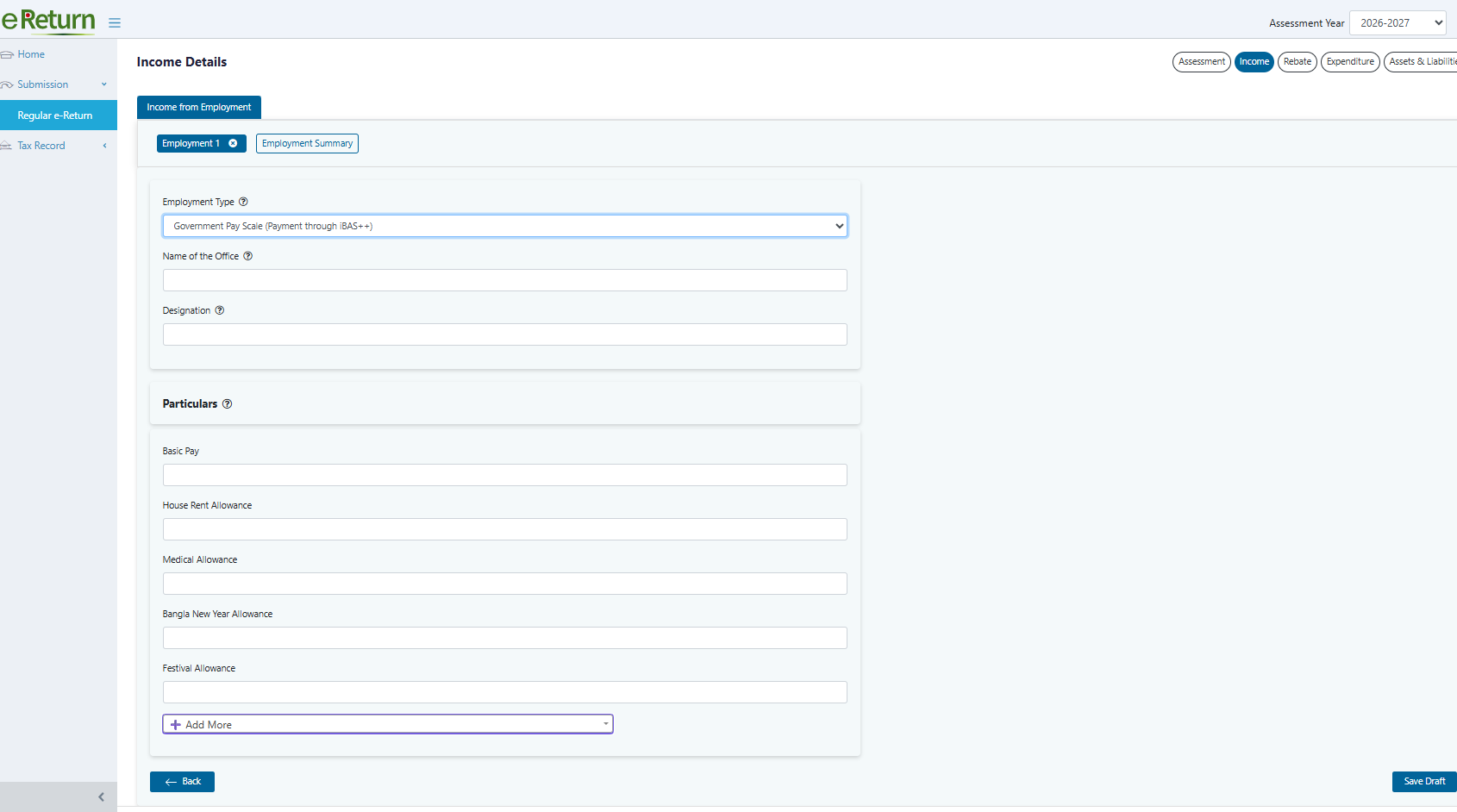
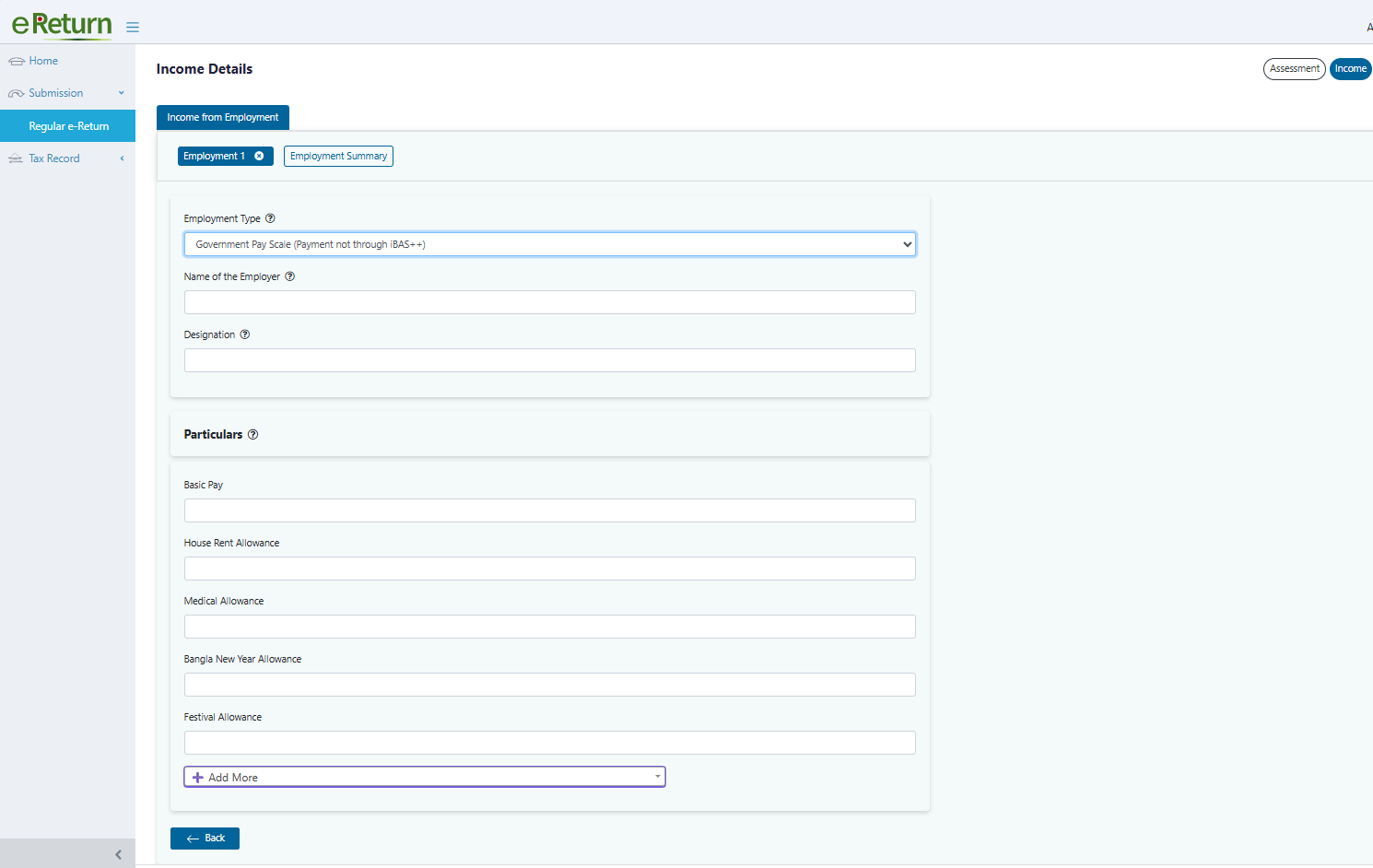
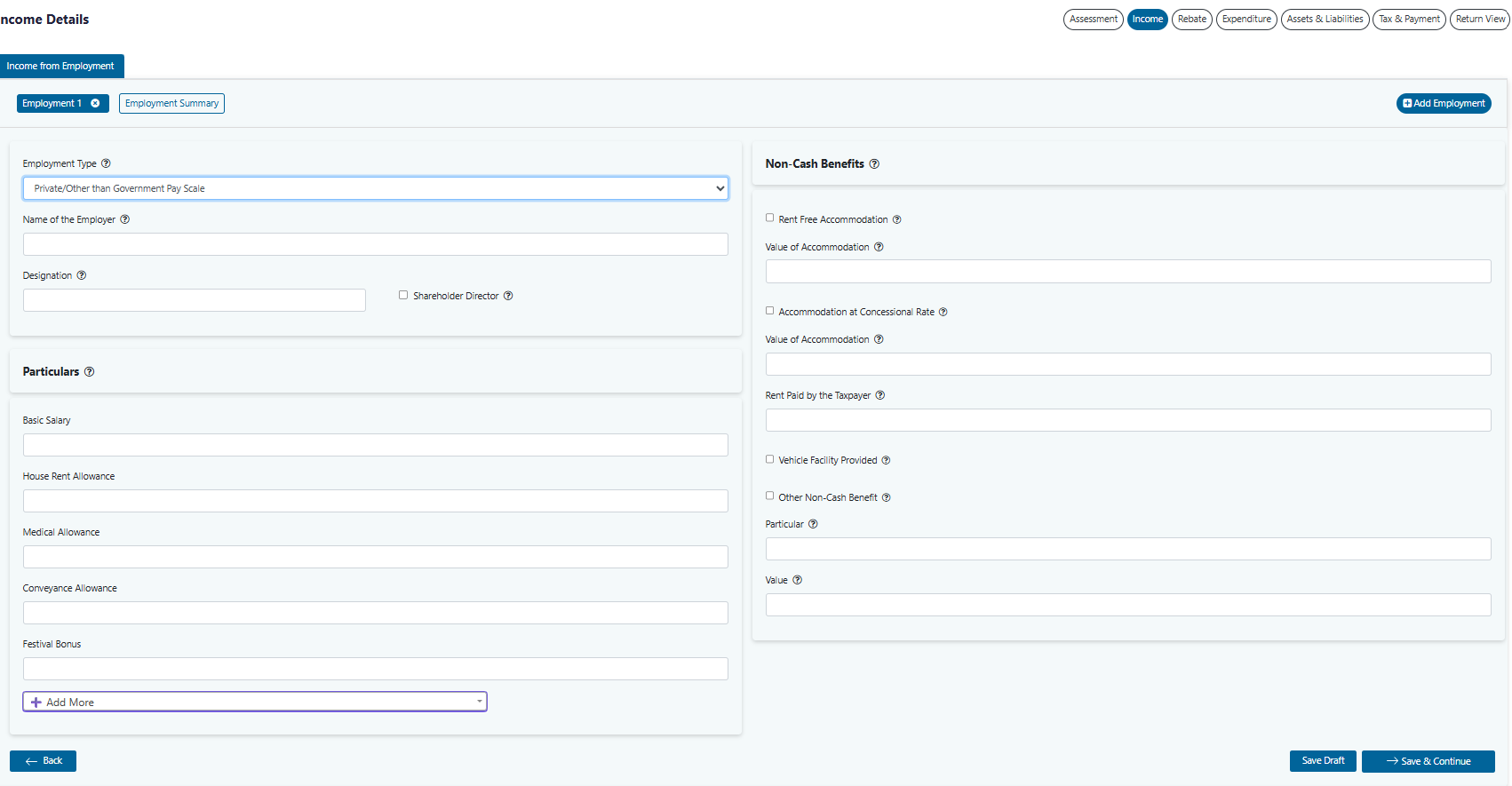
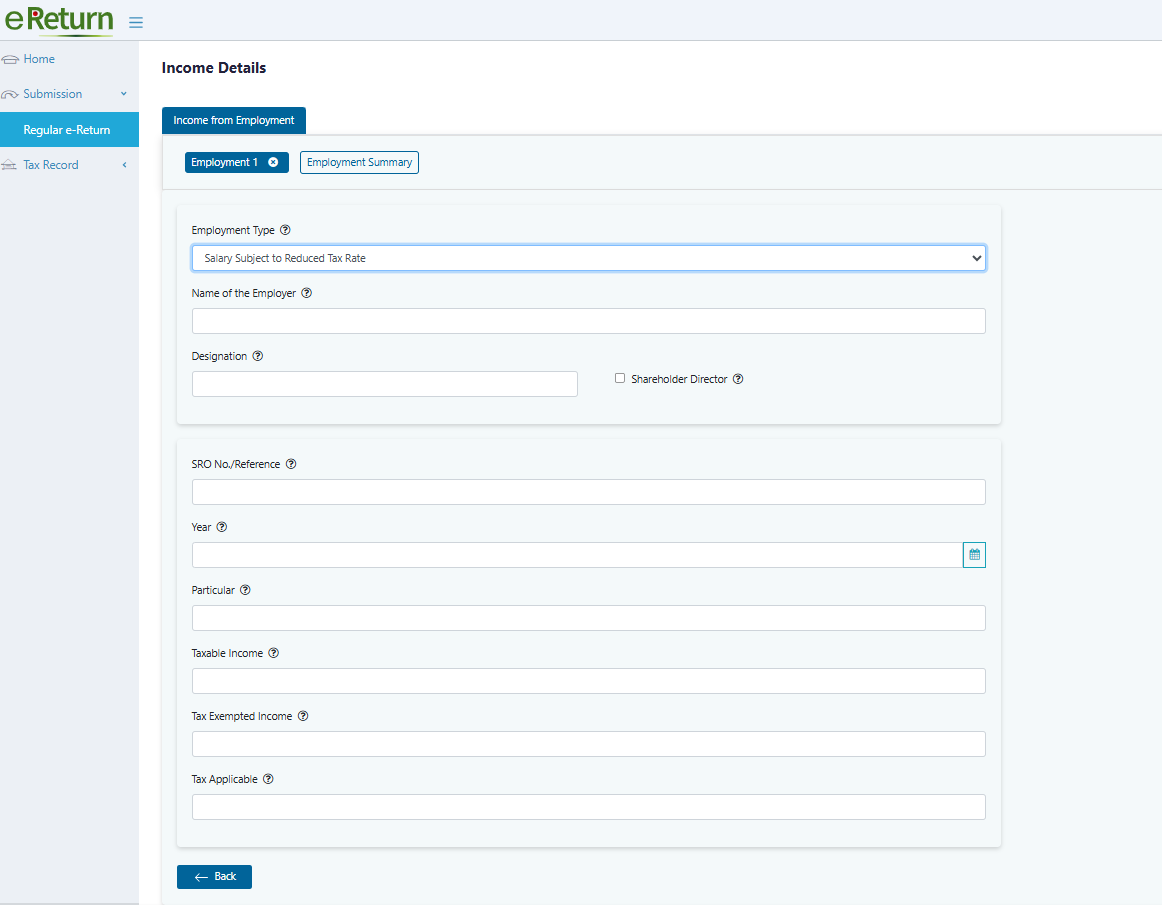
The Income Tax Act has one head—Income from Employment. NBR’s e-Return interface uses four operational employment types so taxpayers can enter the appropriate salary structure and tax treatment.
Choose the option by legal status and payment channel
| e-Return option | Use when |
|---|---|
| Government Pay Scale—payment through iBAS++ | The employee is within the relevant Government Pay Scale/Pay Order and salary is processed through iBAS++. |
| Government Pay Scale—payment not through iBAS++ | The Pay Order applies, but salary is not paid through iBAS++. |
| Private/Other than Government Pay Scale | The employee is outside the specified Government Pay Scale framework. |
| Salary Subject to Reduced Tax Rate | A specific SRO or other legal authority grants a reduced/special rate. |
7. TDS, Documents and Common Filing Errors
Section 86 requires salary TDS at the average rate applicable to the employee’s estimated employment income. Sections 145 and 150 address the certificate and credit for tax properly deducted and deposited.
Documents to retain
| Document | Why it matters |
|---|---|
| Appointment letter and applicable Pay Order | Establish the relationship and exemption regime |
| Salary certificate, payslips and bonus statement | Reconcile annual cash remuneration |
| TDS certificate and e-Return ledger | Support source-tax credit |
| Car, accommodation and ESOP records | Support sections 33–34 valuation |
| Travel, medical and group-insurance records | Support claimed statutory exclusions |
| PF, pension and gratuity documents | Support recognition, approval and exemption treatment |
Common filing errors
- Reporting only basic salary and omitting bonuses, allowances or benefits.
- Selecting Government Pay Scale only because the employer is Government-owned.
- Claiming both SRO 225 relief and the general one-third/Tk 5 lakh exemption.
- Treating private-sector house-rent or medical allowance as automatically tax-free.
- Omitting company-car, accommodation or ESOP income.
- Reporting only the latest employer where the taxpayer had more than one employment in the income year.
- Claiming TDS without matching the salary certificate, challan/reference and e-Return ledger.
8. Employee Filing Checklist
- Confirm whether the payment is employment income or independent professional/business income.
- Identify the applicable Government Pay Order/SRO, if any.
- Reconcile salary, allowances, bonus, arrears and benefits with bank and employer records.
- Document every statutory exclusion and non-cash valuation.
- Apply only one exemption regime.
- Add every employment held during the income year.
- Match TDS with the employer certificate and e-Return ledger before submission.
- Keep the final return, acknowledgement and supporting file together.
9. How Roy Law Nexus Can Help
Roy Law Nexus provides focused employment-income and e-Return support for employees, employers, executives and expatriate-linked remuneration arrangements.
Pay Order and SRO review
Determine whether the employee qualifies for Government Pay Order treatment and identify the applicable exemption route.
Salary and allowance classification
Review basic salary, allowances, bonuses, arrears, official-duty payments and statutory exclusions.
Benefit and ESOP valuation
Calculate accommodation, motor-car, other perquisite and employee-share income under sections 33–34.
TDS reconciliation and e-Return
Reconcile salary and tax certificates, select the correct e-Return employment type and review the completed return.
Employer compliance
Assist with estimated salary tax, deduction adjustments, certificates and employee tax documentation.
Dispute representation
Support assessment, audit, appeal, Taxes Appellate Tribunal and legally available Income Tax Reference proceedings.
10. Frequently Asked Questions
How much employment income is exempt for an ordinary employee?
Generally, the lower of one-third of employment income or Tk 5,00,000, subject to any special regime and the taxpayer’s facts.
Does a Government Pay Order employee also receive the one-third exemption?
Not where the taxpayer receives the SRO 225 exemption. The NBR Guide states that the general paragraph 27 exemption is not added again.
Is house-rent allowance automatically tax-free?
No. A qualifying Pay Order may exempt it for a covered employee; NBR’s ordinary private-sector example includes it in gross employment income before the general exemption.
Is an employer-provided car taxable?
Yes, where section 33 applies. The current monthly statutory value depends on engine capacity.
Are ESOPs taxable even if no cash is received?
They can create employment income under section 34 based broadly on fair market value less the employee’s acquisition cost.
What if I worked for two employers in the same income year?
Report each relevant employment. The e-Return Add Employment function allows multiple entries.
How does an iBAS employee claim salary TDS?
NBR’s e-Return FAQ directs an iBAS salary recipient to Tax & Payment → Claim Source Tax → Salary (iBAS), then verify and save the available credit.
11. Key Legal Sources
Income Tax Act, 2023—sections 32–34
Employment income, statutory exclusions, perquisite valuation and employee-share income.
Income Tax Act, 2023—section 86
Salary tax deduction at the average rate on estimated employment income.
Income Tax Act, 2023—sections 145 and 150
TDS certificate requirements and credit for tax deducted and deposited.
NBR Income Tax Guide 2026–27
Current Government Pay Order and private-employee examples, exemption treatment and return guidance.
Finance Act 2026
Official NBR copy of the current amendments.
NBR e-Return FAQ
Official guidance on salary source-tax credit and online return filing.
12. Conclusion
A reliable employment-income return starts with legal classification, not data entry. Identify the applicable Pay Order or general regime, capture the complete remuneration package, value non-cash benefits, apply only the correct exclusion and exemption, and reconcile TDS before submission. Where the employment arrangement or benefit structure is unusual, obtain advice before taking a tax position.
About the Author

Sawdip Roy Sajib
Advocate, Supreme Court of Bangladesh
Member, Dhaka Bar Association and Dhaka Taxes Bar Association
Legal Disclaimer: This article provides general legal and tax information based on primary official sources reviewed on 1 October 2026. Treatment may vary with the applicable Pay Order, SRO, employee status, residency, contract, benefit structure, fund approval and records. It is not case-specific advice and does not create a lawyer-client relationship.