

Essential answer
Muslim divorce in Bangladesh is not completed safely merely by saying “talaq”, signing an affidavit or collecting a private letter. The lawful route depends on who initiates it. A husband follows section 7 of the Muslim Family Laws Ordinance, 1961; a wife may use delegated divorce only where authority was validly granted; khula and mubarat depend on agreement; and a Muslim wife may seek a Family Court decree on statutory grounds. Notice, the waiting period, proof of service and registration are central. Dower, maintenance and child-related rights remain separate.
Muslim Divorce Compliance Path
A reliable divorce record depends on the correct legal route, competent authority, provable service, statutory timing and registration.
- 1
Identify the legally available route
- 2
Review the Kabinnama, documents and jurisdiction
- 3
Prepare the notice, agreement or Family Court case
- 4
Serve every required recipient and preserve proof
- 5
Complete the waiting, reconciliation or decree process
- 6
Register the divorce and verify Form G-1
The essential answer and process flow are visible. Five broad chapters combine the supporting law and practical detail, while each FAQ opens separately.
1. Legal framework and available divorce routes
The governing legal framework
| Law or rule | What it governs |
|---|---|
| Muslim Family Laws Ordinance, 1961 (opens in a new tab), sections 7–8 | Talaq notice, Arbitration Council, 90-day period, pregnancy and delegated or other dissolution |
| Dissolution of Muslim Marriages Act, 1939 (opens in a new tab), sections 2–5 | Grounds on which a Muslim wife may obtain a judicial decree |
| Muslim Marriages and Divorces (Registration) Act, 1974 (opens in a new tab), sections 6–9 | Registration, proof of delegated authority, registers and attested copies |
| Family Courts Act, 2023 (opens in a new tab), sections 5, 6 and 26 | Family Court jurisdiction, venue and effectiveness of a dissolution decree |
| Muslim Marriages and Divorces (Registration) Rules, 2009, as amended in 2025 (opens in a new tab) | Registration procedure, fees and prescribed marriage and divorce certificates |
The 2023 Act replaced the former Family Courts Ordinance, 1985. The 2025 Rules amendment introduced the prescribed Form G-1 Certificate of Divorce and a divorce-registration fee of BDT 1,000. Separate fees may apply for additional certificates or copies; an official receipt should always be obtained.
Five legally distinct routes to Muslim divorce
| Route | Who initiates it? | Is a court normally required? | Essential safeguard |
|---|---|---|---|
| Husband’s talaq | Husband | No | Section 7 notice to the appropriate Chairman and copy to wife |
| Talaq-e-tafweez | Wife with delegated authority | No | Kabinnama entry or registered delegation document must prove the authority |
| Khula | Usually proposed by wife and accepted by husband | No, if genuinely agreed | Written settlement of dissolution and financial terms |
| Mubarat | Both spouses mutually | No, if genuinely agreed | Clear mutual consent and documented settlement |
| Judicial dissolution | Muslim wife | Yes | Proof of one or more grounds under the 1939 Act |
These routes should not be conflated. In particular, every wife does not possess the same unilateral power of talaq as a husband. Her route may depend on delegated authority, her husband’s agreement, or a Family Court decree.
2. Husband’s talaq, notice and the 90-day rule
Husband’s talaq: the statutory process
Section 7(1) provides that, after pronouncing talaq in any form, the husband must give the appropriate Chairman written notice as soon as may be and supply a copy to the wife. Failure to comply is punishable by imprisonment for up to one year, a fine of up to BDT 10,000, or both.
A compliant file should identify the parties, addresses, marriage and Kabinnama particulars, pronouncement date and statutory basis. It should also contain proof of receipt by the competent Chairman, proof that the wife received a copy, and retained postal or acknowledgement records.
“Chairman” is a statutory expression that may cover the head of a Union Parishad or Paurashava, the Mayor or Administrator of a municipal corporation, or another authorised person. The sender must identify the authority with prescribed territorial jurisdiction. Sending the notice to an arbitrary councillor or only to the Nikah Registrar may not satisfy section 7.
Does verbal talaq alone end the marriage?
A verbal pronouncement may evidence intention, but it does not complete the statutory process. Section 7 requires written notice and delays effectiveness. Decisions on defective or missing notice have not always used identical reasoning; therefore, no one should rely on an oral statement, message or notarised affidavit without completing notice and registration.
In Md Serajul Islam v Most Helena Begum, 19 BLD (AD) 150; 7 BLT (AD) 137, the Appellate Division emphasised the section 7 notice obligation and held that a husband could not take advantage of his own failure after relying on his affidavit as evidence of divorce. The case also affirmed the wife’s dower entitlement on the facts.
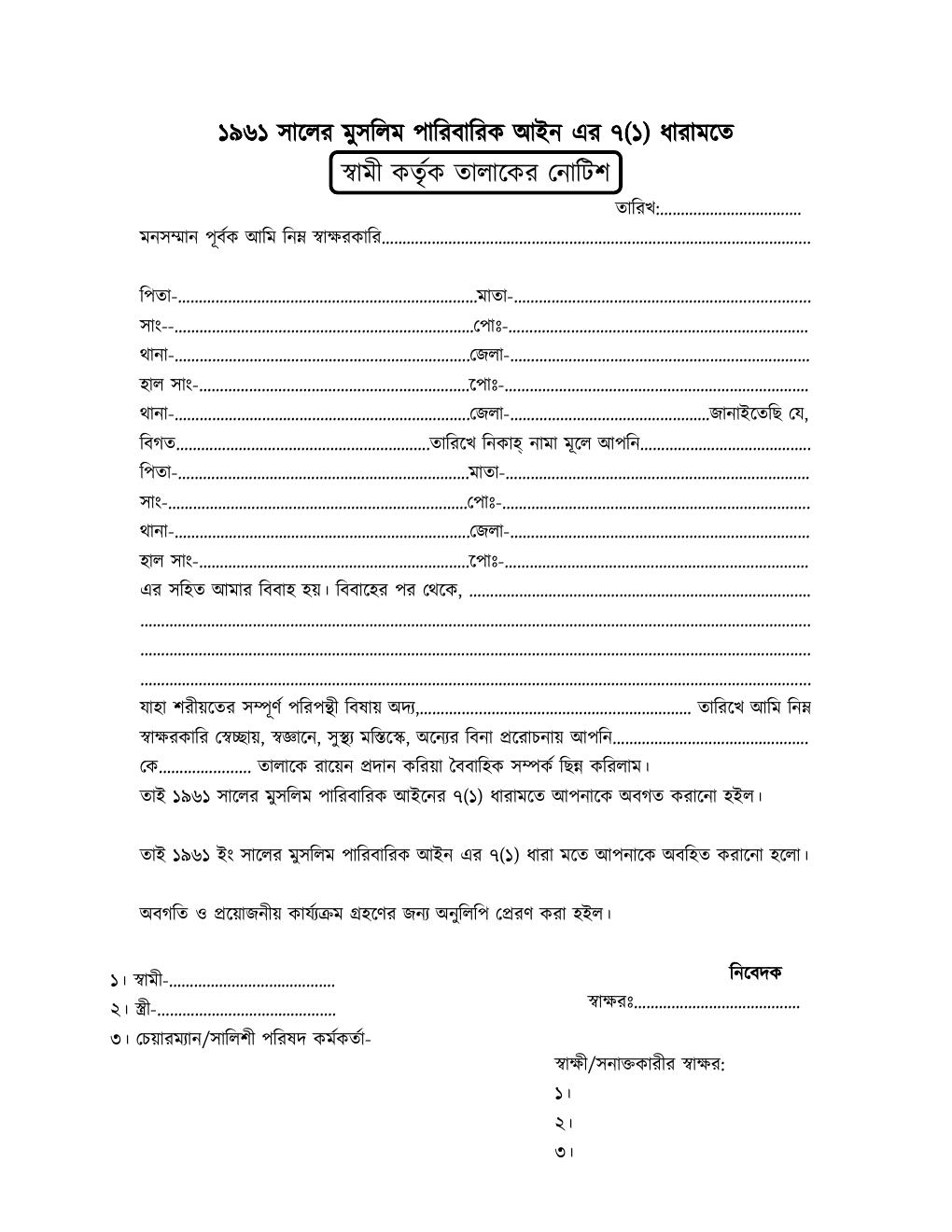
Illustrative husband’s talaq notice
The accompanying form is a drafting aid only. Verify all identities, dates, addresses and jurisdiction. Detailed allegations are not normally needed merely to give section 7 notice and may create avoidable disputes.
Sample document: husband’s section 7 talaq notice
This Bangla sample illustrates the structure of a husband’s notice. Names, dates, addresses, jurisdiction, pronouncement details and service arrangements must be adapted to the actual case.
| Document | Legal purpose | Critical checks |
|---|---|---|
| Husband’s talaq notice | Written notice under section 7(1) with a copy to the wife | Correct Chairman, complete identities, pronouncement date, wife’s copy and proof of both deliveries |
Preview and PDF
Open the preview to inspect the layout or download the one-page PDF for professional adaptation.
Chairman, Arbitration Council and the 90-day rule
The four most important practical answers are:
1. Who receives the notice?
The appropriate Chairman must receive the notice, and the wife must receive a copy. Preserve proof of both deliveries.
2. When does the 90-day period begin?
It begins when the notice is delivered to the Chairman, not on pronouncement, signing, notarisation or posting. In Md Ataul Hoque v Anwar A Karim, 8 BLT (AD) 30, the Appellate Division applied 90 days from receipt by the relevant city authority where the spouse had also been notified.
3. What is the Chairman’s role?
Within 30 days, the Chairman must constitute an Arbitration Council to attempt reconciliation. It consists of the Chairman and a representative of each party, but may be formed without a representative who is not nominated in time. It does not grant a judicial decree, decide dower or exercise a general veto over talaq.
4. What if the wife is pregnant?
Under section 7(5), talaq does not become effective until the later of: (a) expiry of the 90-day period; or (b) the end of the pregnancy.
Talaq may be revoked during the period expressly or “otherwise”. In Rabeya Khatun and others v Taslima Hasan, F.A. No. 08 of 2012 (HCD, 16 November 2015), subsequent conduct showing continuation of married life supported revocation on the evidence. Reconciliation should be documented and notified promptly.
3. Wife-initiated and judicial divorce routes
How a Muslim wife may end the marriage
Talaq-e-tafweez: delegated divorce
A wife may exercise talaq-e-tafweez only if the husband validly delegated the power, commonly in clause 18 of the Kabinnama or a separate registered instrument.
Section 8 applies the section 7 process, with necessary modifications, to delegated divorce and other non-talaq dissolution. Section 6(3) of the 1974 Act further provides that a Nikah Registrar must not register talaq-e-tafweez unless presented with either the registered delegation document or an attested copy of the marriage-register entry proving delegation.
Her notice should identify the delegation and its conditions, explain fulfilment of any condition, and attach official proof. A generic “wife’s talaq notice” is unsafe where no authority exists.
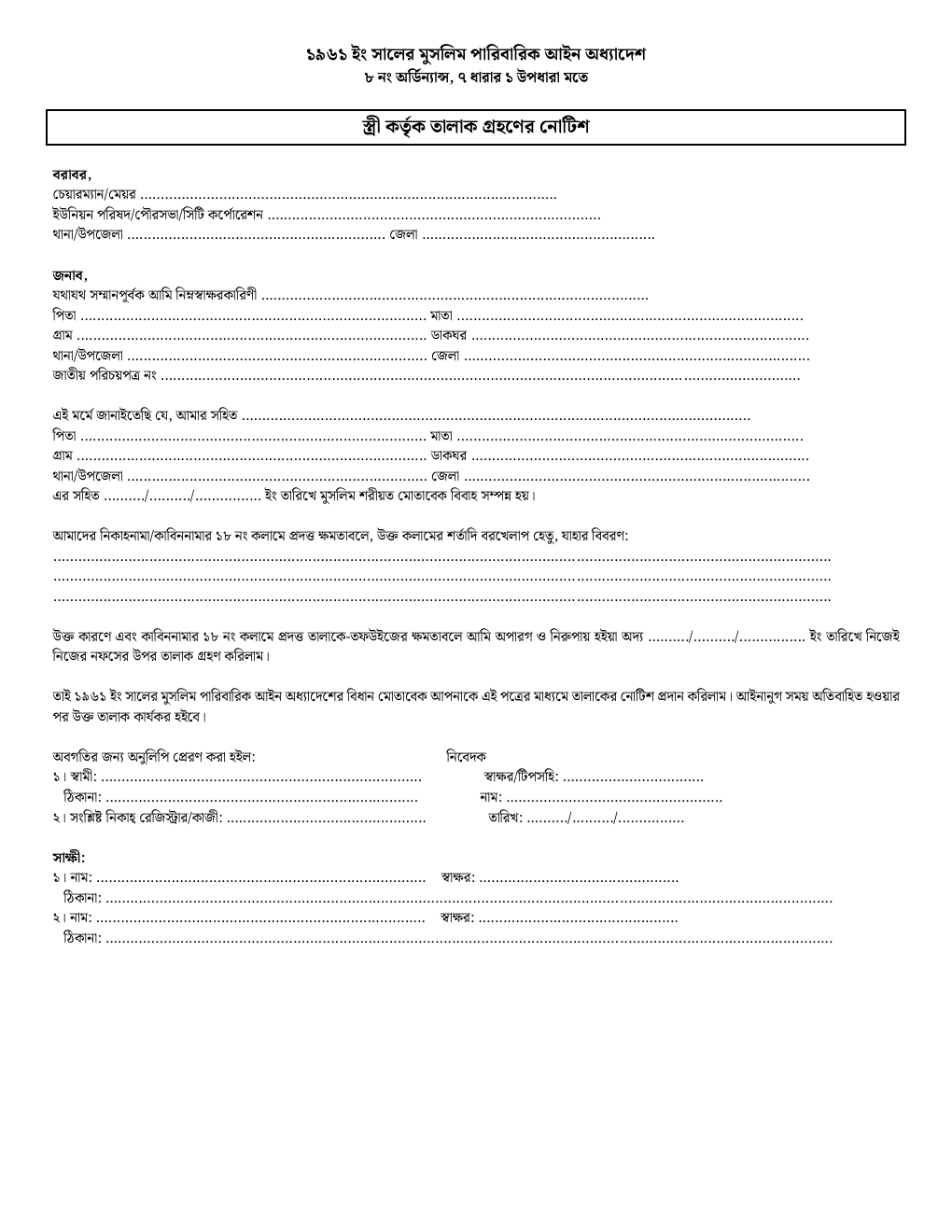
Illustrative wife’s delegated-divorce notice
The accompanying sample is specifically for talaq-e-tafweez. It is not a substitute for a khula agreement or Family Court plaint and should not be used unless the Kabinnama or another valid instrument actually delegates the power.
Khula and mubarat
Khula is generally a negotiated release proposed by the wife and accepted by the husband. Mubarat is a separation mutually desired by both spouses. Their written agreement should address dissolution, notice, registration, unpaid dower, any lawful return or waiver, personal property, maintenance and costs.
A wife does not automatically surrender every claim merely because the agreement is called “khula”. Voluntariness, consideration and existing rights require review. Child maintenance or custody is not the private bargaining property of either parent.
If the husband refuses khula, and the wife has no delegated power, she may pursue judicial dissolution where statutory grounds exist.
Sample document: wife’s delegated-divorce notice
This Bangla sample is specifically for talaq-e-tafweez where a valid Kabinnama entry or registered instrument has delegated the power of divorce to the wife.
| Document | When it may apply | Critical checks |
|---|---|---|
| Wife’s talaq-e-tafweez notice | Only where divorce authority was validly delegated | Kabinnama clause 18 or registered instrument, applicable conditions, correct Chairman, husband’s copy and registration proof |
Preview and PDF
Review the delegation evidence before completing or serving this form.
Judicial dissolution under the 1939 Act
Section 2 of the Dissolution of Muslim Marriages Act, 1939 permits a Muslim wife to seek dissolution on one or more grounds:
| Ground | Statutory threshold or example |
|---|---|
| Husband missing | His whereabouts have been unknown for four years |
| Failure to maintain | Neglect or failure to provide maintenance for two years |
| Unauthorised additional marriage | Another wife taken contrary to the 1961 Ordinance |
| Imprisonment | Final sentence of seven years or more |
| Marital obligations | Failure without reasonable cause for three years |
| Impotence | Existing at marriage and continuing, subject to the Act’s procedure |
| Serious illness | Two years’ insanity, leprosy or virulent venereal disease |
| Option of puberty | Marriage arranged before 18, repudiated before 19 and not consummated |
| Cruelty | Including habitual assault, serious non-physical cruelty and the Act’s other specified conduct |
| Other Muslim-law ground | Any other ground recognised as valid under Muslim law |
The provisos matter: a decree based on a missing husband is delayed for six months and specified relatives must be notified; the imprisonment ground requires a final sentence; and the Act provides a procedure for alleged impotence. Section 5 preserves the wife’s dower rights.
Under sections 5 and 6 of the Family Courts Act, 2023, the Family Court handles dissolution, dower, maintenance, restitution and child guardianship or custody. A dissolution, dower or maintenance suit may also be filed where the wife ordinarily resides, subject to the Act.
The court must send a certified decree to the appropriate Chairman by registered post within seven days. Under section 26, it ordinarily becomes effective 90 days after the Chairman receives it and has no effect if reconciliation occurs within that time. Any additional 1939 Act waiting provision also applies.
4. Registration, Form G-1 and post-divorce rights
Registration and the Form G-1 divorce certificate
Notice and registration are different. The Chairman handles reconciliation; the licensed Nikah Registrar records the divorce and supplies documentary proof.
Sections 6–9 of the 1974 Act regulate divorce registration. In Rabeya Khatun v Taslima Hasan, the High Court Division construed registration as mandatory and stressed that a delegated divorce cannot be registered without proof of the delegation. Registration should therefore be treated as an essential compliance and evidential step—not an optional formality.
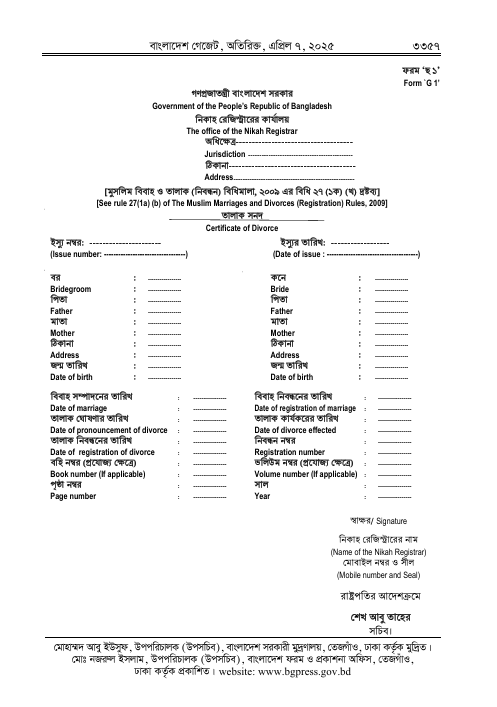
The April 2025 amendment introduced Form G-1, Certificate of Divorce. It separately records:
- date of marriage and marriage registration;
- date of pronouncement of divorce;
- date the divorce became effective;
- date and number of divorce registration;
- book, volume, page and year; and
- the Nikah Registrar’s identifying particulars and signature.
These dates are not interchangeable. Section 9 also requires an attested copy of the completed register entry to be given to the parties without charge.
Current Form G-1 certificate specimen
This is the prescribed blank Gazette form. A real certificate should be checked against the register and published only after all personal details and identifiers are redacted.
Dower, maintenance and children after divorce
Divorce does not itself erase outstanding denmohor or dower. The Kabinnama, payment evidence and applicable law determine what remains due. Where the mode of payment is not stated, section 10 of the 1961 Ordinance treats the whole dower as payable on demand.
Distinguish arrears accrued during marriage from post-divorce maintenance. In Hefzur Rahman (Md) v Shamsun Nahar Begum, 51 DLR (AD) 172, the Appellate Division rejected indefinite post-divorce maintenance and applied the Muslim-law position concerning maintenance during iddat. The amount remains fact-sensitive.
Children’s rights are independent. Divorce does not terminate child-maintenance responsibility. Custody, visitation, guardianship and expenses may be decided separately, with welfare central. A notice or khula deed cannot safely extinguish a child’s lawful claims.
Divorce when one spouse lives abroad
The 1961 Ordinance and 1974 Act apply to Muslim citizens of Bangladesh wherever they may be. An overseas spouse should verify jurisdiction, use traceable delivery and preserve evidence. Consular authentication or a limited power of attorney may be needed for local acts.
A foreign order is not automatically self-proving in Bangladesh. Jurisdiction, notice, finality, public policy and Bangladeshi statutory obligations may affect recognition. Obtain advice before remarriage or changing records.
5. Risk checks and practical compliance
Warning signs of an incomplete or disputed divorce
- Only an oral declaration, message or affidavit exists;
- Notice was sent to the wrong authority or receipt cannot be proved;
- The wife did not receive a copy;
- Ninety days were counted from signing or posting rather than the Chairman’s receipt;
- A wife used a talaq-e-tafweez form without documentary delegation;
- A khula or mubarat document does not record free consent and financial terms;
- Pronouncement, effective and registration dates conflict;
- Reconciliation occurred but was never recorded;
- The divorce was never registered; or
- A certificate cannot be matched with the register.
If status is disputed, avoid remarriage on assumptions. Preserve the Kabinnama, service evidence, council papers, court record, registration entry and certificate, and obtain a legal opinion.
Practical compliance checklist
- Identify the correct route and inspect the Kabinnama.
- Verify the competent Chairman and Nikah Registrar.
- Draft accurately; serve every required recipient and preserve proof.
- Calculate time from the Chairman’s actual receipt.
- Record reconciliation or revocation promptly.
- Register, obtain Form G-1 and address financial and child issues separately.
Frequently asked questions
Is a notarised affidavit a valid divorce certificate?
No. Notarisation authenticates a signature or declaration; it does not replace section 7 notice, the waiting period, registration or the prescribed certificate.
Can a wife issue talaq in Bangladesh?
She may exercise talaq-e-tafweez if the husband validly delegated that power. Otherwise, she may seek an agreed khula or mubarat, or apply to the Family Court on a statutory ground.
Does the 90-day period start when the notice is posted?
No. Section 7(3) calculates it from the day the notice is delivered to the appropriate Chairman. Keep reliable proof of that date.
Can the Chairman refuse the divorce?
The Chairman facilitates reconciliation through the Arbitration Council but has no general judicial veto over a properly initiated husband’s talaq.
What if the Arbitration Council does not call the parties?
Preserve proof of receipt, follow up in writing and obtain advice before relying on the divorce. Administrative inaction does not justify guessing the date or skipping registration.
Is registration necessary after the 90 days expire?
Yes, it should be treated as essential. The 1974 Act provides the registration mechanism, and the High Court Division has construed divorce registration as mandatory.
Does divorce cancel unpaid denmohor?
No. Unpaid dower is a separate enforceable obligation unless it has been lawfully paid, remitted or settled. Section 5 of the 1939 Act expressly preserves dower rights following judicial dissolution.
Can divorced spouses remarry each other?
Section 7(6) permits remarriage to the same husband without an intervening marriage unless the termination was effective for the third time. Individual facts and the form of divorce still require careful review.
How Roy Law Nexus can assist
Route, document and jurisdiction review
Roy Law Nexus reviews the Kabinnama, clause 18 delegation, marital status, applicable divorce route, territorial jurisdiction and the documentary record before any notice, settlement or proceeding is started.
Notice, settlement and court representation
We prepare and review section 7 notices, delegated-divorce notices, khula and mubarat agreements; coordinate provable service; assist before the Arbitration Council; and represent clients in Family Court proceedings concerning dissolution, dower, maintenance, custody and guardianship.
Registration, certificates, affidavits and translations
We assist with divorce registration, Form G-1 certificate and register-entry verification, lawful affidavit preparation where relevant, and certified Bangla-English translation of Kabinnama, divorce notices, agreements, decrees and marriage or divorce certificates. We also advise on attestation, consular use and overseas-document requirements.
Early review is especially important where dates or service are disputed, clause 18 is relied on, reconciliation occurred, a foreign document is involved, or remarriage is contemplated.
About the Author

Sawdip Roy Sajib
Advocate, Supreme Court of Bangladesh
Member, Dhaka Bar Association and Dhaka Taxes Bar Association
Legal Disclaimer: This article provides general legal information based on Bangladesh law and official materials reviewed to 26 September 2026. Divorce status and consequences are fact-specific; obtain advice before relying on a notice, settlement, decree, certificate or foreign order.