
Essential answer
A Muslim marriage in Bangladesh is both a religiously recognised civil contract and a relationship regulated by statute. A legally careful marriage requires more than a ceremony: the parties must have legal capacity and give free consent; the marriage must not fall within a prohibited relationship; offer and acceptance must take place in the presence of competent witnesses under the applicable Muslim law; dower should be settled and accurately recorded; and the marriage must be registered by a licensed Nikah Registrar.
The Kabinnama or Nikahnama is not a ceremonial receipt. It records identity, age, marital status, dower, negotiated conditions, delegated divorce rights, any existing marriage and the registration particulars. In a future dispute, inaccurate or blank entries can affect claims concerning marriage, dower, maintenance, divorce and even alleged fraud.
This guide explains the legal position, the 25 entries in the commonly used Bangladesh Nikahnama, the registration fee, second-marriage rules, the “court marriage” misconception, and the latest digital-registration developments.
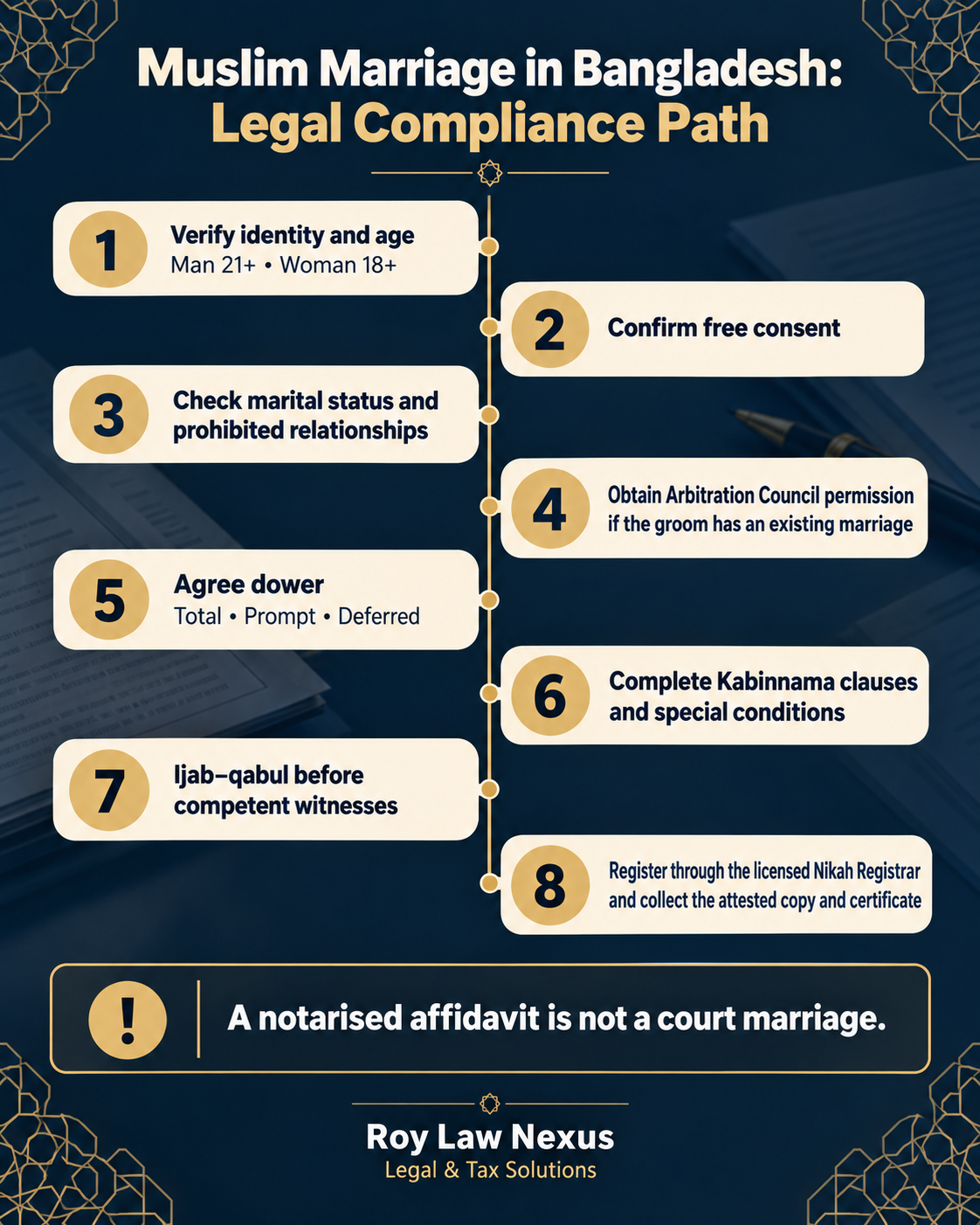
Muslim Marriage Legal Compliance Path
A legally secure Nikah is a sequence of verification, agreement, solemnisation, registration and document preservation.
- 1
Verify identity and statutory age
- 2
Confirm free and informed consent
- 3
Check marital status and prohibited relationships
- 4
Obtain Arbitration Council permission where section 6 applies
- 5
Set total, prompt and deferred dower
- 6
Complete all Kabinnama entries and special conditions
- 7
Complete ijab–qabul before competent witnesses
- 8
Register with the licensed Nikah Registrar and collect official copies
The essential answer, legal compliance path, Kabinnama map and signing safeguards are visible. Open one larger topic only when you need its connected legal detail.
1–4. Legal Framework, Age, Consent and Witnesses
1. Which laws govern a Muslim marriage in Bangladesh?
Bangladesh does not regulate Muslim marriage through one consolidated code. The legal result comes from Muslim personal law, statutes, rules and judicial interpretation working together.
| Legal source | Main relevance to marriage |
|---|---|
| Muslim Personal Law (Shariat) Application Act, 1937 (opens in a new tab) | Makes Muslim personal law the rule of decision in matters including marriage, dissolution, dower, maintenance and guardianship where the parties are Muslims. |
| Muslim Family Laws Ordinance, 1961 (opens in a new tab) | Regulates a further marriage during an existing marriage, talaq procedure, maintenance and the mode of payment of dower. |
| Muslim Marriages and Divorces (Registration) Act, 1974 (opens in a new tab) | Makes registration of every Muslim marriage mandatory and regulates licensed Nikah Registrars, registers and certified copies. |
| Muslim Marriages and Divorces (Registration) Rules, 2009, as amended | Prescribes the registers, forms, registrar practice and fees. Important amendments were published in 2022 (opens in a new tab) and 2025 (opens in a new tab). |
| Child Marriage Restraint Act, 2017 (opens in a new tab) and Rules, 2018 | Sets the marriage ages, identifies acceptable proof of age, provides preventive orders and creates offences relating to child marriage. |
| Dowry Prohibition Act, 2018 (opens in a new tab) | Criminalises dowry-related conduct. It expressly distinguishes lawful dower or mehr from prohibited dowry. |
| Family Courts Act, 2023 (opens in a new tab) | Gives Family Courts jurisdiction over dissolution, restitution of conjugal rights, dower, maintenance and child guardianship or custody. |
| Dissolution of Muslim Marriages Act, 1939 (opens in a new tab) | States grounds on which a Muslim wife may seek judicial dissolution, including a further marriage taken in breach of the 1961 Ordinance. |
| Evidence Act, 1872 (opens in a new tab) | Governs proof of documents, conduct, relationship and other evidence when a marriage or Kabinnama is disputed. |
The 1961 Ordinance and the 1974 Act apply to Muslim citizens of Bangladesh even when they are abroad. An overseas ceremony therefore should not be assumed to fall outside Bangladeshi family-law obligations. Cross-border cases also require analysis of the law of the place of celebration, authentication of documents and the intended use of the marriage record.
2. What makes a Muslim marriage legally compliant?
The following elements should be considered before, during and immediately after the Nikah:
| Element | Legal significance | Practical safeguard |
|---|---|---|
| Parties and identity | The bride and groom must be correctly identified and legally capable of marrying. | Match names, dates of birth, parents’ names and addresses against reliable identity records. Avoid initials or inconsistent spellings. |
| Minimum age | For marriage, an adult is a man of at least 21 and a woman of at least 18. | Use an accepted original age document; do not rely on appearance or an affidavit created for the ceremony. |
| Free consent | Marriage requires real consent. Force, confinement, deception or substitution can make the purported marriage legally vulnerable and may create civil or criminal consequences. | The registrar should speak to each party independently where any concern exists. |
| Offer and acceptance | There must be a clear proposal and acceptance relating to the same marriage in the same meeting, personally or through a validly authorised representative. | Record the ceremony accurately; do not use a wakil without clear authority. |
| Witnesses | Under Sunni/Hanafi doctrine commonly applied in Bangladesh, competent witnesses must hear and understand the offer and acceptance. | Use adult, identifiable witnesses who were actually present and can later be located. |
| No legal prohibition | The parties must not be within prohibited degrees by blood, marriage or fosterage, and no subsisting status may legally prevent the union. | Obtain a careful marital-status and relationship history from both parties. |
| Dower | Dower is a legal obligation from husband to wife, not the price of marriage and not dowry. | State the total, prompt and deferred portions, payment method and any property transferred. |
| Prior permission for a further marriage | A man already married must first obtain written permission from the Arbitration Council under section 6 of the 1961 Ordinance. | Obtain and verify the order before the further Nikah; record its number and date. |
| Registration | Section 3 of the 1974 Act requires every Muslim marriage to be registered. | Use the licensed Nikah Registrar for the correct area and collect the attested copy and applicable certificate. |
These are not interchangeable. For example, registration is mandatory and crucial evidence, but inserting names into a register cannot cure an otherwise prohibited union or manufacture consent that never existed. Conversely, a later dispute about missing registration does not always answer every question of personal-law validity or proof. Courts examine the statute, the nature of the defect and the evidence.
3. Age and prevention of child marriage
Section 2 of the Child Marriage Restraint Act, 2017 treats a man below 21 and a woman below 18 as minors for marriage. If either party is below the relevant age, the marriage is a child marriage for the purposes of the Act.
Under section 12, age may be proved by documents including a birth certificate, National Identity Card, relevant public-examination certificate or passport. The document should be genuine, current and consistent with the identity used in the Kabinnama.
The Act empowers the court to restrain an imminent child marriage and imposes liability on adults contracting one, parents or guardians involved, persons solemnising it and a registrar who registers it. A registrar may also face cancellation of the licence. An adult who contracts a child marriage may be punished with imprisonment up to two years, a fine up to BDT 100,000, or both.
The “special circumstances” provision is not a general exception
Section 19 contains a narrowly framed special provision requiring prescribed special circumstances, the minor’s best interests, a court’s direction and parental or guardian consent, following the prescribed process. It is not permission for families or registrars to reduce the statutory age by private agreement. A claim that a wedding is “socially necessary” does not, by itself, satisfy section 19.
The 2017 Act criminalises and seeks to prevent child marriage, but it does not simply declare in one sentence that every child marriage is automatically void for every legal purpose. Status, dissolution, dower, legitimacy and other consequences require separate legal analysis. That distinction must never be used to facilitate an underage marriage.
4. Consent, offer, acceptance and witnesses
Free and informed consent
Consent is the foundation of the marriage contract. Silence obtained through fear, detention, family pressure or a false representation should not be treated as consent. In Dr Shipra Chaudhury and another v Government of Bangladesh and others, Writ Petition No. 7977 of 2008, the High Court addressed the forced-marriage circumstances of Humayra Abedin and protected personal liberty and the right to choose. The official judgment (opens in a new tab) remains an important constitutional reminder that family preference cannot replace the adult individual’s decision.
Ijab and qabul
The offer (ijab) and acceptance (qabul) must refer to the same marriage and occur in one meeting so that the witnesses understand that a contract has been concluded. The parties may speak personally or, where lawfully authorised, through representatives. A representative cannot exceed the authority given or override a party’s refusal.
Is a bride’s wakil compulsory?
No general statutory rule makes a wakil compulsory for every adult bride. The prescribed Bangladesh Nikahnama itself uses conditional fields—effectively, “if a wakil has been appointed.” Under the Hanafi position commonly relevant in Bangladesh, an adult woman of sound mind has contractual capacity to marry, subject to the applicable substantive rules. Using a wakil may be culturally common, but the wakil is an agent; he is not a substitute for the bride’s free consent.
Witnesses
The Appellate Division’s discussion in Mst. Momtaz Begum v Anowar Hossain, Civil Appeal No. 139 of 2003, describes a Muslim marriage as a civil contract formed through proposal and acceptance before competent witnesses. In the Sunni/Hanafi formulation discussed by the Court, the usual witness combination is two adult Muslim men, or one adult Muslim man and two adult Muslim women. Questions involving another school of Muslim law require school-specific advice.
For evidential strength, record the witnesses’ full names, parents’ names, addresses, identity details and signatures. A person who merely signs later but did not witness the marriage is not a safe substitute for a genuine witness.
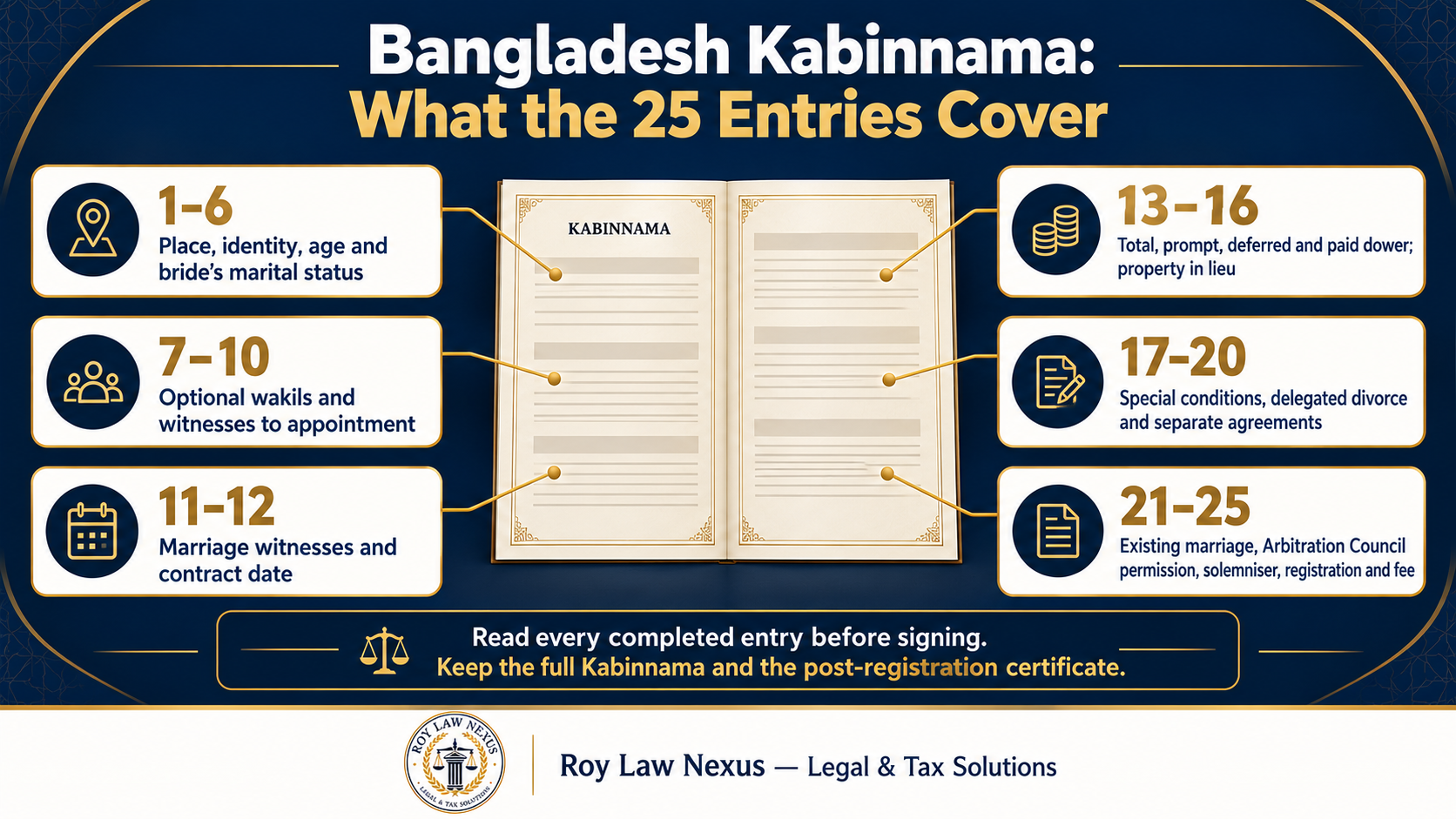
5. Kabinnama explained: what the 25 entries mean
The uploaded sample is the familiar Bangladesh Government Form No. 1601, Form ‘ঘ’ (Nikahnama) used under the 2009 Rules. It contains 25 numbered entries and signature blocks. The clauses should be completed before signing; blank spaces, overwriting and vague promises create avoidable disputes.
| Entries in the sample | Subject | Why it matters |
|---|---|---|
| 1 | Ward, union, town, thana and district where the marriage was solemnised | Connects the ceremony to the registrar’s territorial jurisdiction and the official record. |
| 2–3 | Groom’s name, parents, address and age | Establishes identity and age. Details should match official records. |
| 4–6 | Bride’s name, parents, address, marital status and age | Establishes identity, age and whether she is unmarried, widowed or divorced. Prior-divorce or widowhood documents should be checked where relevant. |
| 7–10 | Bride’s and groom’s wakils, if appointed, and witnesses to those appointments | Records agency. These entries are optional where no wakil is appointed, but any appointment should be genuine and within authority. |
| 11 | Witnesses to the marriage | Identifies the persons who witnessed offer and acceptance. Use accurate, traceable particulars. |
| 12 | Date on which the marriage was contracted | The date of Nikah may differ from the registration date. Both must be accurately stated. |
| 13 | Total dower | Records the husband’s total financial obligation to the wife. Avoid symbolic figures that do not reflect the parties’ agreement. |
| 14 | Prompt and deferred portions | Determines when the dower becomes payable. If the payment mode is omitted, section 10 of the 1961 Ordinance treats the entire amount as payable on demand. |
| 15 | Dower paid at the time of marriage | Record only money or value actually delivered; obtain a receipt where payment is disputed or substantial. |
| 16 | Property transferred in lieu of any part of dower | Describe the property precisely and complete any separate transfer formalities required by law. A vague description does not transfer land. |
| 17 | Special conditions | Can record lawful, clear and enforceable terms concerning residence, education, employment, finances or other agreed matters. |
| 18 | Whether the husband delegates a power of divorce to the wife and on what conditions | This is the principal talaq-e-tafweez field. It should never be left unconsidered or filled mechanically. |
| 19 | Any restriction on the husband’s power of divorce | Requires careful drafting; a clause cannot simply disapply mandatory law. |
| 20 | Separate document concerning dower, maintenance or other matters | Identify the document clearly, sign it properly and preserve it with the Kabinnama. Registration may be necessary depending on its content. |
| 21–22 | Existing wife and prior Arbitration Council permission | Where the groom has an existing marriage, record whether section 6 permission was obtained and state the order number and date. |
| 23 | Person who solemnised the marriage | The solemniser and the licensed registrar may be different people. |
| 24–25 | Registration date and registration fee | Confirms when the statutory registration was completed and the fee charged. |
The form also contains signature spaces for the bride and groom, their wakils where used, witnesses to the appointments, witnesses to the marriage, the person solemnising and the Nikah Registrar. Every signatory should read or have the completed entries read out before signing.
Kabinnama and marriage certificate are not identical
The Kabinnama records the marriage contract and negotiated terms. The 2025 amendment to the Rules introduced a separate prescribed marriage certificate following registration, including core identity, date, dower and registration particulars, with provision for digital verification or QR features. A short certificate should not replace preservation of the full Kabinnama, because clauses 17–20 and the detailed dower entries may become important later.
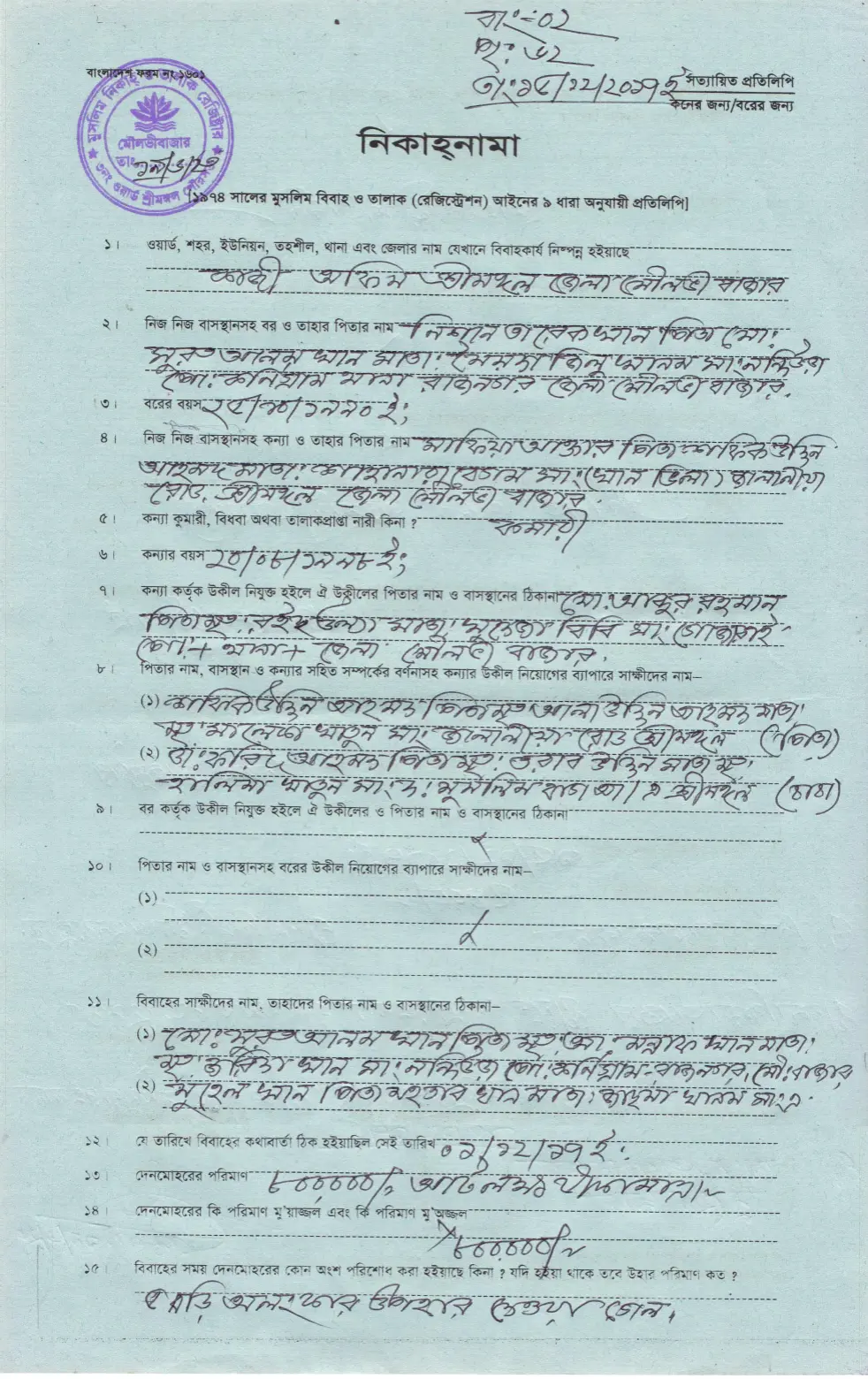
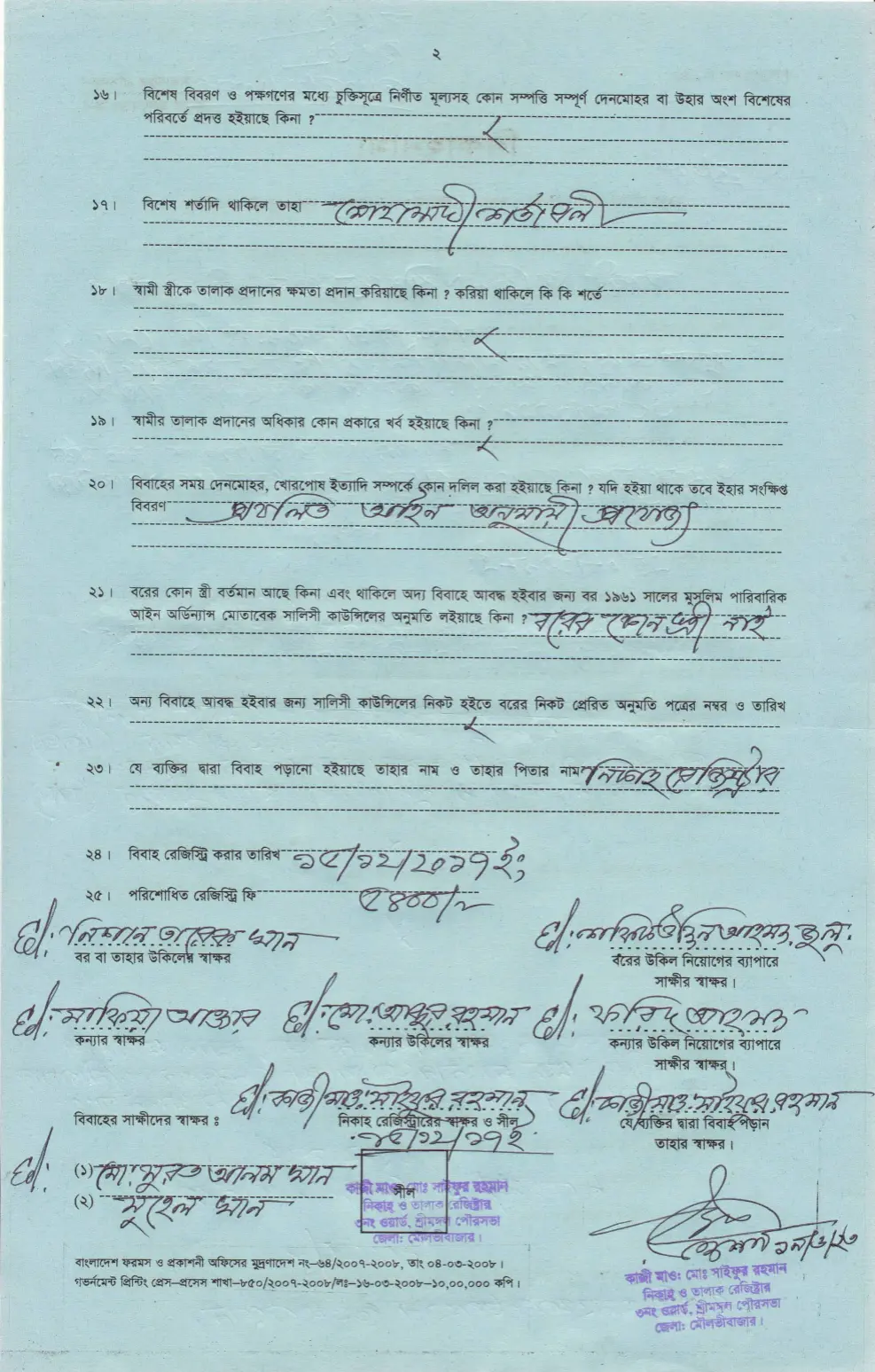
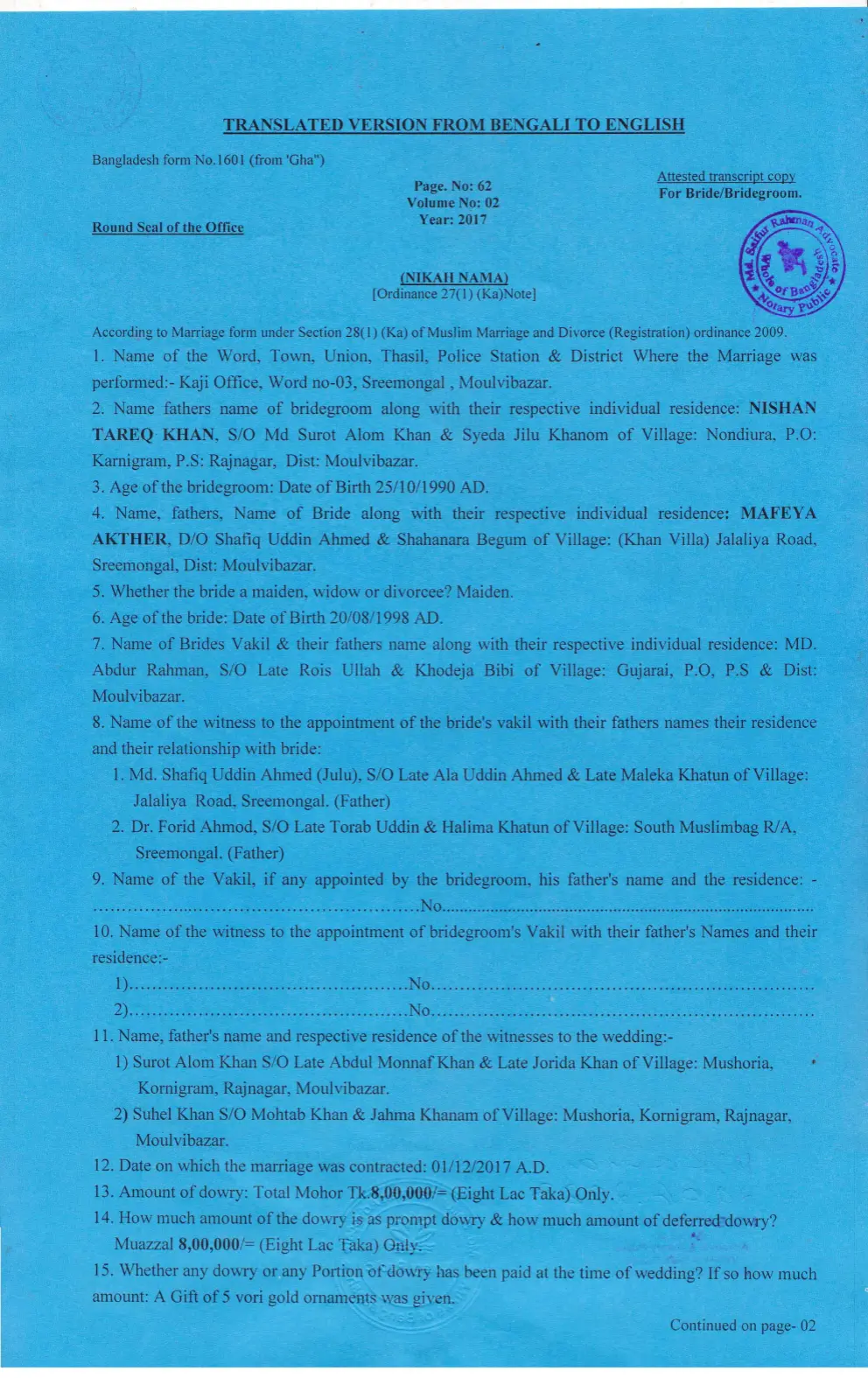
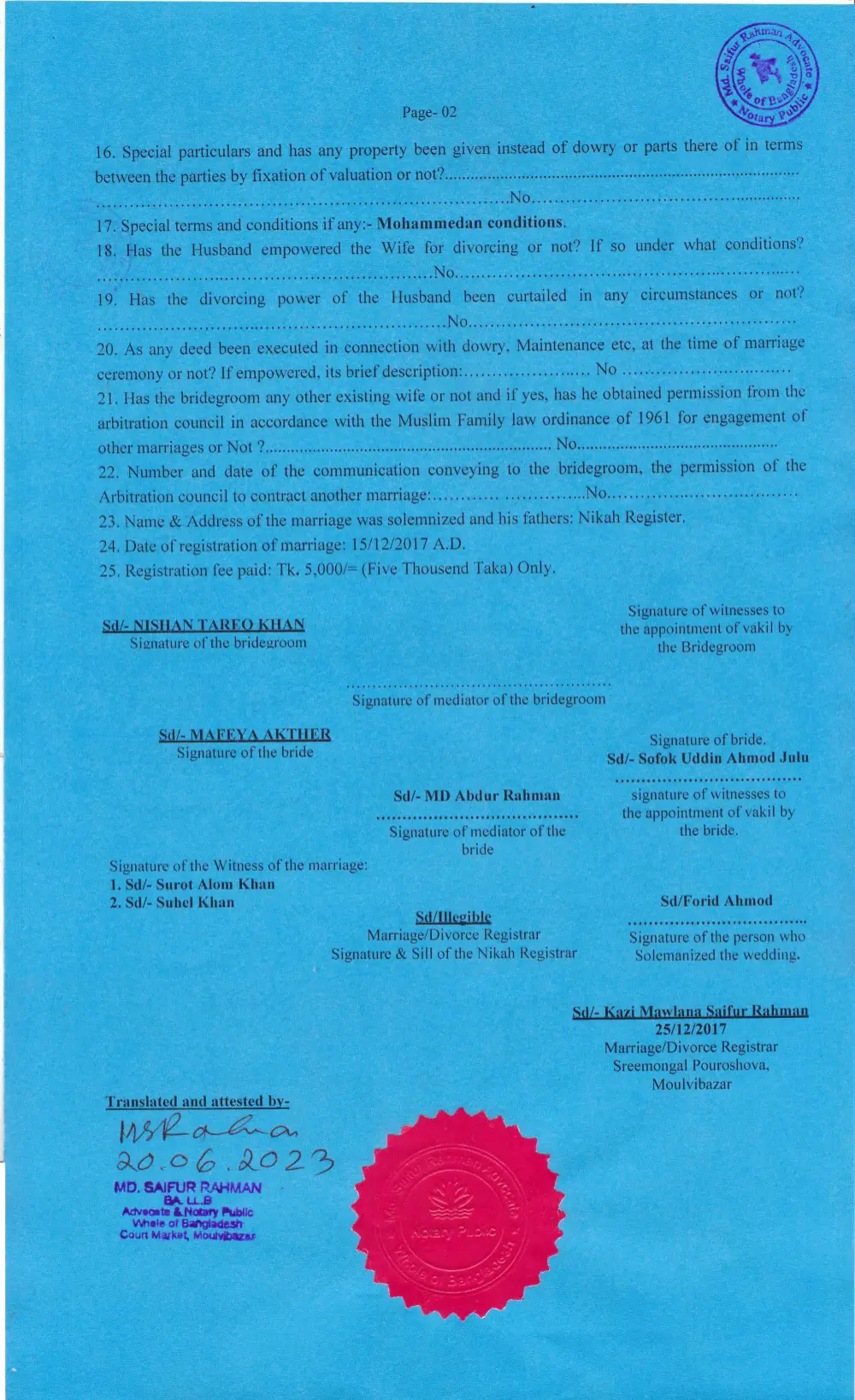
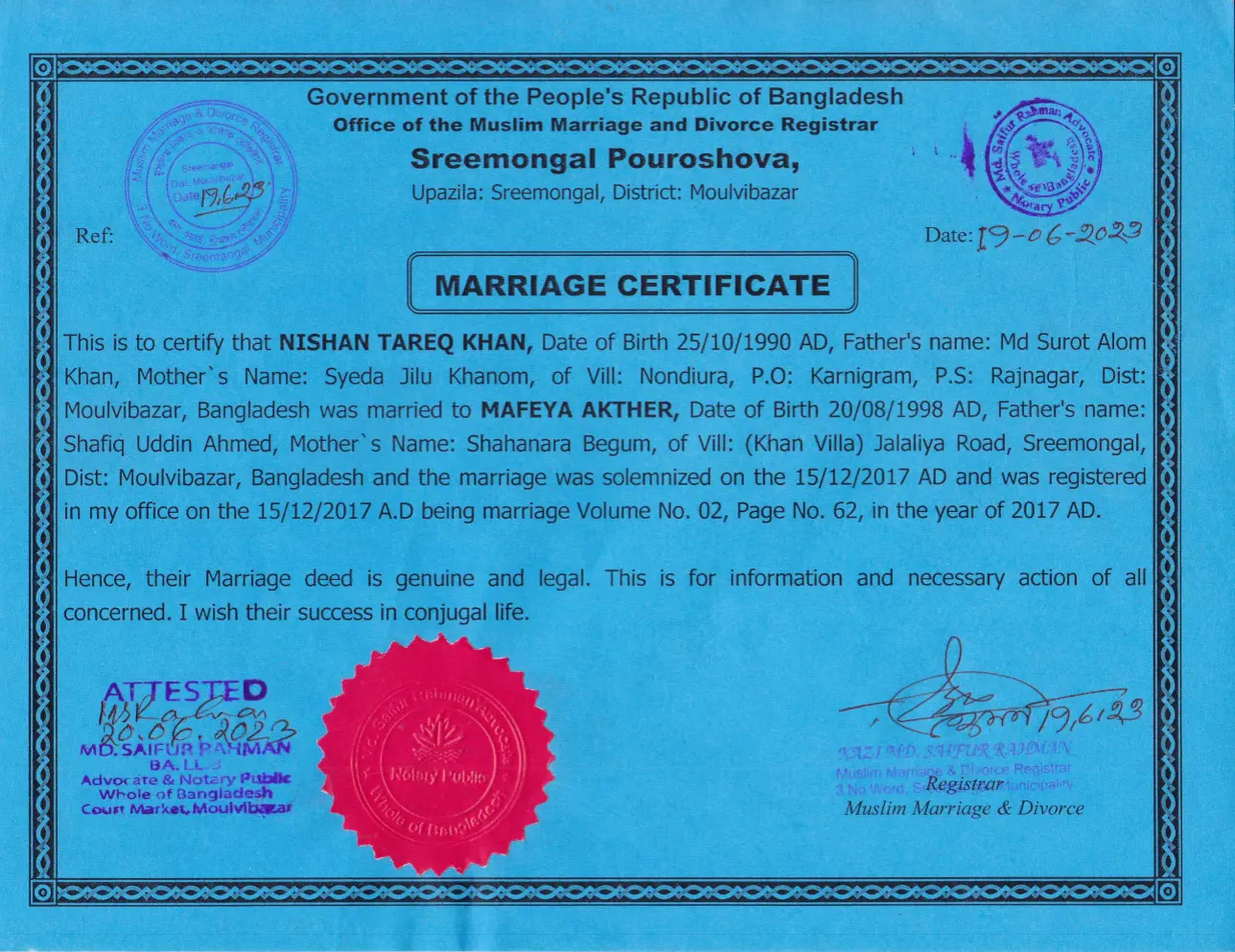
Document samples: filled Nikahnama, English translation and marriage certificate
These connected samples show the full Bangla marriage contract, an attested Bangla-to-English translation and the shorter marriage certificate. Check every spelling, date, amount, address, seal, signature and register reference against the original record.
| Document | What it records | Typical use | Review before relying |
|---|---|---|---|
| Filled Bangla Nikahnama | The 25 contractual and registration entries, including dower and special conditions | Primary marriage contract and register evidence | Names, ages, marital status, dower, clauses 17–20, dates, signatures and registrar details |
| Attested English translation | An English rendering of the Bangla Nikahnama | Embassy, immigration, court, banking or overseas documentary use, subject to the receiving authority's requirements | Exact transliteration, dates, figures, clause numbering, translator certification and attestation |
| Marriage certificate | A concise certificate drawn from the marriage record | Summary proof of the registered marriage | Spouse details, solemnisation and registration dates, volume/page reference, issuing registrar, seal and signature |
A. Filled Bangla Nikahnama
Read both pages together. Page 1 contains entries 1–15; page 2 continues entries 16–25 and the signature blocks.
B. Attested Bangla-to-English Nikahnama translation
The translation should reproduce the original entry numbers and particulars faithfully; it does not replace the Bangla original or the registrar's certified record.
C. Marriage certificate
A marriage certificate is a concise post-registration record. It should be checked against the full Nikahnama and register copy.
6–9. Dower, Special Conditions, Registration and Fees
6. Dower or denmohor: what should be written?
Dower (mehr or denmohor) is a legal obligation owed by the husband to the wife by reason of the marriage. It belongs exclusively to the wife. It is not a payment to her family, not the purchase price of the marriage and not “dowry.” The Dowry Prohibition Act, 2018 excludes dower or mehr from the statutory definition of prohibited dowry.
Prompt and deferred dower
| Type | Meaning | Drafting point |
|---|---|---|
| Prompt dower (mu’ajjal) | Payable immediately or on demand according to the agreement and applicable law | State the exact amount, whether paid, the payment date and method. |
| Deferred dower (mu’wajjal) | Payable on the agreed event or time, often on dissolution or death if no earlier trigger is agreed | State the trigger clearly. “Later” or “when convenient” invites dispute. |
| Dower in property | All or part is satisfied by transfer of identified property | Give a precise schedule and complete the legally required deed, registration, stamp and possession steps. A Kabinnama entry alone may not perfect title. |
| Proper dower (mahr al-mithl) | A reasonable dower determined under applicable principles where no enforceable amount was fixed | Its assessment is fact-sensitive and may require evidence of family and social circumstances. |
Section 10 of the Muslim Family Laws Ordinance, 1961 supplies an important default: if the Nikahnama or marriage contract does not specify the mode of payment, the entire dower is presumed payable on demand. Writing a large total but leaving the prompt/deferred division blank can therefore expose the husband to immediate liability.
The parties should also distinguish between:
- an agreed dower obligation;
- an amount actually paid at marriage;
- jewellery or gifts given voluntarily;
- property transferred in satisfaction of dower; and
- unlawful dowry demanded from the bride or her family.
Do not record jewellery, cash or land as “paid dower” unless it was genuinely delivered and accepted in that capacity. For a land transfer, identify the mouza, khatian, plot, area, title deed and registration particulars in a separate legally effective instrument.
If dower remains unpaid, the wife may bring a claim in the Family Court. Under section 5 of the Family Courts Act, 2023, the Family Court has exclusive jurisdiction over dower suits, and section 6 provides an additional venue for dower, maintenance and dissolution proceedings where the wife ordinarily resides.
7. Special conditions and delegated divorce rights
Clauses 17–20 are among the most valuable—and most neglected—parts of the Kabinnama. They allow the parties to convert important expectations into written contractual terms, provided the terms are lawful, sufficiently certain and not contrary to mandatory law or public policy.
Possible subjects include:
- residence or relocation;
- continuation of education or lawful employment;
- agreed financial arrangements or separate accommodation;
- disclosure of an existing marriage, children or liabilities;
- a process for major family decisions;
- consequences of breach, to the extent lawfully enforceable; and
- delegation to the wife of a power to divorce herself on stated conditions (talaq-e-tafweez).
Clause 18 should not be answered without advice merely because a registrar uses a standard phrase. Section 8 of the 1961 Ordinance applies the statutory notice-and-reconciliation framework to the wife’s exercise of a duly delegated divorce power. Section 6(3) of the 1974 Act also requires documentary proof of the delegation before the Registrar can register a talaq-e-tafweez.
Good drafting is specific. For example, a condition should identify the triggering event, any notice required, the time allowed to remedy a breach and the resulting right. A clause that conflicts with a statute, attempts to remove a court’s jurisdiction or is too vague may not achieve its intended result.
8. How to register a Muslim marriage
Section 3 of the Muslim Marriages and Divorces (Registration) Act, 1974 states that every marriage solemnised under Muslim law must be registered. “Religious marriage only” is therefore not a compliant substitute.
Practical registration process
- Locate the licensed Nikah Registrar. Confirm that the registrar is authorised for the relevant area. The government marriage portal (opens in a new tab) provides a registrar-search function as the digital system is rolled out.
- Verify identity and age. Check original age and identity documents and ensure consistent spelling in Bangla and English where both are used.
- Verify marital status. Review any divorce, death or prior-marriage records. If the groom has an existing wife, obtain the Arbitration Council’s written permission before the new marriage.
- Settle dower and contractual terms. Decide the total, prompt and deferred portions, payment evidence, any property component and clauses 17–20 before the ceremony.
- Solemnise with free consent and competent witnesses. Record the actual date and place of the contract.
- Complete and review the Kabinnama. Do not sign a blank or partially completed form. Correct errors through a transparent, authenticated process—not erasure or concealed overwriting.
- Register immediately or report within 30 days. If the licensed Nikah Registrar solemnises the marriage, section 5 requires registration at once. If another person solemnises it, the bridegroom must report the marriage to the concerned Nikah Registrar within 30 days, and the Registrar must then register it at once.
- Collect the official record. Section 9 requires the Registrar to give the parties an attested copy of the register entry free of charge. Obtain the applicable marriage certificate as well and retain proof of any digital verification.
- Preserve supporting documents. Keep the Kabinnama, certificate, age documents, Arbitration Council order, payment receipts and any separate agreement together. Scan them in colour and maintain secure backups.
A failure to comply with section 5 is punishable with simple imprisonment up to two years, a fine up to BDT 3,000, or both. The modest statutory fine should not obscure the greater practical risks: loss of reliable evidence, difficulty with immigration or inheritance documents, dower disputes and allegations of deception.
9. Registration fee
Under the fee schedule introduced by S.R.O. No. 377-Law/2022, the published marriage-registration fee is calculated on the dower stated in the Kabinnama:
| Dower amount | Registration fee formula |
|---|---|
| Up to BDT 500,000 | BDT 14 for every BDT 1,000 or part of BDT 1,000, subject to a minimum fee of BDT 200 |
| Above BDT 500,000 | BDT 7,000 for the first BDT 500,000, plus BDT 100 for every additional BDT 100,000 or part of BDT 100,000 |
Examples
| Total dower | Illustrative fee |
|---|---|
| BDT 10,000 | BDT 200 minimum |
| BDT 100,000 | BDT 1,400 |
| BDT 500,000 | BDT 7,000 |
| BDT 1,000,000 | BDT 7,500 |
The fee is not the same as dower and is not a percentage payable to the bride. Ask for an official receipt and verify the latest Gazette schedule or portal calculation before payment. Additional lawful charges for certified copies or particular services should be separately identified.
10–12. Second Marriage, Validity and the ‘Court Marriage’ Myth
10. Second marriage during an existing marriage
Section 6 of the Muslim Family Laws Ordinance, 1961 regulates a Muslim man’s further marriage while an existing marriage continues.
What the law requires
- The husband must obtain the previous written permission of the Arbitration Council.
- The application is made to the relevant Chairman in the prescribed manner and must state the reasons for the proposed marriage and whether the existing wife or wives have consented.
- The Chairman asks the applicant and existing wife or wives to nominate representatives.
- The Arbitration Council may grant permission, with reasons and conditions, only if satisfied that the proposed marriage is “necessary and just.”
- A party may seek revision before the competent Assistant Judge in the prescribed manner.
The legal permission comes from the Arbitration Council. Direct consent of the existing wife is relevant and must be disclosed, but the statutory text does not make her signature alone the permission. A reported High Court judgment (opens in a new tab), delivered in 2025 and published in 2026, upheld that structure and rejected a challenge seeking to make the first wife’s consent itself mandatory. Any later appeal or authoritative order should be checked before relying on the report.
Consequences of marrying without permission
An unapproved further marriage cannot be registered under section 6(1). The husband must immediately pay the entire prompt and deferred dower due to the existing wife or wives. On complaint and conviction, he may face simple imprisonment up to one year, a fine up to BDT 10,000, or both. The breach is also a statutory ground on which a wife may seek judicial dissolution under section 2(iia) of the Dissolution of Muslim Marriages Act, 1939.
It is inaccurate to say that the first wife’s consent alone legalises the marriage; it is equally inaccurate to say that the first wife has no role. The Council process, disclosure and prior written order are the controlling statutory safeguards.
11. Valid, void, irregular and unregistered marriages
These labels should not be used casually. Muslim-law classification, statutory offences and evidential proof answer different questions.
| Situation | General legal character | Practical consequence |
|---|---|---|
| Marriage satisfying capacity, consent, offer and acceptance, witness and non-prohibition requirements | Valid (sahih), subject to statutory compliance | Creates the ordinary marital rights and obligations; registration remains mandatory. |
| Marriage within a permanent prohibited degree or where a subsisting marriage legally prevents the woman from marrying another person | Commonly treated as void (batil) | No registrar should proceed; urgent fact-specific advice is required. |
| A defect treated as temporary or curable under the applicable school—for example, certain witness defects discussed in Sunni authorities | May be irregular (fasid) rather than void | Consequences can differ before and after consummation. Do not attempt a private “cure” without legal advice. |
| Marriage not registered under the 1974 Act | Statutory breach and serious proof problem | Non-registration does not provide a safe route around the law and may attract section 5 liability; a court may still have to decide whether a marriage existed on other evidence. |
| Child marriage | Prohibited and punishable under the 2017 Act | The Act provides prevention and sanctions; it does not make every status consequence reducible to an automatic-void formula. |
| Further marriage without Arbitration Council permission | Contravention of section 6; cannot be registered; dower and penal consequences arise | Do not describe it merely as a private marital issue or assume the first wife’s later consent cures the breach. |
The precise classification may vary with the parties’ school of law and facts. A website checklist cannot replace a legal opinion where legitimacy, inheritance, immigration, criminal exposure or the existence of a marriage is contested.
12. “Court marriage” and the Special Marriage Act
A notarised affidavit is not a Muslim marriage
In Bangladesh, couples sometimes sign an affidavit described as a “court marriage.” A Notary Public’s attestation proves, at most, that a declaration or signature was acknowledged before the notary. It does not by itself perform a Nikah, establish the required witnesses, create dower terms or satisfy registration under the 1974 Act.
A Magistrate or court also does not ordinarily convert such an affidavit into a Muslim marriage certificate. Adult couples may use legal remedies for protection against threats or unlawful confinement, but a protection order and a marriage contract are different instruments.
Can two Muslims marry under the Special Marriage Act, 1872?
The Special Marriage Act, 1872 (opens in a new tab) is frequently misunderstood. Section 2 is framed for persons who do not profess specified religions, or for parties who both profess Hindu, Buddhist, Sikh or Jaina religion. It is not the ordinary civil-registration route for two persons who continue to profess Islam. Muslim couples should not use an affidavit or a Special Marriage Act form as a shortcut around Nikah requirements, dower, registration, age restrictions or section 6.
Interfaith and conversion cases require individual advice on constitutional rights, personal law, the 1872 Act, succession and documentary consequences. Labels chosen merely to obtain a paper may create deeper legal problems later.
13–14. Court Guidance and Current Legal Developments
13. What the courts say
Marriage is a civil contract—but proof can be complex
In Mst. Momtaz Begum v Anowar Hossain, Civil Appeal No. 139 of 2003, reported in 20 BLT (AD) 143, 17 BLC (AD) and 2012 BLD (AD) 32, the Appellate Division explained that Muslim marriage is a civil contract and does not depend on a particular religious ceremony. The Court examined proposal, acceptance, witnesses, conduct, prolonged cohabitation and reputation. It held, on the facts, that the absence of a registered Kabinnama was not necessarily fatal to proving the marriage. The official judgment (opens in a new tab) also discusses the evidential relevance of conduct under section 50 of the Evidence Act.
That decision is not permission to avoid registration. Section 3 of the 1974 Act remains mandatory. The case demonstrates that personal-law validity, statutory breach and evidential proof are analytically distinct.
A Family Court can examine whether the Kabinnama and marriage are genuine
In Md Shahidul Islam v Parul Begum, Civil Revision No. 3076 of 2019, decided on 3 January 2024, the High Court considered a dower and maintenance dispute in which the marriage and Kabinnama were challenged. The decision confirms that a Family Court resolving matters within its jurisdiction may examine the genuineness of the Kabinnama and whether a marital relationship existed; it is not confined to reading the face of a disputed document. The official judgment (opens in a new tab) also discusses earlier Family Court authority.
Secret or deceptive ceremonies carry serious risk
In Sabbir Sheikh v State, Criminal Appeal No. 9135 of 2019, judgment dated 24 June 2021, the High Court examined allegations involving a purported secret marriage, non-registration and later denial in the context of a criminal proceeding. The official judgment (opens in a new tab) illustrates how alleged deception about marriage may contribute to grave criminal allegations. It does not establish that every unregistered marriage is automatically rape or fraud; criminal responsibility depends on the elements of the offence and evidence.
14. 2025–2026 legal and administrative developments
Online registration and the newer marriage certificate
The amendment published on 7 April 2025 (opens in a new tab) authorised online as well as manual processes under the 2009 Rules, added government-controlled software concepts and introduced prescribed post-registration marriage and divorce certificates. The marriage-certificate format includes identity details, dates of marriage and registration, dower information and provision for digital verification.
The government CRVS Marriage and Divorce portal (opens in a new tab) now provides citizen-registration and Nikah Registrar search functions. Implementation, training, identity integration and field availability have developed in phases. Couples should confirm whether the full online workflow is operational for their locality rather than assume that the existence of the portal has eliminated the licensed Registrar or documentary review.
Nikah Registrar qualification amendment
The 7 December 2025 amendment (opens in a new tab) to the Rules added a Dawra-e-Hadith (Takmil) certificate from a recognised board under Al-Haiatul Ulya lil-Jamiatil Qawmia Bangladesh as an alternative educational qualification for registrar licensing. This concerns eligibility to hold a Nikah Registrar licence; it does not change the substantive essentials of an individual marriage.
September 2026 High Court rule on fuller disclosure
On 14 September 2026, the High Court issued a Rule (opens in a new tab) asking the authorities to explain why the Nikahnama should not require fuller disclosure of both parties’ previous and existing marriages, children, maintenance or guardianship liabilities and verifiable government identification. This is a pending judicial rule seeking explanations—not a final amendment of the form. Until the law or prescribed form changes, parties can still reduce risk by voluntarily making full, accurate disclosure and using carefully drafted special conditions or schedules.
15. Common mistakes and a pre-signing checklist
Common mistakes
| Mistake | Why it is dangerous | Better practice |
|---|---|---|
| Treating the Nikah as complete without registration | Breaches the 1974 Act and weakens proof | Register at once through the licensed area Registrar. |
| Signing a blank Kabinnama | Enables later insertion or alteration of dower and conditions | Complete, read and initial every material entry before signing. |
| Using inconsistent names or ages | Causes passport, immigration, succession and litigation problems | Copy accurately from verified records and correct discrepancies first. |
| Recording an unrealistic dower without payment terms | Can generate immediate liability and future enforcement disputes | Choose a deliberate amount and specify prompt/deferred portions and triggers. |
| Confusing dower with dowry or gifts | Obscures ownership and may conceal unlawful conduct | Record each category separately; reject dowry demands. |
| Leaving clauses 17–20 blank without discussion | Loses the opportunity to document important rights and expectations | Obtain advice and record lawful, precise terms. |
| Assuming first wife’s consent replaces Council permission | Does not satisfy section 6 | Obtain prior written Arbitration Council permission. |
| Calling a notarised affidavit a “court marriage” | The affidavit does not solemnise or register a Muslim marriage | Complete a valid Nikah and statutory registration. |
| Using a person called a “Qazi” without checking the licence | A religious title or community role is not proof of statutory authority | Verify the licensed Nikah Registrar and territorial area. |
| Failing to collect the official copy and receipt | Leaves the parties dependent on a third party for proof | Collect, review, scan and safely store every official document. |
Pre-marriage legal checklist
- Verify the licensed Nikah Registrar and territorial jurisdiction.
- Match each party’s full name, date of birth, parents’ names and address against original documents.
- Confirm the groom is at least 21 and the bride at least 18, unless a court-directed section 19 process genuinely applies.
- Confirm each party’s free and informed consent without pressure or substitution.
- Investigate prior marriages and obtain divorce or death records where relevant.
- Check prohibited degrees of blood, marriage and fosterage.
- If there is an existing wife, obtain the Arbitration Council’s prior written permission and record its details.
- Agree the total dower, prompt amount, deferred amount, payment trigger and proof of payment.
- Draft clauses 17–20 and any separate agreement before the ceremony.
- Use witnesses who are present, competent, correctly identified and contactable.
- Review all 25 entries and strike through genuinely inapplicable blank spaces in the accepted manner.
- Sign only after the completed contents have been read and understood.
- Collect the free attested register copy, applicable marriage certificate and official fee receipt.
- Preserve the original documents and secure digital copies.
How Roy Law Nexus can assist
Muslim-marriage matters are often approached only after a dispute has begun. Preventive review is usually faster, less expensive and less damaging than later litigation over a blank clause, incorrect dower entry, undisclosed marriage or disputed signature.
Roy Law Nexus—Legal & Tax Solutions can assist with:
- pre-marriage legal consultation and compliance review;
- Kabinnama and special-condition drafting;
- dower structuring and documentation of payment or property transfer;
- marital-status and document verification;
- advice on Arbitration Council permission for a proposed further marriage;
- review of overseas or cross-border marriage documents;
- drafting and review of marriage-related affidavits and statutory declarations;
- Bangla-to-English and English-to-Bangla legal translation of Nikahnama, marriage certificates, affidavits and related records;
- coordination of translator certification, notarial attestation and other authentication required for court, embassy, immigration or overseas use, subject to the receiving authority's rules;
- obtaining or reviewing marriage certificates, attested Nikahnama copies and duplicate or certified register records;
- correction, certified-copy and registration-record issues;
- Family Court claims concerning dower, maintenance or marital status; and
- strategic management of civil, family and related criminal proceedings where a marriage or document is disputed.
The firm’s role is not to replace the licensed Nikah Registrar or to guarantee that every foreign authority will accept the same form of certification. It is to ensure that the parties understand the legal consequences, that negotiated terms are drafted defensibly, that the Bangla source document and English translation correspond, and that the documentary record is prepared for the stated legal or administrative purpose.
Discuss a Muslim Marriage Matter →16. Frequently asked questions
1. Is registration compulsory for a Muslim marriage in Bangladesh?
Yes. Section 3 of the Muslim Marriages and Divorces (Registration) Act, 1974 requires every marriage solemnised under Muslim law to be registered.
2. Is an unregistered Muslim marriage automatically void?
Not necessarily. Non-registration is a statutory breach and a serious evidential problem, but personal-law validity, criminal liability and proof are separate questions. The Appellate Division in Momtaz Begum considered other strong evidence on the facts. No one should rely on that possibility instead of registration.
3. What is the legal marriage age in Bangladesh?
For marriage, a man must have completed 21 years and a woman 18 years under the Child Marriage Restraint Act, 2017.
4. Is a guardian or wakil compulsory for an adult Muslim bride?
The prescribed form treats a wakil as conditional, not universal. An adult bride’s own free consent is indispensable. School-specific or unusual capacity questions should be reviewed individually.
5. How many witnesses are required?
Under the Sunni/Hanafi formulation commonly applied in Bangladesh and discussed by the Appellate Division, the usual requirement is two adult Muslim men, or one adult Muslim man and two adult Muslim women. The applicable school and facts matter.
6. Can dower be left blank?
It should not be. Failure to state an amount does not necessarily erase the wife’s dower entitlement; proper dower may arise under Muslim law. If the mode of payment is omitted, section 10 of the 1961 Ordinance treats the entire stated dower as payable on demand.
7. Is dower the same as dowry?
No. Dower is an obligation from the husband to the wife. Dowry is a prohibited demand connected with marriage, and the 2018 Act expressly excludes dower or mehr from its definition of dowry.
8. Does the first wife have to consent to a second marriage?
Section 6 requires prior written permission from the Arbitration Council. The application must disclose whether the existing wife or wives consent, and they participate through representation. Their direct consent is not, by itself, the statutory permission.
9. Can a Muslim couple complete a “court marriage” by affidavit?
No. A notarised affidavit does not replace a valid Nikah, witnesses, dower terms or registration by the licensed Nikah Registrar.
10. Can two Muslims use the Special Marriage Act, 1872 instead?
Not as the ordinary civil-marriage route while both continue to profess Islam. Section 2 of that Act is limited to the categories it specifies. Interfaith cases need tailored legal advice.
11. Who must report the marriage if someone other than the Registrar solemnises it?
Under section 5 of the 1974 Act, the bridegroom must report it to the concerned Nikah Registrar within 30 days. The Registrar must then register it at once.
12. Is the digital marriage certificate the same as the full Kabinnama?
No. The certificate is a concise post-registration record. The Kabinnama contains the detailed contract, including dower divisions, special conditions and delegated-divorce provisions. Keep both.
Conclusion
A properly documented Muslim marriage in Bangladesh is not achieved by obtaining signatures on a standard form after the celebration. Legal protection begins before the ceremony: verify identity and age, ensure free consent, examine marital status and prohibited relationships, decide dower and contractual conditions deliberately, obtain Arbitration Council permission where required, and complete registration with the licensed Nikah Registrar.
The strongest Kabinnama is not the one containing the highest dower or the most clauses. It is the one that accurately reflects a lawful agreement, records genuine consent, allocates financial obligations clearly and is supported by a reliable official registration trail.
Key legal and academic references
Legislation, rules and official materials
- Muslim Personal Law (Shariat) Application Act, 1937 (opens in a new tab).
- Muslim Family Laws Ordinance, 1961 (opens in a new tab), especially sections 6, 8 and 10.
- Muslim Marriages and Divorces (Registration) Act, 1974 (opens in a new tab), especially sections 3, 5, 8, 9 and 13.
- Muslim Marriages and Divorces (Registration) Rules, 2009, as amended; S.R.O. No. 377-Law/2022 (opens in a new tab) and April 2025 amendment (opens in a new tab).
- Child Marriage Restraint Act, 2017 (opens in a new tab) and Child Marriage Restraint Rules, 2018.
- Dowry Prohibition Act, 2018 (opens in a new tab).
- Family Courts Act, 2023 (opens in a new tab).
- Dissolution of Muslim Marriages Act, 1939 (opens in a new tab).
- Special Marriage Act, 1872 (opens in a new tab).
- Government CRVS Marriage and Divorce portal (opens in a new tab).
Selected decisions
- Mst. Momtaz Begum v Anowar Hossain, Civil Appeal No. 139 of 2003, 20 BLT (AD) 143; 17 BLC (AD); 2012 BLD (AD) 32 — official judgment (opens in a new tab).
- Dr Shipra Chaudhury and another v Government of Bangladesh and others, Writ Petition No. 7977 of 2008, judgment dated 19 January 2009 — official judgment (opens in a new tab).
- Md Shahidul Islam v Parul Begum, Civil Revision No. 3076 of 2019, judgment dated 3 January 2024 — official judgment (opens in a new tab).
- Sabbir Sheikh v State, Criminal Appeal No. 9135 of 2019, judgment dated 24 June 2021 — official judgment (opens in a new tab).
Selected scholarship
- Lucy Carroll, “Talaq-i-Tafwid and Stipulations in a Muslim Marriage Contract: Important Means of Protecting the Position of the South Asian Muslim Wife” (opens in a new tab), Modern Asian Studies.
- Sharmin Aktar, “Fixing Dower and Its Recovery under Shariah and Statutory Laws of Bangladesh” (opens in a new tab), Dhaka University Law Journal.
- S. T. Hoque, “Rethinking Marriage: Blurring the ‘Legal’ and the ‘Social’” (opens in a new tab), Law & Social Inquiry.
About the Author
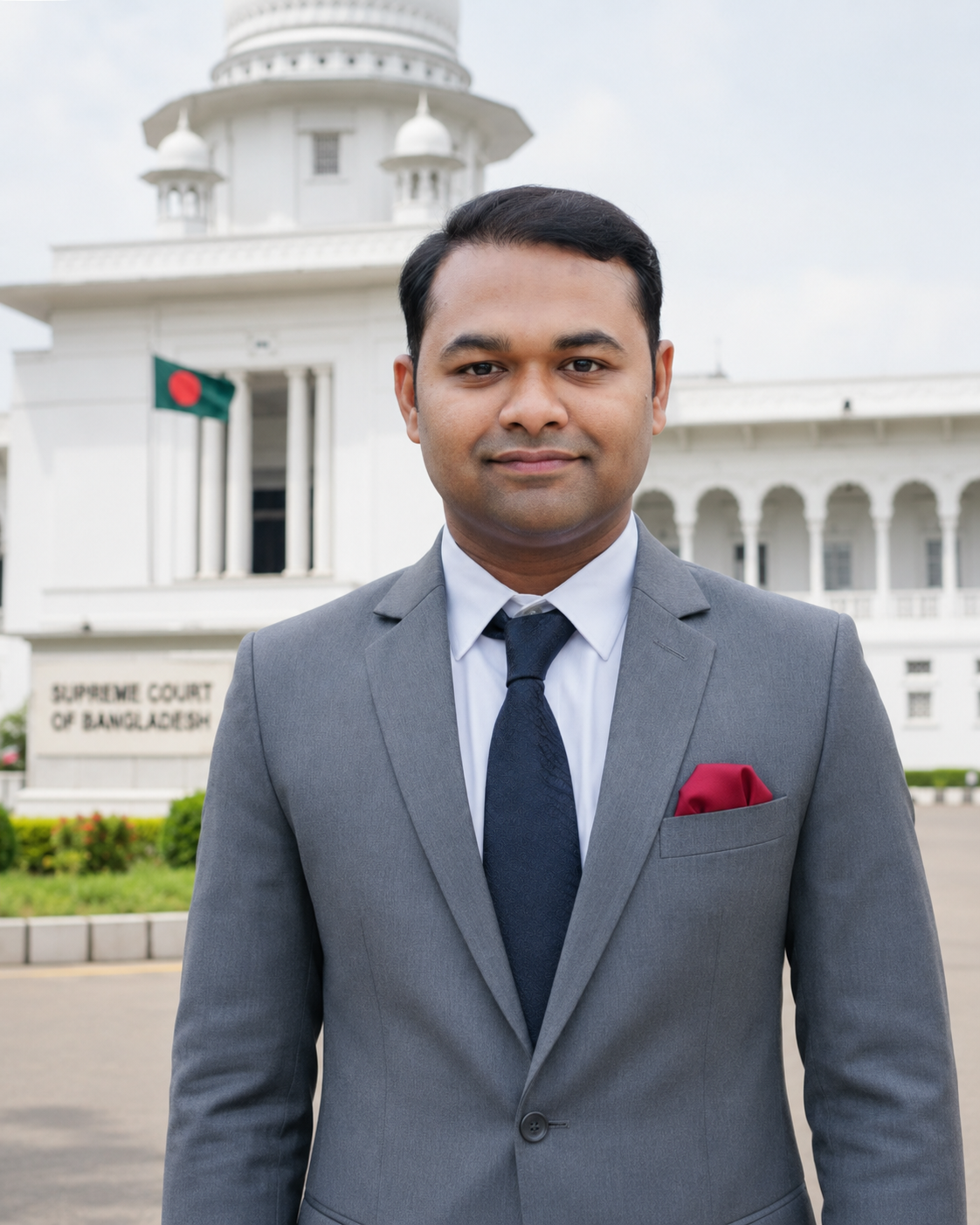
Sawdip Roy Sajib
Advocate, Supreme Court of Bangladesh
Member, Dhaka Bar Association and Dhaka Taxes Bar Association
Legal Disclaimer: This article provides general legal information based on Bangladesh law and materials reviewed to 24 September 2026. Muslim-marriage validity and consequences are fact-specific and may depend on the parties’ school of law, personal status, documents and current administrative practice.