
Key points at a glance
/hindu-inheritance-law-bangladesh-dayabhaga-succession
Hindu succession in Bangladesh cannot safely be determined by using the modern Indian Hindu Succession Act, 1956.
For Bangladeshi Hindus, the principal traditional system of intestate inheritance is the Dayabhaga School of Hindu Law, developed in Bengal and repeatedly recognised by the Supreme Court of Bangladesh.
The Appellate Division has expressly referred to:
when analysing Hindu inheritance and Stridhan.
However, modern Hindu succession in Bangladesh is not governed by classical Dayabhaga alone. The applicable legal framework combines:
- Dayabhaga principles;
- the Hindu Women’s Rights to Property Act, 1937;
- other surviving statutory enactments;
- testamentary and procedural provisions where relevant; and
- authoritative decisions of the Bangladesh Supreme Court.
Accordingly, the first question in any Hindu inheritance dispute should not simply be:
“Who are the relatives?”
It should be:
That distinction often determines the entire succession result.
Hindu Succession Case Flow
A defensible opinion starts with the succession-opening facts—not with a generic heir chart.
- 1
Identify the deceased and date of death
- 2
Check for a valid Will
- 3
Classify every property and its source
- 4
Fix the family tree at each succession opening
- 5
Apply the 1937 Act before the Dayabhaga ranking
- 6
Reconcile deeds, records, prior transfers and judgments
The key answer, decision flow and essential cautions are visible. Open one larger topic only when you need its connected legal detail.
Legal Framework and Dayabhaga Heir Order
1. Dayabhaga and Mitakshara: Which System Applies in Bangladesh?
Historically, Hindu inheritance law developed primarily through two major schools:
Mitakshara and Dayabhaga.
The traditional material supplied for this article also identifies these two systems and correctly places Bangladesh within the Dayabhaga tradition.
Dayabhaga is particularly associated with Bengal and differs from Mitakshara in important respects relating to ownership, succession and religious efficacy.
The Bangladesh Supreme Court continues to treat Dayabhaga as the governing school for ordinary Hindu succession in Bangladesh.
Why this matters
A large amount of online information on “Hindu inheritance law” is based on Indian statutes.
That can be dangerously misleading for a Bangladeshi estate.
India extensively codified Hindu succession through the Hindu Succession Act, 1956, whereas Bangladesh did not adopt that legislation.
Therefore, an Indian “Class I heir” chart should not be used to calculate a Bangladeshi Hindu inheritance.
3. The Traditional Dayabhaga Principle: Religious Efficacy
Dayabhaga succession historically developed around the concept of religious efficacy.
The Appellate Division has explained religious efficacy as the capacity to confer special spiritual benefit upon the deceased.
Traditionally, this influenced the order in which relatives were preferred as heirs.
The supplied reference material accordingly divides traditional heirs into three broad groups:
Sapinda → Sakulya → Samanodaka.
However, modern courts do not treat inheritance as dependent merely on who actually performs funeral ceremonies.
In Bimal Mistri and others v Anil Mistri, 20 SCOB [2025] HCD, the High Court Division held that a higher-ranked heir did not lose inheritance simply because he had not performed the deceased’s funeral rites. The Court emphasised that inheritance does not remain in abeyance: on death, the nearest lawful heir becomes entitled immediately.
This is a valuable modern clarification of the classical religious-efficacy principle.
4. Sapinda, Sakulya and Samanodaka
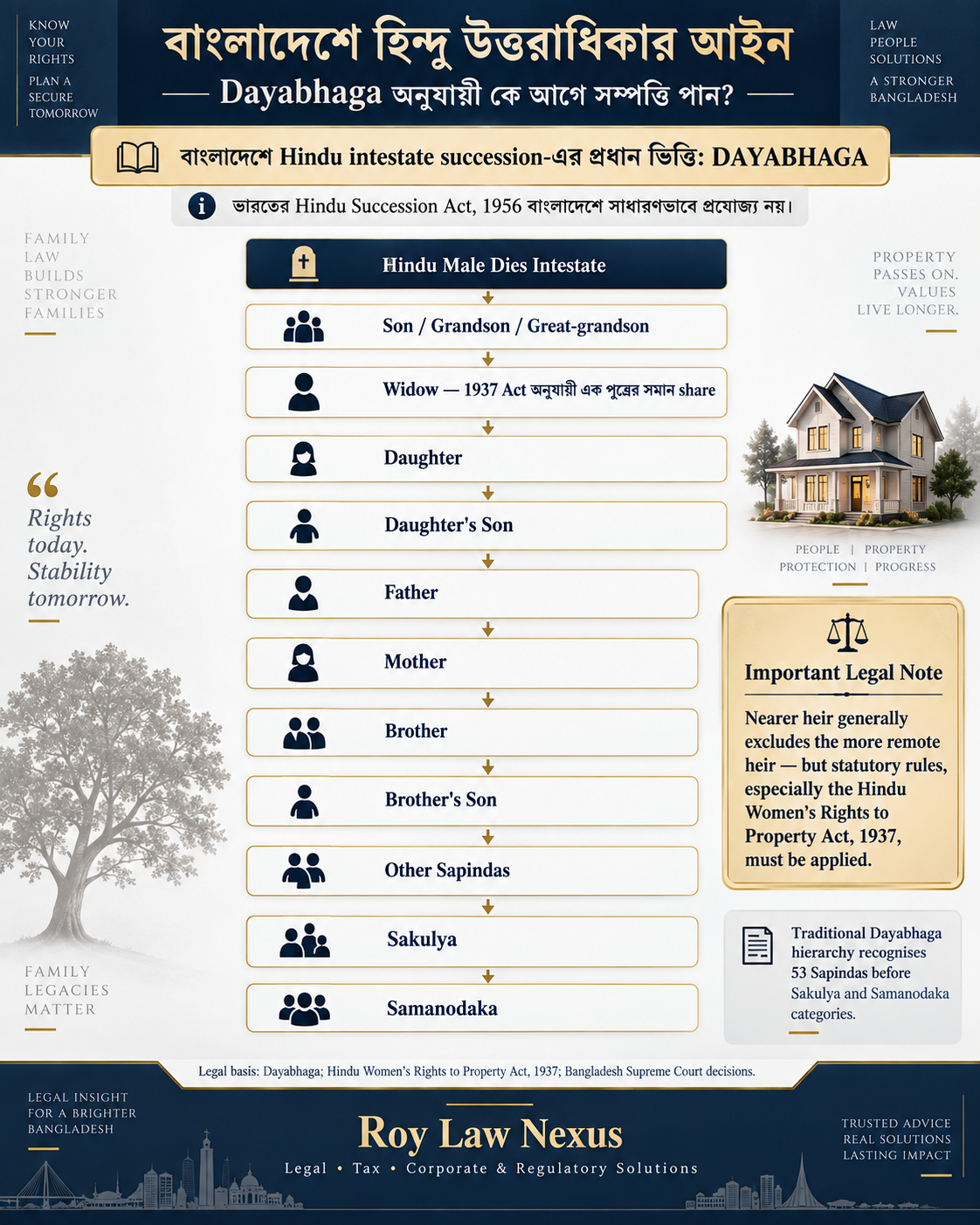
Traditional Dayabhaga literature identifies a hierarchy of relatives.
The materials supplied for this article describe:
- 53 Sapindas;
- followed by Sakulyas;
- followed by Samanodakas.
For public understanding, it is usually unnecessary to reproduce all 53 Sapindas in the main article.
Bangladesh High Court jurisprudence has referred to the traditional order beginning substantially as follows:
- Son
- Son’s son
- Son’s son’s son
- Widow
- Daughter
- Daughter’s son
- Father
- Mother
- Brother
- Brother’s son
- Brother’s son’s son
- Sister’s son
- Paternal grandfather
- Paternal grandmother
- Paternal uncle
- Paternal uncle’s son
- Paternal uncle’s grandson
- Father’s sister’s son
- Paternal great-grandfather
- Paternal great-grandmother
and thereafter more remote relatives.
A crucial caution
This traditional order must not be applied mechanically.
The Hindu Women’s Rights to Property Act, 1937 significantly altered the position of widows and certain widows in predeceased branches.
That statutory modification must be superimposed on the classical hierarchy.
Widow’s Statutory Share and Limited Estate
5. The Most Important Statutory Reform: Hindu Women’s Rights to Property Act, 1937
The Hindu Women’s Rights to Property Act, 1937 remains one of the most important statutes governing Hindu succession in Bangladesh.
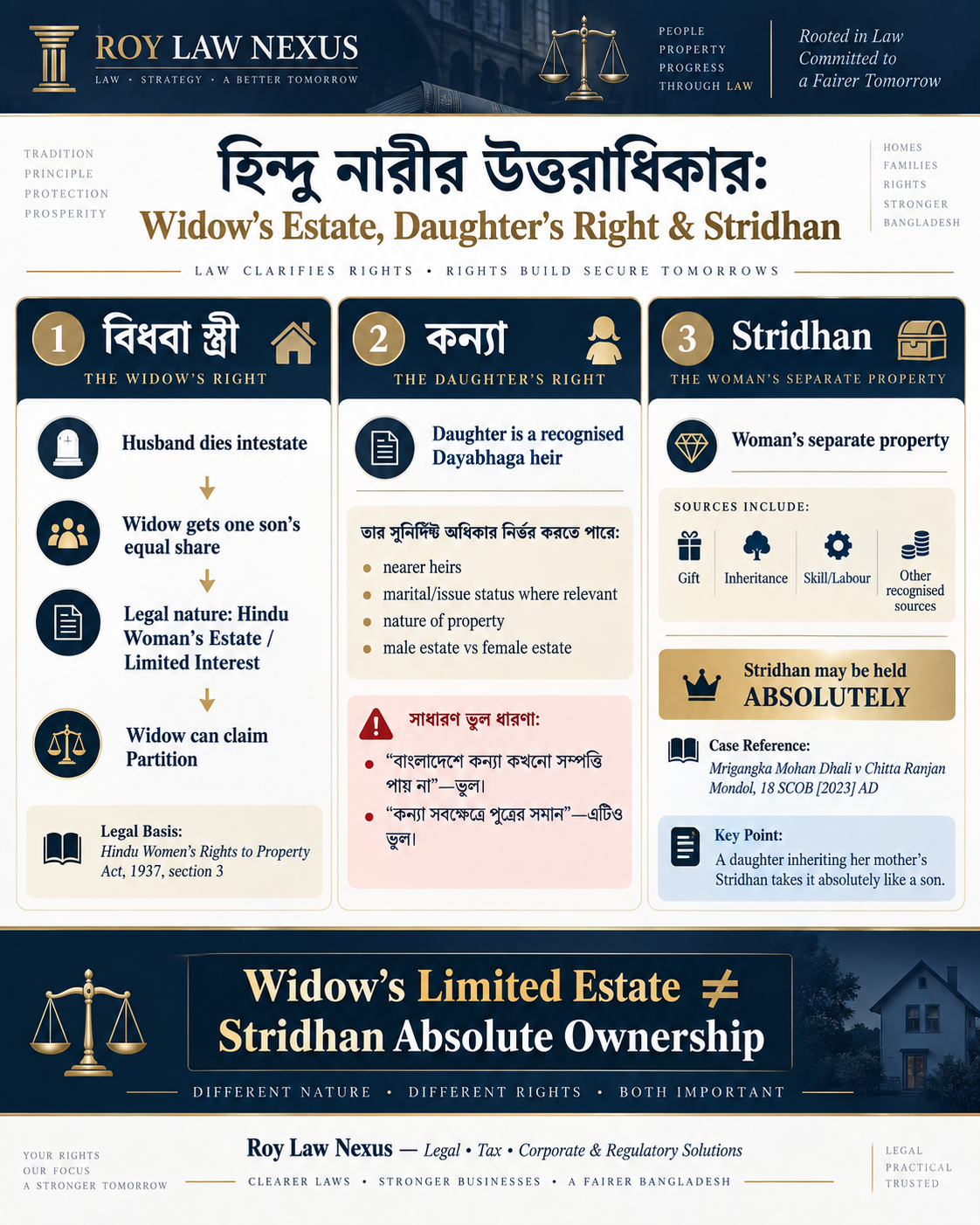
Section 3(1) states that where a Hindu governed by Dayabhaga dies intestate leaving property, his widow—or all widows collectively if there is more than one—is entitled to:
subject to subsection (3).
This materially changed the classical succession position of Hindu widows.
6. Example: Husband Dies Leaving a Widow and Two Sons
Suppose H dies intestate leaving:
- widow W;
- son A;
- son B.
For the purpose of section 3(1), the estate is divided conceptually into three equal shares:
| Heir | Share |
|---|---|
| Widow W | 1/3 |
| Son A | 1/3 |
| Son B | 1/3 |
However, equality of share size does not necessarily mean equality of estate character.
The sons’ interests and the widow’s statutory interest are legally different.
7. What Kind of Interest Does the Widow Receive?
Section 3(3) expressly provides that an interest devolving upon a Hindu widow under section 3 is:
while giving her the same right to claim partition as a male owner.
Therefore, a widow:
- becomes a co-sharer;
- may claim partition;
- may possess and enjoy her share;
- may exercise the legal powers available to a limited owner;
but she should not automatically be treated as holding the same unrestricted absolute estate as a son.
The High Court Division in Probir Kumar Dey @ Saiful v Shipra Rani Dey, 17 SCOB [2023] HCD 154 confirmed the widow’s statutory share and her right to seek partition.
8. Is “Life Interest” an Accurate Description?
The expression “life interest” is useful for general public explanation, but it can be too narrow if used as a complete legal definition.
The statutory term is:
Hindu Woman’s Estate / limited interest.
The widow is not merely a licensee permitted to live on the property.
She has an inheritable share during her lifetime, can claim partition, and may exercise powers recognised by Hindu law in relation to a limited estate.
Therefore, for legal writing:
Hindu Woman’s Estate is preferable to simply saying “she can only live on the property.”
9. Predeceased Son’s Widow: An Important Statutory Right
The 1937 Act also protects the widow of a predeceased son.
Section 3(1) provides that:
- if no son of that predeceased son survives, his widow may inherit in like manner as a son;
- if a son or son’s son of the predeceased son survives, the widow inherits in the manner prescribed for that branch.
The Act further extends the rule, mutatis mutandis, to the widow of a predeceased son of a predeceased son.
This is why a modern Hindu succession calculation should never rely solely on a simplified “nearest male heir” formula.
Daughters, Stridhan and Women’s Property
11. Daughters Have Inheritance Rights in Bangladesh
Two popular statements are both legally unsafe:
and
Neither accurately reflects Bangladeshi Dayabhaga law.
A daughter is a recognised Dayabhaga heir.
The traditional order places daughter after the relevant earlier heirs and before daughter’s son, father, mother and more remote relatives.
But her precise right depends on:
- the existence of nearer heirs;
- the nature and source of the property;
- whether the property belonged to a man or woman;
- whether it was Stridhan;
- and, in some classical contexts, her marital or issue status.
This is one of the areas where generic internet charts create the most confusion.
12. The Unmarried Daughter and the Probir Kumar Dey Case
In Probir Kumar Dey @ Saiful v Shipra Rani Dey & others, the High Court Division considered the inheritance position of an unmarried Hindu daughter after the surviving son had converted to Islam.
The Court’s facts require careful reading. The son retained the share that had already vested when his father died while he was Hindu. But when the widow’s limited estate later ended, the Court held that his prior conversion affected eligibility in that later succession opening; the unmarried daughter Shipra Rani Dey succeeded to that property. The judgment should therefore not be reduced to a universal rule that conversion retrospectively removes property already vested.
The judgment is important for at least three reasons:
- it reinforces the continuing operation of Dayabhaga;
- it confirms the widow’s rights under the 1937 Act; and
- it demonstrates that a daughter may become the operative heir in the relevant succession order.
13. Daughter’s Son
The daughter’s son occupies an important position in Dayabhaga succession.
Traditional ordering places:
Daughter → Daughter’s son → Father
in that sequence.
This reflects the historical religious-efficacy foundation of Dayabhaga.
However, the daughter’s son does not automatically displace a living daughter who ranks ahead of him.
14. Father, Mother, Brother and More Remote Heirs
If the earlier lines fail, succession may proceed through increasingly remote Sapinda relations.
The commonly recognised sequence includes:
Father → Mother → Brother → Brother’s son → Brother’s grandson → Sister’s son → paternal ancestors and collateral relatives.
The High Court has also recognised the traditional preference of a full brother over a half-brother where applicable.
Once the Sapinda line is exhausted, classical law moves to Sakulya, and thereafter Samanodaka relations. The supplied reference material reflects this structure.
15. Hindu Women’s Property Is Not One Single Category
This is perhaps the most important academic distinction in Hindu women’s succession.
It is incorrect to say:
One must distinguish at least between:
Hindu Woman’s Estate
A statutory or traditional limited interest, such as the widow’s interest under section 3 of the 1937 Act.
Stridhan
A woman’s separate property, which may be held absolutely.
Confusing these two categories can completely change the legal conclusion.
16. What Is Stridhan?
Stridhan refers broadly to property recognised as belonging separately to a Hindu woman.
Depending on the applicable Hindu-law principles, it may arise from sources such as:
- gifts;
- inheritance;
- property acquired through skill or labour;
- and other recognised sources.
Its most important feature is that, where property has the legal character of Stridhan, a woman may hold an absolute proprietary interest.
This is fundamentally different from a widow’s limited estate inherited from her husband.
18. Male Estate and Stridhan Must Be Kept Separate
The distinction can be summarised as follows:
| Issue | Woman inheriting a male estate | Stridhan |
|---|---|---|
| Typical source | Husband or other male owner | Woman’s separate property |
| Nature of interest | May be limited | May be absolute |
| 1937 Act widow | Hindu Woman’s Estate | Not merely by reason of widowhood |
| Partition | Widow may claim partition | Absolute owner may have wider proprietary powers |
| Death of woman | Reversionary rules may become relevant | Woman’s Stridhan succession applies |
| Key authority | Probir Kumar Dey | Mrigangka Mohan Dhali |
This is one of the most valuable distinctions for both practitioners and courts.
19. What Happens When a Widow Holding a Limited Estate Dies?
Where a widow received property from her husband as a Hindu Woman’s Estate, her death does not necessarily cause the property to pass to her own personal heirs as though she had been absolute owner.
Traditional Hindu law may require the estate to open in favour of the next heir of the last full owner.
This is often referred to in terms of reversionary succession.
The Appellate Division in Mrigangka Mohan Dhali contrasted property inherited from a husband with the woman’s own Stridhan, illustrating why identifying the original source of the property is essential.
20. What Happens to Stridhan on the Woman’s Death?
Stridhan must be analysed under the succession rules applicable to the woman’s separate property.
The Appellate Division rejected a rigid proposition that a daughter’s daughter could never succeed to Stridhan.
The Court noted that Hindu-law authorities contemplated second-generation Stridhan heirs, including a daughter’s daughter, and held that there was no absolute bar to such succession.
This is a significant modern development in Bangladeshi Hindu succession jurisprudence.
Special Situations: Will, Conversion, Adoption and Remarriage
21. The 1929 Hindu Law of Inheritance Amendment: A Common Source of Error
The Hindu Law of Inheritance (Amendment) Act, 1929 still appears in the Bangladesh Code.
But it has a critical limitation.
Section 1(2) says that it applies only to persons who, but for the Act, would have been subject to Mitakshara law in relation to the matter dealt with by the Act.
Its section 2 changes the ranking of certain heirs such as:
- son’s daughter;
- daughter’s daughter;
- sister; and
- sister’s son.
But because ordinary Hindu succession in Bangladesh is governed by Dayabhaga, the 1929 Act should not be treated as a universal amendment of Bangladeshi Hindu succession.
The Appellate Division addressed precisely this issue in Mrigangka Mohan Dhali, correcting reliance on the 1929 Act in a Dayabhaga case.
22. Does a Valid Will Change the Succession Analysis?
Yes.
Dayabhaga intestate rules apply where the deceased has not effectively disposed of the relevant property through a valid testamentary instrument.
Section 5 of the Hindu Women’s Rights to Property Act, 1937 defines “die intestate” by reference to property not effectively disposed of by testamentary disposition.
Therefore, before calculating Hindu inheritance, one of the first questions must always be:
23. Conversion of Religion and Succession
Religious conversion can affect Hindu succession in Bangladesh.
In Probir Kumar Dey @ Saiful v Shipra Rani Dey, the son’s conversion occurred after he had already inherited a share from his father. The High Court Division did not retrospectively divest that vested share. It held, however, that the conversion affected his eligibility when succession later reopened on the widow’s death in relation to her limited estate. Conversion questions must therefore be tied to the precise date on which the relevant succession opened.
This is an area in which case-specific facts matter considerably.
It would therefore be unsafe to make a universal statement that conversion never affects inheritance.
24. Does Failure to Perform Funeral Rites Cause Disqualification?
No—not by itself.
In Bimal Mistri and others v Anil Mistri, 20 SCOB [2025] HCD, the High Court Division rejected the argument that a higher-ranked brother lost his inheritance merely because he had not performed funeral ceremonies.
The Court observed that:
and the nearest heir becomes entitled immediately on death.
This is particularly important academically because it distinguishes the historical religious basis of Dayabhaga from modern rules of vesting and disqualification.
25. Physical Disability and Old Classical Disqualifications
Traditional Hindu-law writings discuss various disqualifications based on disability, disease, renunciation and other personal circumstances.
Older explanatory materials often list such conditions categorically.
That approach is unsafe for a modern law-firm publication.
Bangladesh still lists the Hindu Inheritance (Removal of Disabilities) Act, 1928 in its Code.
However, the interaction between that legislation, Dayabhaga doctrine and particular historical disqualifications is specialised.
Accordingly:
This is more accurate than reproducing old textbook lists as contemporary absolute rules.
26. Adoption and the Adopted Son
Adoption is historically important in Hindu law and may significantly affect succession.
However, it is unsafe to state as a universal modern rule that an adopted son will simply receive “one-third of a natural son’s share”.
Questions of adoption require examination of:
- whether a legally valid adoption occurred;
- the applicable Dayabhaga principles;
- existence of natural sons;
- timing and nature of the adoption;
- source of the property; and
- the particular succession opening.
For a general public article, the safer proposition is:
A separate article on Hindu adoption and succession would be more appropriate for detailed treatment.
27. Widow’s Remarriage
Hindu widow remarriage historically affects certain rights derived from the deceased husband.
The Bangladesh Code continues to list the Hindu Widow’s Re-marriage Act, 1856 (opens in a new tab) as part of the legal framework.
The legal effect must nevertheless be distinguished according to the source of the property.
A widow’s limited interest derived from her deceased husband should not be confused with property that she owns absolutely in her own right.
The practical question is therefore not simply:
“Has she remarried?”
but:
“What type of property right did she hold before remarriage?”
28. Agricultural Land
The Bangladesh Code also continues to list the Hindu Women’s Rights to Property (Extension to Agricultural Land) Act, 1943.
Accordingly, the nature of the asset—particularly where agricultural land is involved—should be identified before giving a final succession opinion.
Land tenure legislation may also affect the practical incidents of ownership.
30. Mutation Does Not Create Inheritance Title
Mutation is important for revenue administration, but it does not itself create inheritance.
Succession arises because of:
death + applicable law + relationship + nature of property.
A Hindu succession dispute should therefore examine:
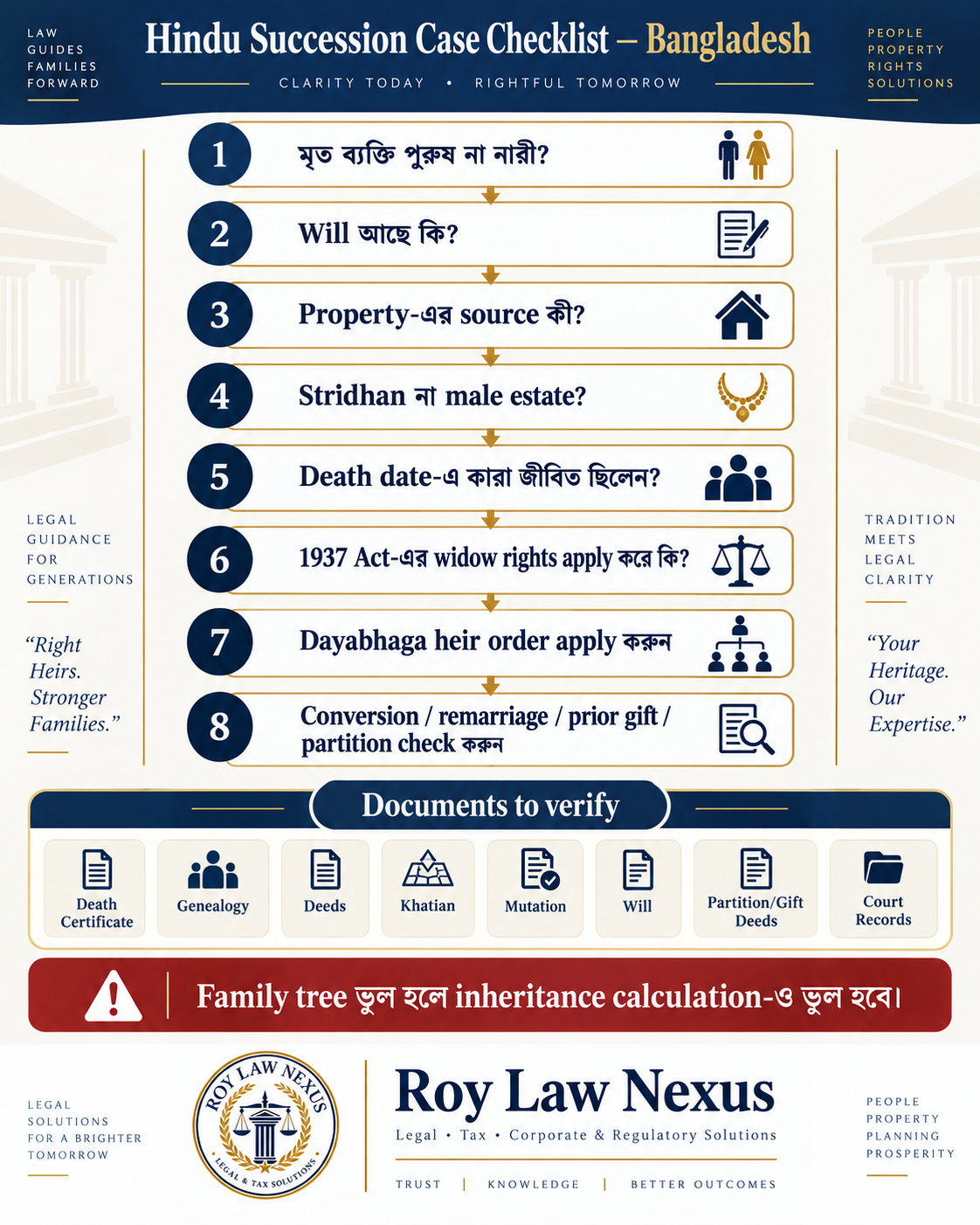
- title deeds;
- khatians;
- mutation records;
- death certificates;
- genealogical evidence;
- Will, if any;
- prior gift deeds;
- partition deeds;
- court decrees;
- possession; and
- the source of the property.
A mutation entry is evidence, not the sole source of title.
Case Analysis and Practical Examples
31. The Correct Way to Analyse a Hindu Inheritance Case
A structured legal analysis should normally proceed as follows:
Step 1 — Identify the deceased
Was the deceased:
- male; or
- female?
The answer affects the relevant succession system.
Step 2 — Determine whether a Will exists
If there is a valid testamentary disposition, intestate succession may not govern that property.
Step 3 — Identify the source of each property
Ask:
- inherited from whom?
- purchased by whom?
- gifted by whom?
- part of Stridhan?
- inherited by a widow as limited estate?
Step 4 — Determine who was alive on the date of death
The family tree must be reconstructed as at the succession opening.
Step 5 — Apply statutory widow rights
The 1937 Act must be applied before relying on a purely classical heir list.
Step 6 — Apply the Dayabhaga hierarchy
Identify the nearest eligible heir.
Step 7 — Check special issues
Including:
- conversion;
- remarriage;
- adoption;
- predeceased branches;
- disability claims;
- prior gift;
- prior partition;
- previous sale; or
- litigation.
Step 8 — Reconcile the legal title documents
The family tree and property record must tell the same legal story.
32. Three Practical Examples
Example A: Widow and Two Sons
A Hindu man dies intestate leaving:
- wife;
- two sons.
Under section 3 of the 1937 Act:
Widow = 1/3
Son 1 = 1/3
Son 2 = 1/3
But the widow’s share is a Hindu Woman’s Estate, not automatically the same absolute estate as her sons.
Example B: Widow, No Son
A Hindu man dies intestate leaving his widow but no surviving son.
The widow’s statutory entitlement must be determined under the 1937 Act, and her interest retains the character of a Hindu Woman’s Estate.
On her later death, the next succession inquiry may involve the heirs of the last full owner rather than treating the property as her absolute estate.
Example C: Mother’s Stridhan
A Hindu woman owns property as Stridhan and dies leaving a daughter.
The daughter’s position is materially different from that of a widow inheriting her husband’s estate.
Under Mrigangka Mohan Dhali, a daughter inheriting her mother’s Stridhan takes it absolutely like a son.
33. Common Myths About Hindu Inheritance in Bangladesh
| Common claim | Legal position |
|---|---|
| “India’s Hindu Succession Act applies in Bangladesh.” | Incorrect. |
| “A Hindu daughter never inherits.” | Incorrect. |
| “A daughter always receives the same share as a son.” | Incorrect as a general Bangladesh rule. |
| “Every Hindu woman only has life interest.” | Incorrect—Stridhan may be absolute property. |
| “A widow gets no share if sons exist.” | Incorrect under the 1937 Act. |
| “Multiple widows each get one son’s share.” | Incorrect—they collectively receive one son’s share. |
| “Whoever performs the funeral inherits.” | Incorrect as a modern legal rule. |
| “Mutation proves inheritance title conclusively.” | Incorrect. |
| “Every predeceased heir is represented automatically by children.” | Incorrect as a universal rule. |
Current Supreme Court Guidance and Primary Legal Sources
34. Why Recent Supreme Court Jurisprudence Matters
Hindu inheritance law in Bangladesh is not frozen in nineteenth-century commentary.
The Supreme Court continues to interpret the relationship between:
- classical Dayabhaga texts;
- statutory intervention;
- colonial precedents;
- modern property concepts; and
- Bangladesh law.
Two decisions are especially valuable.
Mrigangka Mohan Dhali v Chitta Ranjan Mondol (opens in a new tab)
18 SCOB [2023] AD 20
The Appellate Division examined Stridhan, female heirs and the scope of the 1929 Act, and recognised that Stridhan may devolve as absolute ownership.
Probir Kumar Dey @ Saiful v Shipra Rani Dey
17 SCOB [2023] HCD 154
The High Court Division analysed widow’s statutory rights, partition, religious conversion and an unmarried daughter’s succession position.
A more recent High Court decision on funeral rites further confirmed that non-performance of funeral ceremonies does not itself disqualify the nearest heir.
These authorities significantly improve the academic reliability of a modern explanation of Bangladeshi Hindu succession.
35. Key Legal Sources
Dayabhaga of Jimutavahana
The principal traditional school governing Hindu succession in Bengal and Bangladesh.
Hindu Women’s Rights to Property Act, 1937 (opens in a new tab)
The central statutory modification concerning widows, including:
- widow’s share equal to one son;
- predeceased son’s widow;
- Hindu Woman’s Estate;
- right to partition.
Hindu Women’s Rights to Property (Extension to Agricultural Land) Act, 1943 (opens in a new tab)
Relevant to the statutory extension of Hindu women’s property rights to agricultural land and still listed in the Bangladesh Code.
Hindu Law of Inheritance (Amendment) Act, 1929 (opens in a new tab)
Still part of the Bangladesh Code but expressly limited to persons subject to Mitakshara in relation to its provisions.
Hindu Widow’s Re-marriage Act, 1856 (opens in a new tab)
Relevant to the consequences of remarriage for certain rights derived from a deceased husband.
Succession Act, 1925 — section 29 (opens in a new tab)
Its general intestate succession provisions do not apply to Hindu property under section 29(1), although probate and administration provisions may remain relevant.
36. How Roy Law Nexus Can Assist With Hindu Succession Matters
Hindu inheritance disputes are particularly vulnerable to error because a seemingly small factual difference can completely change the succession result.
For example:
- a property may be Stridhan rather than a male estate;
- a widow may hold a limited interest rather than absolute ownership;
- an heir may have died before the succession opened;
- a conversion may affect succession;
- a prior gift or partition may have removed property from the estate;
- or the recorded family tree may be incomplete.
Roy Law Nexus can assist with:
- Hindu inheritance legal opinions;
- Dayabhaga heir identification;
- genealogical and family-tree analysis;
- widow’s inheritance and partition rights;
- daughter and granddaughter succession;
- Stridhan;
- Hindu Woman’s Estate;
- predeceased branch analysis;
- conversion-related inheritance disputes;
- remarriage implications;
- Hindu adoption-related succession;
- partition suits;
- title and deed review;
- mutation and land-record issues;
- Will and probate matters;
- letters of administration;
- succession-related declaratory suits;
- inherited-property sale review;
- appellate litigation; and
- property due diligence.
For any contested estate, the safest approach is:
Discuss a Hindu Succession Matter →Frequently Asked Questions
Which Hindu inheritance system applies in Bangladesh?
The principal traditional system is the Dayabhaga School, subject to applicable statutes and Bangladesh Supreme Court precedent.
Does the Indian Hindu Succession Act, 1956 apply in Bangladesh?
No. It is Indian legislation and should not be used as the general inheritance law for Bangladeshi Hindus.
Does a widow inherit when there are sons?
Yes. Under section 3 of the Hindu Women’s Rights to Property Act, 1937, she receives the same share as one son.
Is the widow an absolute owner?
Her statutory interest under section 3 is the limited interest known as a Hindu Woman’s Estate, although she may claim partition like a male owner.
If there are several widows, does each receive one son’s share?
No. All widows together receive one son’s share.
Can a daughter inherit Hindu property in Bangladesh?
Yes. A daughter is a recognised Dayabhaga heir. Her exact position depends on the nearer heirs and nature of the property.
Does a daughter always inherit equally with a son?
No. Bangladesh has not adopted the Indian Hindu Succession Act, 1956 model of general equal son-daughter succession.
What is Stridhan?
Stridhan is a recognised category of a Hindu woman’s separate property and may constitute absolute ownership.
Can a daughter inherit her mother’s Stridhan absolutely?
Yes. The Appellate Division in Mrigangka Mohan Dhali held that a daughter inheriting her mother’s Stridhan takes it absolutely like a son.
Is every property held by a Hindu woman merely a life estate?
No. This is one of the most important misconceptions. A widow’s limited estate and Stridhan are legally different.
Does religious conversion affect succession?
It can, but the succession-opening date matters. In Probir Kumar Dey @ Saiful v Shipra Rani Dey, conversion did not retrospectively remove the son’s share already vested on his father’s death; it affected his eligibility when a separate succession later opened after the widow’s limited estate ended.
Does failure to perform funeral rites disqualify an heir?
Not by itself. A recent High Court decision held that the nearer heir did not lose succession merely for failing to perform funeral ceremonies.
Does mutation create inheritance rights?
No. Mutation is a revenue record; inheritance title arises under the applicable law upon death.
Conclusion: Hindu Succession in Bangladesh Requires More Than an Heir List
Bangladesh Hindu succession law cannot safely be reduced to a single chart.
The correct legal analysis requires the interaction of:
Dayabhaga + statutory reform + property character + family tree + judicial precedent.
The most important practical distinctions are:
Male estate ≠ Stridhan
Widow’s limited estate ≠ absolute ownership
Daughter’s rights in Bangladesh ≠ India’s Hindu Succession Act model
Traditional religious efficacy ≠ automatic modern disqualification
Mutation ≠ title
and
Intestate succession ≠ testamentary succession.
The recent Appellate Division decision in Mrigangka Mohan Dhali is especially important because it demonstrates that Hindu women’s property cannot be treated under a single “limited ownership” formula. Where the property is Stridhan, an entirely different succession analysis may apply.
Likewise, Probir Kumar Dey and the recent funeral-rites decision show that Bangladesh courts continue to refine the application of Dayabhaga to modern disputes.
For property owners, heirs and lawyers, perhaps the most useful rule is therefore:
That is the difference between a generic inheritance chart and a legally defensible succession opinion.
Disclaimer: This article is intended for general legal awareness and academic discussion based on Bangladesh law reviewed in September 2026. Hindu succession is highly fact-specific. The precise heirs and shares in an individual estate should be determined only after examining the complete genealogy, sequence of deaths, property source, title documents, testamentary dispositions and applicable authorities.
About the Author
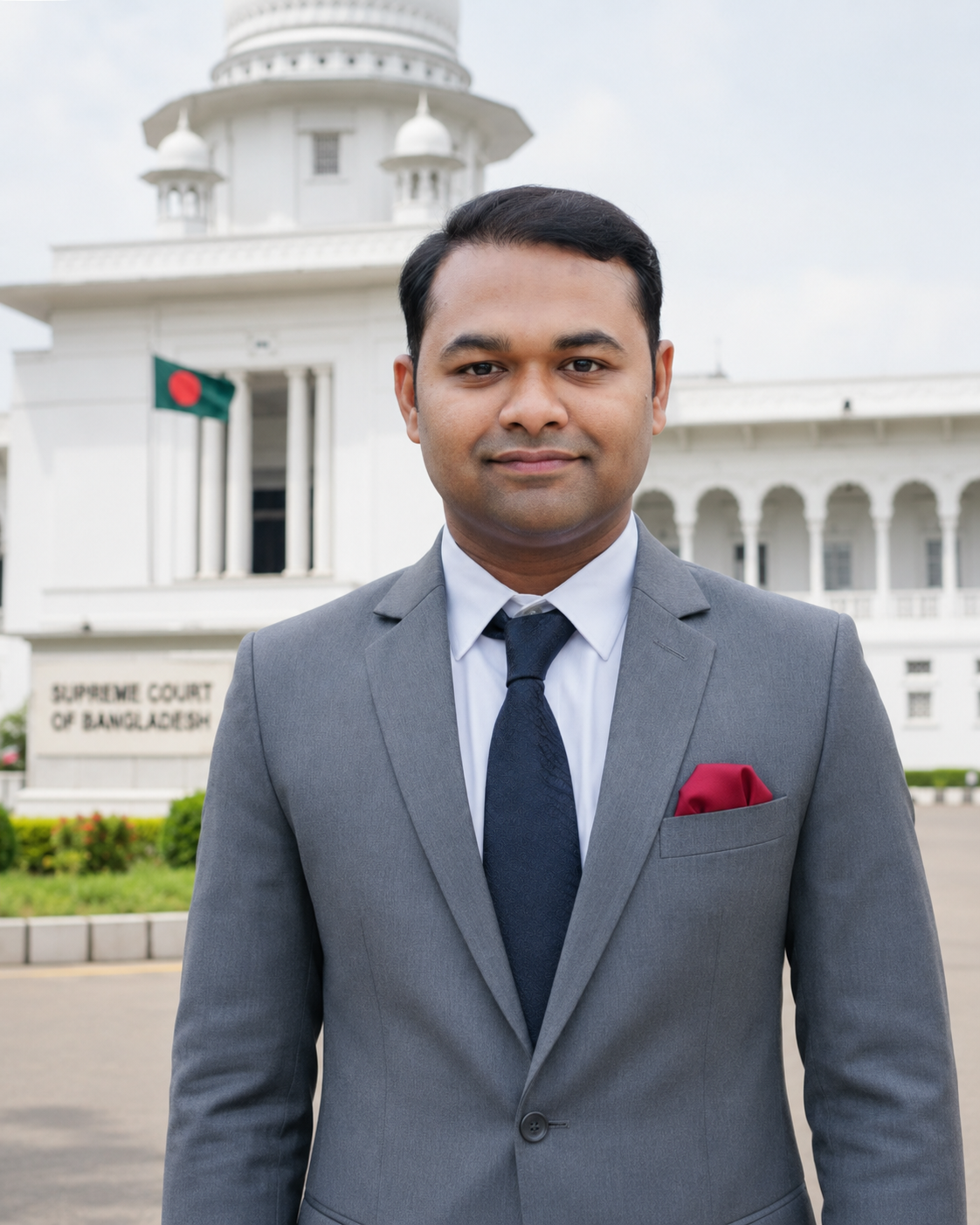
Sawdip Roy Sajib
Advocate, Supreme Court of Bangladesh
Member, Dhaka Bar Association and Dhaka Taxes Bar Association
Legal Disclaimer: This article provides general legal information based on Bangladesh law and authorities reviewed to 8 September 2026. Hindu succession is highly fact-specific. A share calculation requires the complete genealogy, sequence of deaths, property source, title documents, Will (if any), prior transfers and applicable decisions.