

Key points
An Import Registration Certificate (IRC) is the principal registration required for businesses intending to import goods into Bangladesh as registered importers.
IRC registration is administered by the Office of the Chief Controller of Imports and Exports (CCI&E) under the Ministry of Commerce. Under the Importers, Exporters and Indentors (Registration) Order, 2023, an importer generally cannot import goods unless registered with CCI&E or otherwise exempted under the applicable legal framework. Bangladesh Bank's current import regulations repeat this requirement.
For most businesses, obtaining the IRC is only the first step. The actual import transaction may also require compliance with the applicable Import Policy Order, Bangladesh Bank foreign-exchange rules, Customs requirements, correct HS Code classification, VAT/BIN requirements and any product-specific licences, permits or certificates.
Select a topic to read the detailed guidance
What Is an Import Registration Certificate (IRC)?
An Import Registration Certificate is an official registration issued through CCI&E that establishes a person or business entity as a registered importer for Bangladesh's import-control framework.
The current direct legal basis is the Importers, Exporters and Indentors (Registration) Order, 2023 (S.R.O. No. 326-Law/2023), issued under section 3(1) of the Imports and Exports (Control) Act, 1950. The 2023 Order repealed the previous Importers, Exporters and Indentors (Registration) Order, 1981, while preserving prior registrations and actions to the extent recognised by the new Order.
This is an important update because many older online guides still refer to the 1981 Order.
Is IRC Mandatory for Importing into Bangladesh?
For an ordinary registered commercial or industrial importer, yes.
Paragraph 3 of the 2023 Registration Order establishes the registration requirement. Bangladesh Bank's current import rules also require banks to verify the importer-registration position or an applicable exemption before initiating an import transaction.
The words “or exempted” are important. It would therefore be inaccurate to say that an IRC is required for every conceivable import without exception. Government imports, bona fide-user arrangements, certain samples, gifts or other specially permitted transactions may fall under different rules or permit mechanisms depending on the goods and circumstances.
For a normal business intending to import goods commercially on a continuing basis, however, IRC registration should be treated as a fundamental regulatory requirement.
Why IRC Matters Before You Place an Import Order
An IRC is connected with several stages of the import process.
A registered importer may need its IRC information when dealing with:
- an Authorized Dealer (AD) bank for import transactions;
- Letters of Credit (LCs) or other permissible payment arrangements;
- Bangladesh Bank's import-monitoring system;
- Customs clearance;
- import permits or regulatory approvals;
- supplier and banking documentation; and
- verification of the business's authorised import status.
Bangladesh Customs currently lists the IRC and VAT Registration/BIN among the general documents relevant to import clearance. Its guidance also identifies documents such as the LC or purchase order, Proforma Invoice, insurance cover note, Commercial Invoice, Packing List, transport document and Country of Origin Certificate, depending on the transaction.
Bangladesh Bank's current import rules also require correct classification of imported goods. The correct HS Code should be stated in the LC, purchase contract or Proforma Invoice, as applicable, and verified before the bank initiates the import transaction.
Commercial IRC or Industrial IRC: Which One Do You Need?
CCI&E currently administers both Commercial IRC and Industrial IRC, while the 2023 framework also contains separate documentation for multinational import registration.
Commercial IRC
A Commercial IRC is generally relevant where a business imports goods for commercial trading, distribution or resale rather than importing production inputs for its own manufacturing activity.
Typical applicants include import houses, wholesalers, distributors and trading businesses.
Industrial IRC
An Industrial IRC is intended for an industrial enterprise importing items connected with its manufacturing or industrial operations, such as approved raw materials and production-related inputs.
Because the industrial registration is linked with the industrial project, additional documents are required, including the sponsoring authority's industrial project registration, factory-related licences and a raw-material list containing HS Codes.
Multinational IRC
The 2023 Order also separately identifies documentation for a Multinational IRC, including requirements relevant to foreign-invested or multinational entities.
Selecting the correct IRC category should be done before filing the application. The nature of the business, intended goods, industrial status, sponsoring authority and proposed import ceiling should be reviewed together.
Documents Required for Commercial IRC in Bangladesh
The 2023 Registration Order provides a specific document list for Commercial IRC applications. The principal documents are:
- Updated Trade Licence, or where applicable:
- Certificate of Incorporation and updated Form XII for a limited company; or
- registered Partnership Deed for a partnership firm.
- e-TIN / income-tax certificate / receipt or acknowledgement relating to tax-return filing, as applicable.
- National ID or passport of the applicant.
- Certificate from the nominated bank.
- Updated membership certificate from a recognised Chamber of Commerce or relevant trade association.
- Challan showing payment of the prescribed fee and applicable VAT.
Is BIN Required for the Initial IRC Application?
This point needs careful distinction.
The specific attachment list for an initial Commercial IRC application under the 2023 Registration Order does not separately list BIN as one of those six attachments. However, Bangladesh Customs lists VAT Registration/BIN among the general documents for import operations, and the statutory renewal form expressly requires the BIN to be provided when applying for the first renewal.
Therefore, businesses should not interpret the absence of BIN from the initial IRC attachment list as meaning that VAT/BIN registration is irrelevant to actual import and customs compliance.
Additional Documents for Industrial IRC
Industrial IRC applications require more extensive documentation. In addition to the relevant entity, tax, identity, banking and chamber documents, the 2023 Order requires items including:
- Trade Licence at the factory address or applicable corporate/partnership documents;
- nominated bank certificate mentioning the factory and office addresses;
- valid Fire Licence for the factory address;
- industrial project registration issued by the relevant sponsoring authority;
- list of raw materials with their HS Codes; and
- prescribed fee and VAT payment challan.
Depending on the industry and goods, further registrations or approvals may also be necessary from authorities such as BIDA, BSCIC, BEZA, BEPZA, BSTI, the Department of Environment, Bangladesh Food Safety Authority, Plant Quarantine Wing or another sector regulator.
The exact requirement depends on the product and business model; an IRC by itself does not replace those approvals.
Step-by-Step IRC Application Process in Bangladesh
Step 1: Determine the Correct Type of IRC
First identify whether the proposed activity requires a Commercial, Industrial or another applicable form of IRC.
At this stage, the applicant should also confirm the proposed annual import ceiling/slab, because the IRC registration fee depends on that ceiling.
Step 2: Check the Business Documents
Before filing, the names, addresses, ownership information and business particulars appearing in the Trade Licence, incorporation documents, TIN, bank certificate and Chamber/Association membership should be checked for consistency.
For Industrial IRC, the factory address and sponsoring-authority documentation deserve particular attention.
Step 3: Create or Use the CCI&E OLM Account
The application is submitted online through the CCI&E Online Licensing Module (OLM).
The 2023 Order expressly requires the registration application, relevant information, supporting documents and prescribed fee to be submitted online.
Step 4: Complete the Application and Upload Documents
The applicant must enter the business information accurately and upload the documents required for the relevant category.
The Registration Authority may examine the documents and request additional information or supporting documents where necessary.
Step 5: Pay the Government Fee and Applicable VAT
The applicable registration fee depends on the annual import ceiling. The payment information and challan should correspond with the application.
Step 6: CCI&E Verification
CCI&E reviews the submitted information and documents. Where the authority is satisfied as to their correctness, registration may be issued online. If the authority is not satisfied, the application may be rejected, with the reasons recorded and communicated to the applicant.
Step 7: Obtain the IRC
The Registration Order allows the certificate to be issued online in Bangla, English or both languages according to the applicant's request.
IRC Government Fees in Bangladesh — Current Gazette Schedule
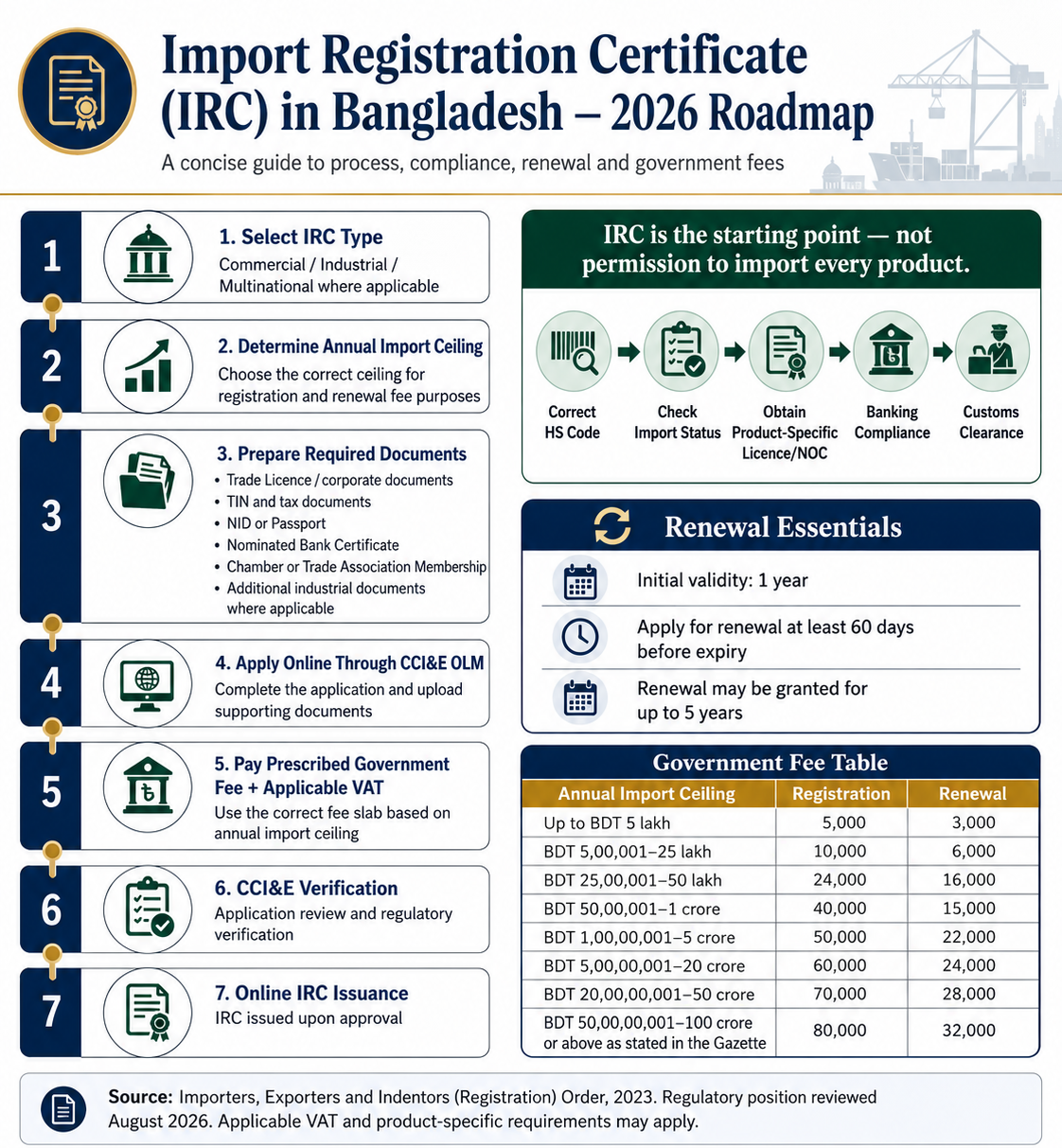
The following registration and one-year renewal fees are stated in the Schedule to the Importers, Exporters and Indentors (Registration) Order, 2023:
| Annual Import Ceiling | Initial Registration Fee | Renewal Fee per Year |
|---|---|---|
| Up to BDT 5,00,000 | BDT 5,000 | BDT 3,000 |
| BDT 5,00,001 – 25,00,000 | BDT 10,000 | BDT 6,000 |
| BDT 25,00,001 – 50,00,000 | BDT 24,000 | BDT 16,000 |
| BDT 50,00,001 – 1,00,00,000 | BDT 40,000 | BDT 15,000 |
| BDT 1,00,00,001 – 5,00,00,000 | BDT 50,000 | BDT 22,000 |
| BDT 5,00,00,001 – 20,00,00,000 | BDT 60,000 | BDT 24,000 |
| BDT 20,00,00,001 – 50,00,00,000 | BDT 70,000 | BDT 28,000 |
| BDT 50,00,00,001 – 100,00,00,000 or above, as worded in the Gazette | BDT 80,000 | BDT 32,000 |
Applicable VAT is payable in addition to the prescribed fee. Applicants should use the current CCI&E/OLM payment instructions and generated challan rather than relying on an old payment code or an unofficial fee calculator.
The figures above come directly from the Schedule to the 2023 Registration Order. Notably, the Gazette specifies BDT 16,000, not BDT 10,000, as the one-year renewal fee for the BDT 25,00,001–50,00,000 slab.
How Long Does IRC Registration Take?
There is no 4–5 working-day statutory guarantee in the 2023 Registration Order.
Actual processing time may depend on:
- completeness and consistency of the documents;
- whether CCI&E requests further information;
- the type of IRC;
- verification of industrial or business particulars; and
- the workload and processing requirements of the competent CCI&E office.
For this reason, businesses should avoid planning shipment, LC opening or contractual deadlines on the assumption that a new IRC will necessarily be issued within a fixed number of days.
How Long Is an IRC Valid?
An initial IRC is valid for one year from the date of issuance and is renewable.
However, an important change under the 2023 framework is that renewal is not necessarily limited to only one year at a time. If the Registration Authority is satisfied with the application and documents, it may renew the registration for a period of up to five years.
IRC Renewal: Do Not Wait Until the Expiry Date
Under paragraph 8 of the 2023 Registration Order, the renewal application should be submitted online at least 60 days before expiry.
If that deadline is missed, renewal is still possible subject to the prescribed late fee.
The renewal documentation includes:
- challan for the renewal fee and applicable VAT;
- acknowledgement/receipt of filing the latest income-tax return; and
- other updated documents where applicable.
For the first renewal application, providing the BIN number is mandatory in Form 3.
Late Renewal Fees for Importers
Under the 2023 Schedule, the additional late fee for Commercial and Industrial importers is:
| Period of Delay | Late Fee |
|---|---|
| 1–3 years | BDT 2,000 |
| 4–5 years | BDT 5,000 |
| 6 years or more | BDT 25,000 |
These are late fees in addition to the applicable renewal fees and other required payments.
Important 2026 Update: Import Policy Order 2026–2029 and Industrial IRC Service Status
The Import Policy Order 2026–2029 is now the current policy order. The official CCI&E policy portal records its publication on 13 May 2026. Older online articles that still describe the 2025–2028 proposal as a draft should not be relied on for a current transaction.
There is also an important operational update. As at 25 August 2026, the live CCI&E OLM notice states that, because of changes under Chapter IV, paragraph 23(a) and (b) of the Import Policy Order 2026–2029, software-development work is continuing and Industrial IRC issuance and renewal services are temporarily suspended until further instruction.
This notice concerns the Industrial IRC service described by OLM and should not automatically be treated as suspension of every Commercial IRC service. An applicant should check the live OLM notice immediately before filing, paying fees, planning an LC or committing to shipment dates.
IRC Does Not Mean Every Product Is Freely Importable
One of the most common misunderstandings is:
“I have an IRC, so I can import any product.”
That is incorrect.
Even after obtaining an IRC, the importer must determine:
- the correct HS Code;
- whether the item is freely importable, restricted, controlled or prohibited;
- whether an Import Permit, Clearance Permit, NOC, licence or certificate is required;
- applicable Customs duties and taxes;
- product-standard, labelling, quarantine, health, environment or safety requirements; and
- the permissible banking and payment method.
The current Import Policy Order regulates prohibited and controlled goods, while Bangladesh Customs maintains legislation and product-level import information. Bangladesh Bank's import rules also require correct HS Code use for bank-initiated import transactions.
This product-level compliance review should ideally take place before placing a purchase order or arranging shipment.
Can a Foreign-Owned Company Obtain an IRC in Bangladesh?
Yes, depending on its legal establishment and compliance status.
The 2023 Registration Order recognises foreign firms but provides that a foreign firm cannot be registered as an importer, exporter or indentor unless it has the required registration or place of business in Bangladesh and complies with the relevant requirements of the Companies Act, 1994, including the provisions applicable to foreign companies.
A Bangladesh-incorporated company with foreign shareholders may therefore obtain the appropriate import registration subject to the applicable CCI&E, corporate, investment, tax and regulatory requirements.
Foreign or multinational applicants may also face additional documentary requirements depending on their structure.
Can an IRC Be Suspended or Cancelled?
Yes.
Under paragraph 10 of the 2023 Registration Order, CCI&E may suspend or cancel registration for specified grounds, including:
- violation of the Imports and Exports (Control) Act or the Registration Order;
- violation of import, export or foreign-exchange laws;
- violations connected with the Money Laundering Prevention Act, 2012;
- under-invoicing or over-invoicing;
- fraudulent procurement of registration;
- false declarations;
- breach of applicable conditions; or
- absence of the business from its declared or registered place.
Importantly, the Order also requires the affected party to be given a reasonable opportunity of hearing before suspension or cancellation under paragraph 10.
A decision may be challenged through the review, appeal and revision mechanism under the Review, Appeal and Revision Order, 1977.
Common IRC Problems That Delay New Importers
A technically complete application can still create problems if the underlying business setup does not match the proposed import activity. Common issues include inconsistent addresses across documents, wrong IRC category, incorrect import ceiling, outdated Chamber membership, unsuitable industrial documentation, incorrect HS Codes, differences in business names, tax-return compliance gaps and assuming that IRC alone is sufficient for a regulated product.
A pre-application legal and regulatory review is often more efficient than trying to correct an incorrect registration or an import transaction after the goods have already been shipped.
How Roy Law Nexus Can Assist With IRC and Import Compliance in Bangladesh
Obtaining an IRC is often only one component of a broader import-compliance process.
Roy Law Nexus can assist businesses, investors and importers with:
- determining the appropriate IRC category and import ceiling;
- reviewing Trade Licence, corporate and partnership documents;
- Commercial and Industrial IRC applications;
- checking the live OLM service status and planning around temporary Industrial IRC restrictions;
- IRC renewal and regularisation;
- reviewing CCI&E objections or additional-document requirements;
- foreign-owned and multinational business compliance;
- HS Code and product-specific regulatory coordination;
- Import Policy Order compliance;
- regulatory licences, permits and NOCs;
- Bangladesh Bank and foreign-exchange compliance issues;
- Customs and import-document review; and
- legal assistance concerning suspension, cancellation, review or appeal.
For businesses planning their first import, obtaining legal advice before signing the supply contract or arranging shipment can help identify regulatory restrictions, licensing requirements and banking issues before they become costly.
Discuss Your IRC or Import Matter →Frequently Asked Questions About IRC in Bangladesh
1. Who issues IRC in Bangladesh?
IRC is administered by the Office of the Chief Controller of Imports and Exports (CCI&E) under the Ministry of Commerce. CCI&E currently issues Commercial and Industrial IRCs under the 2023 Registration Order.
2. Can I import commercially without an IRC?
As a general rule, a person must be registered with CCI&E before importing as an importer unless a recognised exemption applies.
3. Is IRC required to open an import LC?
For ordinary import transactions by a registered importer, the bank will require compliance with the applicable importer-registration and import-document requirements. However, Bangladesh's import regime also recognises permissible non-LC and exempted/special arrangements, so it is safer to say that a valid IRC or applicable exemption/authority is required rather than that every import must use an LC.
4. Is a Trade Licence required for IRC?
An updated Trade Licence is part of the prescribed documentation, subject to the alternative corporate or partnership documentation applicable to the applicant's legal structure.
5. Is Chamber membership required?
Under the current 2023 Registration Order, an updated membership certificate from a recognised Chamber or relevant trade association is included in the prescribed Commercial and Industrial IRC documentation.
6. Is a bank solvency certificate required?
The current 2023 Order uses the broader wording certificate from the nominated bank, rather than simply describing the statutory document as a “bank solvency certificate.” Applicants should therefore obtain the certificate in the form currently required by CCI&E/OLM and the nominated bank.
7. Does IRC expire after one year?
The initial registration has a one-year validity. Renewal may subsequently be granted for up to five years, subject to approval and payment of the applicable renewal fees.
8. When should IRC renewal be filed?
The 2023 Order requires the application to be filed online at least 60 days before expiry. Late applications are possible subject to late fees.
9. How much does an IRC cost?
The registration fee depends on the chosen annual import ceiling and currently ranges from BDT 5,000 to BDT 80,000, excluding applicable VAT. Renewal fees vary by slab.
10. How many days are required to obtain an IRC?
The 2023 Registration Order does not establish a universal 4–5 working-day statutory processing period. Processing depends on the completeness and verification of the application.
11. Does having an IRC allow me to import any product?
No. The goods must also comply with the Import Policy Order, Customs rules and any product-specific licensing or regulatory requirements.
12. Is BIN required?
BIN is relevant to import and Customs compliance. Although the prescribed initial Commercial IRC attachment list does not separately name BIN, the first renewal form expressly requires the BIN number, and Bangladesh Customs lists BIN among general import documents.
Key Laws and Regulations Governing IRC and Imports in Bangladesh
The principal legal and regulatory instruments include:
1. Imports and Exports (Control) Act, 1950 The statutory basis for regulation of imports and exports.
2. Importers, Exporters and Indentors (Registration) Order, 2023 — S.R.O. No. 326-Law/2023 The principal current registration framework governing IRC, ERC and indentor registration.
3. Import Policy Order 2026–2029 This is the current import policy order. It must be read together with CCI&E notices, including the live notice on the temporary suspension of Industrial IRC issuance and renewal while OLM is updated.
4. Foreign Exchange Regulation Act, 1947 and Bangladesh Bank Import Regulations These govern foreign-exchange and banking aspects of import transactions. The current Bangladesh Bank circulars and AD-bank requirements should be checked for the specific payment method and goods.
5. Customs Act, 2023 and related Customs rules These regulate Customs procedures, classification, assessment, clearance and related matters. Bangladesh Customs lists the Customs Act, 2023 as the current Customs legislation.
Other sector-specific laws may apply depending on the imported product.
Official Sources and Live Service Links
- CCI&E—official functions and current registration framework (opens in a new tab)
- CCI&E Online Licensing Module—live service notices and filing portal (opens in a new tab)
- CCI&E policy portal—Import Policy Order 2026–2029 (opens in a new tab)
- Bangladesh Bank Foreign Exchange Investment Department circular portal (opens in a new tab)
- Bangladesh Customs (opens in a new tab)
Final Takeaway
An Import Registration Certificate is the starting point—not the entire import permission—for doing import business in Bangladesh.
Before importing, a business should ensure that:
the correct entity is registered + the correct IRC category and import ceiling are selected + the goods are legally importable + the correct HS Code is used + required regulatory approvals are obtained + banking and Customs requirements are satisfied.
Getting these matters right before the first shipment can prevent blocked LCs, regulatory objections, Customs delays, unexpected costs and potentially serious compliance problems.
This article provides general legal and regulatory information based on the position reviewed as of 25 August 2026. Product-specific import requirements and government policies may change through Gazette notifications, SROs, public notices and regulatory circulars. Specific transactions should therefore be checked against the rules in force at the relevant time.
About the Author

Sawdip Roy Sajib
Advocate, Supreme Court of Bangladesh
Member, Dhaka Bar Association and Dhaka Taxes Bar Association
Legal Disclaimer: This article provides general legal and regulatory information based on official materials available on 25 August 2026. It is not transaction-specific legal, tax, Customs or foreign-exchange advice and does not create a lawyer-client relationship. The live OLM service status, applicable policy, fees and product-specific approvals should be rechecked before filing or shipment.