

Key points
An Export Registration Certificate (ERC) is the principal registration through which a business is recognised as an exporter under Bangladesh's trade-control framework.
The certificate is administered by the Office of the Chief Controller of Imports and Exports (CCI&E) under the Ministry of Commerce. The current governing instrument is the Importers, Exporters and Indentors (Registration) Order, 2023, issued under section 3(1) of the Imports and Exports (Control) Act, 1950.
The 2023 Order expressly defines an exporter as an establishment registered for exporting goods or services from Bangladesh and makes registration part of the legal framework for export activity. Bangladesh Bank's latest consolidated export circular also requires Authorized Dealer banks to ensure that exporters are registered under the 2023 Order.
Select a topic to read the detailed guidance
What Is an Export Registration Certificate?
An ERC is the government registration used to identify and regulate businesses undertaking exports from Bangladesh.
The direct current legal basis is:
Importers, Exporters and Indentors (Registration) Order, 2023 — S.R.O. No. 326-Law/2023.
It was issued on 29 November 2023 under the Imports and Exports (Control) Act, 1950. The Order expressly repealed the previous Importers, Exporters and Indentors (Registration) Order, 1981.
This distinction matters because a large amount of older online guidance still cites the 1981 Order.
Who Needs an ERC in Bangladesh?
For an ordinary business establishment intending to export goods or services from Bangladesh, ERC registration forms part of the applicable legal framework.
The 2023 Order covers different types of establishments, including proprietorships, partnerships, companies and certain foreign or multinational business structures. It defines “exporter” by reference to export of goods or services, not goods alone.
Common ERC applicants include:
- trading and export houses;
- manufacturers exporting their products;
- garments, leather, jute, agro-processing and other export-oriented businesses;
- technology and service-export companies;
- proprietorships and partnerships carrying on export business;
- Bangladesh-incorporated companies; and
- multinational or foreign-invested establishments meeting the applicable requirements.
Individual freelancers and online service exporters require a little more care. Bangladesh Bank now has a dedicated foreign-exchange framework for freelancers and individual service exporters, under which physical-goods export procedures such as EXP Forms do not apply to services delivered through the internet or electronic media. ERC and business-registration requirements should therefore be considered according to the individual's legal/business structure and the applicable CCI&E and Authorized Dealer bank requirements rather than mechanically applying the goods-export workflow.
ERC Is the First Step—Not the Entire Export Permission
The Government's Export Policy 2024–2027 itself identifies obtaining an ERC from CCI&E as the first step in the export process. It also provides that goods are generally freely exportable unless they fall within the prohibited list or are subject to conditions stated in the relevant appendix.
This means an exporter must separately check whether the proposed product is:
- freely exportable;
- conditionally exportable;
- subject to an NOC, certificate, licence or permission; or
- prohibited from export.
For example, food, agricultural products, plants, fisheries products, medicines, chemicals, cultural property or other regulated goods may involve separate authorities and product-specific requirements.
Having a valid ERC does not override those restrictions.
ERC vs Export Permit vs Bond Licence
These documents perform different functions.
ERC
The ERC registers the business as an exporter with CCI&E.
Export Permit or Other Regulatory Approval
Depending on the product and mode of transaction, an Export Permit, NOC or regulatory approval may be required in addition to the ERC.
Bangladesh Customs specifically lists regulatory approvals and, where applicable, an Export Permit or other payment-related document among the general documentation for export clearance.
Bonded Warehouse Licence
A bonded warehouse licence is a separate Customs facility. It is particularly relevant to qualifying export-oriented manufacturers that import raw materials or inputs under duty-suspension or duty-free arrangements.
An ERC does not itself grant bonded warehouse privileges, and not every exporter needs a bond licence.
Documents Required for a New ERC in Bangladesh
The 2023 Registration Order contains a specific list of documents for an ordinary Export Registration Certificate.
The prescribed attachments are:
- Updated Trade Licence, or as applicable:
- Certificate of Incorporation and updated Form XII for a limited company; or
- registered Partnership Deed for a partnership firm.
- e-TIN / income-tax certificate / receipt evidencing filing of the tax return, as applicable.
- NID or Passport of the applicant.
- Certificate from the nominated bank.
- Updated membership certificate from a recognised Chamber of Commerce or relevant Trade Association.
- Challan showing payment of the prescribed fee and applicable VAT.
Is a Bank Solvency Certificate Specifically Required?
Older guides commonly use the expression “Bank Solvency Certificate.”
The current 2023 Gazette uses the broader term certificate from the nominated bank. Applicants should therefore follow the current CCI&E/OLM format and obtain the certificate in the form required by the nominated bank and registration authority.
Is BIN an Initial ERC Attachment?
Interestingly, BIN is not separately listed among the six prescribed attachments for the initial ordinary ERC application under the 2023 Order.
However, VAT/BIN remains relevant to actual export and Customs operations. Bangladesh Customs lists the VAT Registration/BIN Certificate among the general export documents. In addition, the 2023 renewal form makes the BIN number mandatory when applying for the first renewal.
Accordingly, businesses should not assume that BIN is irrelevant simply because it is not separately identified in the initial ERC attachment list.
Multinational ERC: Additional Considerations
The 2023 Registration Order separately recognises a Multinational Export Registration Certificate.
Its prescribed documentation may include:
- updated Trade Licence or incorporation documentation and Form XII;
- Joint Venture Agreement where applicable;
- tax documentation;
- NID or Passport;
- Passport and Work Permit in the case of a foreign applicant;
- nominated bank certificate;
- recognised Chamber or Trade Association membership; and
- prescribed fee and VAT challan.
Foreign-owned and multinational businesses should therefore identify the correct category before submitting the application.
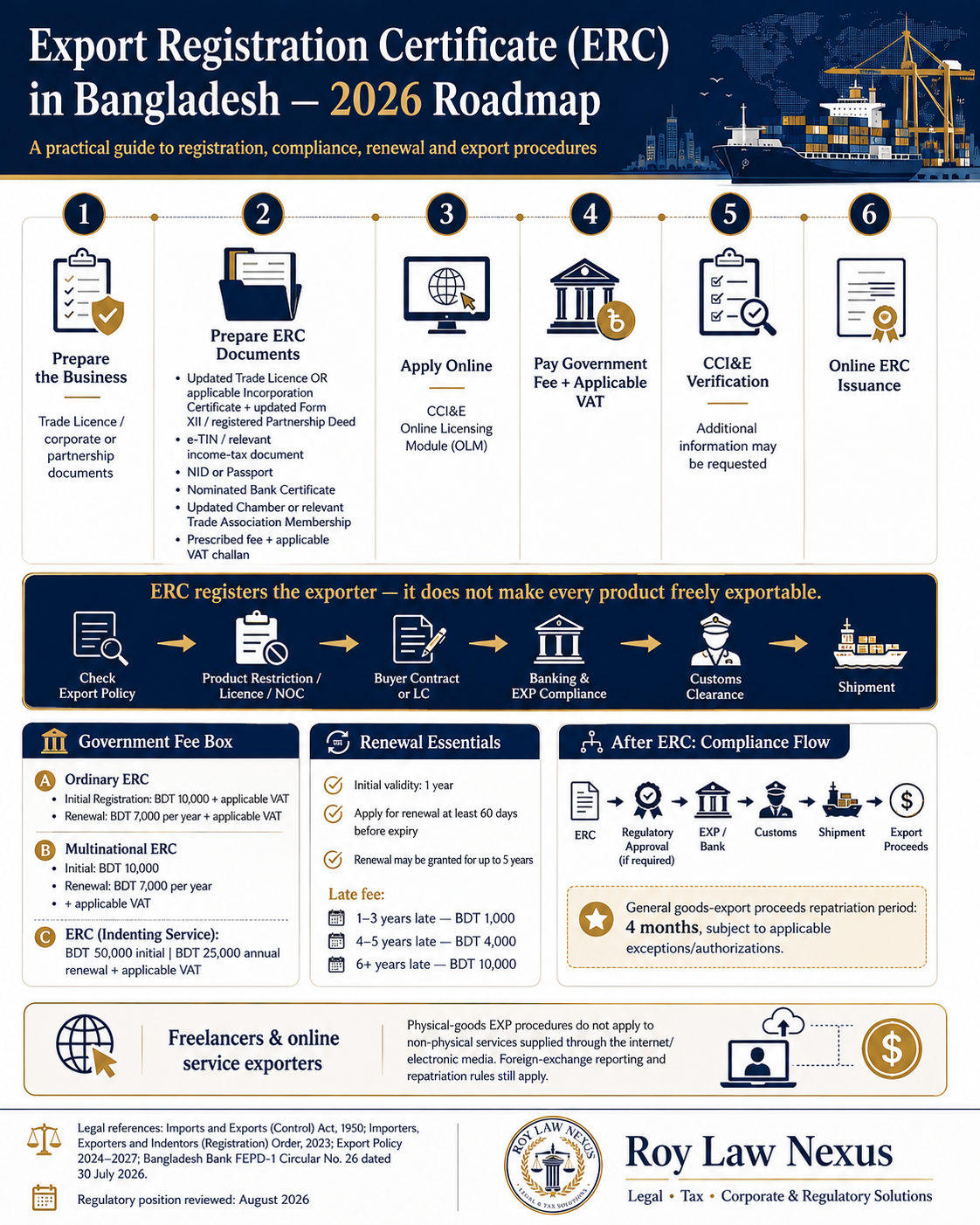
How to Apply for an ERC in Bangladesh: Step by Step
Step 1: Confirm the Business Structure and ERC Category
Before starting the application, determine whether the applicant is a proprietorship, partnership, limited company, multinational establishment or another eligible structure.
The business name, registered address and ownership details should be consistent across the Trade Licence, tax documents, incorporation documents, bank certificate and Chamber/Association membership.
Step 2: Prepare the Prescribed Documents
Use the current 2023 Registration Order as the baseline rather than relying on an older checklist circulating online.
Expired Trade Licences, outdated Chamber membership, inconsistent company addresses or outdated Form XII information can create avoidable queries.
Step 3: Apply Online Through CCI&E's OLM
The 2023 Order expressly requires the registration application to be filed online, using the prescribed form, supporting documents and applicable fee.
CCI&E may examine the application and request additional information or documents where necessary.
Step 4: Pay the Prescribed Government Fee and VAT
The application form contains particulars for the amount, challan number and date, bank/branch and payment code.
Because payment systems and portal integrations can change, applicants should follow the current instructions displayed by CCI&E/OLM at the time of payment rather than rely on old articles describing one payment method as the only permissible method.
Step 5: CCI&E Verification
CCI&E examines the submitted information and documents.
If the Registration Authority is satisfied with their correctness, registration is granted. If it is not satisfied, the application may be rejected, but the authority must record the reason and inform the applicant.
Step 6: Online ERC Issuance
The Registration Authority may issue the certificate online in Bangla, English or both languages, depending on the applicant's request.
ERC Registration and Renewal Fees in Bangladesh
The current fee schedule under the 2023 Registration Order is:
| ERC Service | Government Fee |
|---|---|
| Ordinary Export Registration Certificate — Initial Registration | BDT 10,000 |
| Ordinary ERC — Renewal for each year | BDT 7,000 |
| Multinational ERC — Initial Registration | BDT 10,000 |
| Multinational ERC — Renewal for each year | BDT 7,000 |
| ERC for Indenting Service — Initial Registration | BDT 50,000 |
| ERC for Indenting Service — Renewal for each year | BDT 25,000 |
Applicable VAT is payable in addition to the prescribed fee.
These amounts are stated in the Schedule to the 2023 Registration Order.
Important: “ERC for Indenting Service” Is a Different Registration
The separate fee category for Indenting Service should not be confused with an ordinary ERC used by a normal exporter of goods or services. The 2023 Order provides separate documentary requirements for indenting activities.
How Long Does It Take to Get an ERC?
It is common to see online claims that ERC registration takes three to five working days.
However, the 2023 Registration Order does not establish a universal three-to-five-working-day statutory deadline for issuance.
The actual time may depend on:
- completeness of the application;
- verification of documents;
- inconsistencies in business information;
- requests for additional documents;
- the applicant's structure; and
- CCI&E's administrative processing.
A business should therefore avoid fixing a shipment deadline or contractual commitment on the assumption that a new ERC is guaranteed within a particular number of days.
How Long Is an ERC Valid?
The initial registration is valid for one year from the date of issue and is renewable.
This is different from saying that the exporter must necessarily renew for only one year each time.
Under the 2023 Order, after reviewing a renewal application the authority may renew the registration for a period of up to five years.
When Should ERC Renewal Be Filed?
An exporter should apply for renewal at least 60 days before the ERC expires.
If the application is not made within that period, renewal is still possible subject to payment of the prescribed late fee.
Documents for Renewal
The statutory renewal attachment list includes:
- challan for the renewal fee and applicable VAT;
- acknowledgement of filing the latest income-tax return; and
- other updated documents where applicable.
The renewal form also states that BIN must be provided when applying for the first renewal.
Late ERC Renewal Fees
The 2023 Schedule prescribes the following additional late fees for ordinary exporters:
| Period of Delay | Additional Late Fee |
|---|---|
| 1–3 years | BDT 1,000 |
| 4–5 years | BDT 4,000 |
| 6 years or more | BDT 10,000 |
These amounts are additional to the applicable renewal fee and other required payments.
What Happens After You Obtain the ERC?
Obtaining the certificate does not complete the export process.
For an actual goods shipment, Bangladesh Customs currently lists documents that may include:
- ERC;
- VAT/BIN Certificate;
- Export LC, Export Contract, Sales Contract or Guarantee;
- Export Permit or other relevant document where applicable;
- approval from the relevant regulatory authority where required;
- EXP Form;
- Proforma Invoice;
- Commercial Invoice;
- Packing List;
- transport document; and
- Country of Origin Certificate and other product-specific documentation where applicable.
The precise documents depend on the goods, payment mechanism, destination, Customs procedure and regulatory requirements.
EXP Form and Bangladesh Bank Compliance in 2026
Foreign-exchange compliance is a critical part of exporting from Bangladesh.
Bangladesh Bank's FEPD-1 Circular No. 26 dated 30 July 2026 consolidates the country's current export-related foreign-exchange instructions. It states that Authorized Dealer banks should ensure that exporters are registered under the 2023 Registration Order.
For goods exports, the regulatory framework generally requires an export declaration, and the EXP Form remains an important component of the declaration and monitoring system except where an applicable exemption exists.
Exporters should therefore coordinate the ERC, banking documents, Customs declaration and foreign-exchange compliance rather than treating them as unrelated formalities.
How Quickly Must Export Proceeds Be Repatriated?
For ordinary goods exports, Bangladesh Bank's current consolidated rules state that the prescribed period for repatriating export proceeds is generally four months, unless a special/general authorization or another specific rule applies.
Certain categories have different arrangements—for example, the current circular provides special treatment for specified jute exports.
Failure to realise export proceeds within the prescribed period without applicable authorization can expose an exporter to consequences under the Foreign Exchange Regulation Act, 1947.
This makes post-shipment follow-up just as important as Customs clearance.
Special Position of Freelancers and Online Service Exporters
Bangladesh Bank now separately regulates foreign-exchange transactions of freelancers and individual service exporters engaged in non-physical exports such as ICT, BPO and online professional services.
The 2026 consolidated circular expressly provides that procedures applicable to physical-goods exports, including submission of the EXP Form, do not apply to services supplied through the internet or other electronic media. The receipt, repatriation and reporting of the proceeds nevertheless remain subject to foreign-exchange regulations.
Therefore:
A freelancer receiving foreign payments online should not simply copy the compliance checklist of a garment or merchandise exporter.
The appropriate bank account, payment channel, evidence of service, secure digital reporting, tax position and any CCI&E business-registration issue should be considered according to the actual structure.
Bangladesh Bank's consolidated circular also provides for secure digital interfaces for remittance information and states that Form-C and Form-C (ICT) shall stand discontinued. Until the relevant bank's interface is implemented, the bank may collect purpose and supporting information through its existing digital channels. Exporters should therefore follow the live procedure of their Authorized Dealer bank rather than rely on an older paper-form checklist.
Can an ERC Be Suspended or Cancelled?
Yes.
The 2023 Registration Order permits suspension or cancellation on specified grounds, including:
- breach of the Imports and Exports (Control) Act or Registration Order;
- violation of import, export or foreign-exchange law;
- relevant money-laundering violations;
- under-invoicing or over-invoicing;
- obtaining registration through fraud;
- false declarations;
- breach of registration conditions; and
- other grounds specified in the Order.
The authority may also inspect documents, accounts and the business premises and require information relating to the exporter's activities.
Where suspension or cancellation is proposed under the relevant provision, procedural safeguards under the Order must also be observed.
Can a CCI&E Decision Be Challenged?
Yes.
The 2023 Registration Order expressly provides that a decision of the Registration Authority may be challenged by review, appeal or revision under the Review, Appeal and Revision Order, 1977.
This can become important where an ERC application is refused or an existing registration is suspended or cancelled.
Common ERC Mistakes Businesses Should Avoid
1. Relying on the 1981 Registration Order
The governing registration Order is now the 2023 Order.
2. Treating ERC as Permission to Export Any Product
Product-specific restrictions under the Export Policy and other regulations must still be checked.
3. Using an Outdated Document Checklist
The statutory attachments under the 2023 Order should be the starting point.
4. Ignoring the 60-Day Renewal Rule
Renewal should be initiated well before expiry.
5. Treating Customs and Banking Compliance as Separate From ERC
An export transaction may involve ERC, BIN, contracts/LC, EXP, Customs documents, regulatory approvals and repatriation requirements.
6. Shipping Before Checking Product-Specific Regulations
Discovering that a licence or NOC is required after the goods reach the port can create delay and financial loss.
7. Ignoring Export-Proceeds Repatriation
Compliance does not end when the goods leave Bangladesh.
How Roy Law Nexus Can Assist Exporters in Bangladesh
Export registration often sits within a wider corporate, tax, banking and regulatory process.
Roy Law Nexus can assist businesses with:
- new ERC registration;
- ERC renewal and regularisation;
- multinational ERC matters;
- review of Trade Licence and corporate documents;
- CCI&E objections and additional-document requirements;
- Export Policy compliance;
- product-specific permit and NOC requirements;
- Customs and export-document review;
- foreign-exchange and Authorized Dealer bank compliance;
- export contracts and commercial documentation;
- foreign-owned company and investment-related regulatory issues; and
- legal assistance concerning ERC suspension, cancellation, review or appeal.
For a new exporter, regulatory review before accepting the first international order or arranging shipment can help identify problems at a stage when they are still relatively easy to correct.
Discuss Your ERC or Export Matter →Frequently Asked Questions About ERC in Bangladesh
1. What is an ERC in Bangladesh?
An Export Registration Certificate is the registration through which a business is recognised as an exporter under Bangladesh's current trade-control framework.
2. Who issues an ERC?
ERC registration is administered by the Office of the Chief Controller of Imports and Exports (CCI&E) under the Ministry of Commerce.
3. Which law currently governs ERC?
The current principal registration instrument is the Importers, Exporters and Indentors (Registration) Order, 2023, issued under the Imports and Exports (Control) Act, 1950. The former 1981 Order has been repealed.
4. How much is the ERC registration fee?
The current base fee for an ordinary ERC is BDT 10,000 plus applicable VAT.
5. How much is the ERC renewal fee?
The prescribed renewal fee is BDT 7,000 for each year plus applicable VAT.
6. How long is an ERC valid?
The initial certificate is valid for one year from issuance.
7. Can an ERC be renewed for five years?
Yes. Under the 2023 Order, the Registration Authority may approve renewal for a period not exceeding five years.
8. When should renewal be applied for?
At least 60 days before expiry. Late renewal is possible upon payment of the applicable late fee.
9. Is BIN required for ERC?
BIN is not separately included in the six-item statutory attachment list for the initial ordinary ERC, but it is relevant to export/Customs compliance and must be entered during the first renewal under Form 3.
10. Is a bank solvency certificate mandatory?
The current Order formally requires a certificate from the nominated bank. Applicants should follow the current CCI&E/OLM format rather than assume that a document bearing a particular older label will always be sufficient.
11. Does ERC allow export of every product?
No. The Export Policy 2024–2027 contains prohibited and conditionally exportable categories. Product-specific laws may impose additional requirements.
12. How long does ERC registration take?
The 2023 Registration Order does not guarantee a universal three-to-five-working-day processing period. Processing depends on verification and the completeness of the application.
13. Does a freelancer need an EXP Form?
For non-physical services supplied through the internet or electronic media, Bangladesh Bank's current framework provides that physical-goods procedures including the EXP Form do not apply.
14. How soon must goods-export proceeds normally come back to Bangladesh?
Bangladesh Bank currently prescribes a general four-month repatriation period for export proceeds, subject to specific exceptions and authorizations.
15. Is a bonded warehouse licence the same as an ERC?
No. ERC registers the exporter; a bond licence is a separate Customs facility for qualifying businesses.
Key Laws and Regulations for Exporters in Bangladesh
1. Imports and Exports (Control) Act, 1950 Provides the statutory foundation for regulation of import and export trade.
2. Importers, Exporters and Indentors (Registration) Order, 2023 — S.R.O. No. 326-Law/2023 The current principal framework for ERC registration, renewal, fees, suspension and cancellation.
3. Export Policy 2024–2027 Sets out Bangladesh's current export-policy framework, including freely exportable, prohibited and conditionally exportable products and the general export process.
4. Foreign Exchange Regulation Act, 1947 Governs foreign-exchange aspects of export transactions and repatriation.
5. Bangladesh Bank FEPD-1 Circular No. 26, dated 30 July 2026 The current consolidated Bangladesh Bank instructions on export transactions, exporter registration, EXP declarations, repatriation and service-export foreign-exchange arrangements.
6. Customs Act, 2023 and related Rules Relevant to export declaration, Customs procedures and clearance.
7. Review, Appeal and Revision Order, 1977 Provides the mechanism referred to in the 2023 Registration Order for challenging registration-authority decisions.
Official Sources and Live Service Links
- CCI&E — Importers, Exporters and Indentors (Registration) Order, 2023 (opens in a new tab)
- CCI&E Online Licensing Module (OLM) (opens in a new tab)
- CCI&E — Export Policy 2024–2027 (opens in a new tab)
- Bangladesh Bank — FEPD-1 Circular No. 26 dated 30 July 2026 (opens in a new tab)
- Bangladesh Customs — Export clearance procedures (opens in a new tab)
- Bangladesh Customs Import Export Hub (opens in a new tab)
Final Takeaway
An ERC is a gateway to formal export business in Bangladesh—but it is only the beginning of the compliance chain.
A properly structured export should generally move through:
Business setup → ERC → Product eligibility check → Export contract/payment arrangement → Sector-specific licence or NOC where required → Banking/EXP compliance → Customs clearance → Shipment → Timely repatriation of export proceeds.
For service exporters, particularly freelancers and online professionals, the foreign-exchange workflow differs from physical-goods exports and should be assessed separately.
Businesses that address these issues before the first order or shipment are far better placed to avoid Customs delays, banking queries, regulatory objections and foreign-exchange compliance problems.
This article provides general legal and regulatory information based on the position reviewed as of 26 August 2026. Export policies, SROs, CCI&E public notices, Customs requirements and Bangladesh Bank foreign-exchange instructions may be amended from time to time. A specific transaction should therefore be reviewed against the rules applicable at the relevant date.
About the Author

Sawdip Roy Sajib
Advocate, Supreme Court of Bangladesh
Member, Dhaka Bar Association and Dhaka Taxes Bar Association
Legal Disclaimer: This article provides general legal and regulatory information based on official materials available on 26 August 2026. It is not transaction-specific legal, tax, Customs or foreign-exchange advice and does not create a lawyer-client relationship. The live OLM service status, applicable policy, fees and product-specific approvals should be rechecked before filing or shipment.