
Quick answer
Bangladesh law does not impose a blanket rule requiring every person to produce only a TIN certificate whenever land or an apartment is purchased. In the property-registration situation specified in section 264(3)(7) of the Income Tax Act, 2023, the document generally required is Proof of Submission of Return (PSR)—not merely a TIN certificate.
The statutory property rule generally applies where all the following elements are present:
- the relevant person is a resident for Bangladesh income-tax purposes in that income year;
- the transaction concerns the registration or sale of land, a building or an apartment, including the specified agreement or power-of-attorney situations;
- the property is situated within a city corporation, paurashava (municipality) or cantonment board area; and
- the deed value exceeds BDT 1 million (Tk 10 lakh).
An expatriate Bangladeshi who has no National Identity Card may still follow the passport-based e-TIN route described in the National Board of Revenue’s official FAQ. However, e-TIN registration and e-Return registration are separate processes. Standard e-Return registration ordinarily requires a Bangladeshi mobile SIM biometrically registered against the taxpayer’s own NID. NBR introduced an email-OTP special-registration facility for eligible Bangladeshi taxpayers residing abroad, but its published identity-verification requirements include an NID copy. A person who has no NID at all should therefore obtain case-specific written guidance from NBR or the relevant tax circle instead of using another person’s NID, SIM or identity.
This article has been reviewed against the Income Tax Act, 2023 (opens in a new tab), the Finance Act, 2026 (opens in a new tab) and relevant NBR guidance available as of 22 August 2026.
Select a topic to read the detailed guidance
At a glance: when may TIN or PSR be required?
| Situation | General legal position | Recommended action |
|---|---|---|
| Tax resident; property within a city corporation, municipality or cantonment board; deed value above Tk 10 lakh | PSR is generally required under section 264(3)(7) | Obtain TIN, file the relevant return and collect valid PSR before registration |
| Tax non-resident | On the wording of section 264(3)(7), the property clause should not apply solely because of this transaction, since it refers to a resident | Confirm tax residency and check whether another statutory ground applies |
| Property outside the specified urban areas | The location condition in section 264(3)(7) is not met solely on those facts | Check other tax, registration and transaction-specific requirements |
| Property in a specified area but deed value is Tk 10 lakh or less | The value threshold in that clause is not met solely on those facts | Use the genuine lawful deed value and check for other applicable grounds |
| Bangladeshi taxpayer without an NID | NBR’s FAQ describes a passport-and-visa-based e-TIN route | Use accurate passport, visa, photograph and identity information |
| No Bangladeshi SIM, but the taxpayer has an NID and resides abroad | NBR’s email-OTP special-registration procedure may be available after verification | Apply from the taxpayer’s own email with the required documents |
| Neither NID nor Bangladeshi SIM is available | Passport-based TIN may be possible, but published email-OTP verification requirements include NID | Seek written instructions from NBR or the relevant tax circle for a lawful filing route |
This table is a general guide. A baynanama, power of attorney, gift, heba, inheritance, partition, joint purchase, developer sale, corporate purchase or transfer through a legal representative may require a separate analysis.
TIN certificate and Proof of Submission of Return are not the same
The phrase “TIN is required for land registration” is often used informally. Legally, however, a Taxpayer’s Identification Number (TIN) and Proof of Submission of Return (PSR) serve different purposes.
What is a TIN?
A TIN is the identification number issued to a registered taxpayer. Under section 261 of the Income Tax Act, 2023, registration may be required where a person:
- is an assessee;
- is required to file a return under section 166;
- must furnish PSR under section 264; or
- wishes voluntarily to pay tax or submit a return.
NBR issues a TIN after the person is registered as an assessee.
What is PSR?
Under section 264, Proof of Submission of Return may generally take the form of:
- a return certificate or acknowledgement receipt;
- a system-generated certificate showing the taxpayer’s name, TIN and assessment year; or
- a certificate issued by the Deputy Commissioner of Taxes containing the required particulars.
Therefore, holding a TIN does not automatically mean that the person has PSR. Where PSR is legally required, the taxpayer will normally need evidence that the relevant income-tax return has actually been filed.
When is PSR required for registration of land, a building or an apartment?
Section 264(3)(7) of the Income Tax Act, 2023 (opens in a new tab) must be read carefully. Its application depends on the person’s tax residence, the nature of the instrument, the property’s location and the deed value.
The four principal conditions
- Tax residence: The relevant person must be a resident for that income year.
- Nature of the transaction: The provision covers the specified registration or sale of land, a building or an apartment and expressly includes the stated baynanama and power-of-attorney contexts.
- Location: The property must be within a city corporation, paurashava or cantonment board.
- Value: The deed value must exceed Tk 10 lakh.
Where the provision applies, the authority processing or executing the registration must obtain and verify PSR in the prescribed manner.
Why is the statement “TIN is mandatory for every land registration” misleading?
Because the final statutory provision contains residence, location and value conditions. Budget announcements, proposals and social-media summaries are not substitutes for the law as finally enacted. The Finance Act, 2026 (opens in a new tab) must be read with the Income Tax Act as amended; the core conditions described above remain relevant to the property clause.
PSR is only one part of property compliance
Even where PSR is not required under this particular clause, the transaction may still involve stamp duty, registration fees, advance or source tax, VAT where applicable, local-government charges and other supporting documents. Conversely, possessing PSR does not prove that the seller has a valid title.
Does “expatriate” automatically mean “non-resident” for tax purposes?
No. A person may live or work abroad and still be a Bangladesh tax resident for a particular income year.
Under section 2(45) of the Income Tax Act, 2023, an individual is generally treated as resident if the individual is present in Bangladesh:
- for 183 days or more in that income year; or
- for 90 days or more in that income year and for 365 days or more in total during the four preceding years.
An individual who does not satisfy the residence test is generally a non-resident for that year.
Why the residence test matters
Tax residence may affect:
- whether the property-related PSR clause applies;
- the scope of income brought within Bangladesh taxation;
- the assets and liabilities that must be disclosed;
- the treatment of foreign income and remittances; and
- eligibility for particular return-filing exceptions or procedures.
Residence should be calculated separately for each income year. Passport entry and exit stamps, immigration records, boarding passes and a travel-day schedule should be retained.
How can a Bangladeshi without an NID obtain a TIN?
The NBR Income Tax FAQ (opens in a new tab) lists the following information for a foreign national or a “Bangladeshi without NID” seeking e-TIN registration:
- passport number;
- passport issue date;
- visa number;
- visa issue date; and
- a digital passport-size photograph of the taxpayer.
Practical steps
- Use the taxpayer’s name, date of birth and other particulars exactly as shown in the valid passport.
- Keep the current visa or residence permit and proof of the overseas address available.
- Provide accurate information relevant to tax jurisdiction in Bangladesh, including the permanent address, source of income and property location.
- If the online process does not accommodate the person’s circumstances, obtain assistance from the relevant tax circle or NBR.
- After the TIN is issued, verify the name, passport details, address and assigned tax jurisdiction.
An applicant must not use a relative’s NID merely because the applicant has no NID. Doing so may connect the tax record to the wrong legal identity.
How can an expatriate file an e-Return without a Bangladeshi SIM?
It is essential to distinguish between e-TIN registration and registration in the e-Return system.
Standard e-Return registration
According to the NBR FAQ, standard e-Return registration ordinarily requires:
- the taxpayer’s TIN; and
- a Bangladeshi mobile number on a SIM biometrically registered using the taxpayer’s own NID.
The mobile number originally used when obtaining the TIN is not necessarily decisive; the important point for standard e-Return registration is that the SIM is registered against the taxpayer’s own NID.
Email OTP for taxpayers residing abroad
In its press release dated 24 February 2026 (opens in a new tab), NBR announced an email-verification and special-registration arrangement for Bangladeshi taxpayers living abroad. The published procedure instructs an applicant to email ereturn@etaxnbr.gov.bd from the taxpayer’s own email address and provide identity and overseas-contact information, including:
- a copy of the passport;
- a copy of the NID;
- a copy of the relevant visa page;
- the current overseas address;
- the taxpayer’s overseas mobile or telephone number; and
- the latest date of departure from Bangladesh.
After verification by NBR, an eligible taxpayer may receive OTP access through the verified email for registration, password reset and related e-Return functions.
What if the taxpayer has no NID at all?
This requires special care. NBR’s FAQ supports a passport-based route for obtaining TIN, but the published email-OTP procedure asks for an NID copy. It would therefore be inaccurate to promise that every NID-less taxpayer will automatically receive email-OTP access.
A taxpayer in this position should:
- complete the lawful passport-based TIN process;
- explain the absence of NID to NBR from the taxpayer’s own email and request written instructions;
- contact the Deputy Commissioner of Taxes of the relevant tax circle;
- check any special order governing online filing for the applicable assessment year; and
- where lawfully permitted, use the authorised paper, tax-circle or Bangladesh-mission filing route.
NBR’s FAQ also refers to the possibility of filing a return through a Bangladesh mission where the taxpayer is abroad. The applicable procedure and any assessment-year-specific online filing order should be checked before submission.
For e-Return assistance, NBR’s published call-centre number is 09643 717171, during the service hours announced by NBR.
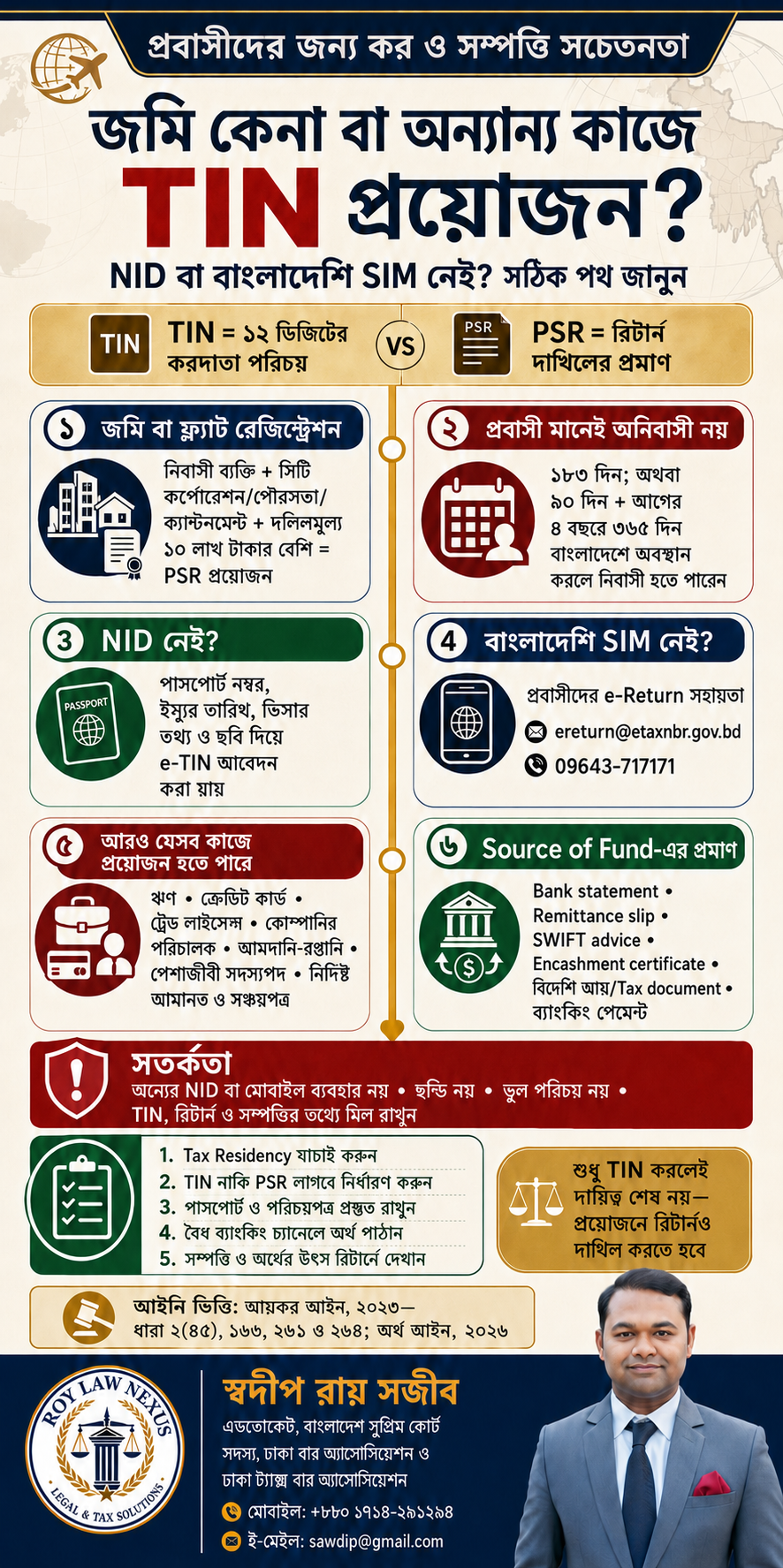
What other transactions may require TIN or PSR?
Section 264 contains a broad list that may be amended from time to time. Common examples include:
- applying for a loan above the specified threshold;
- becoming a director or sponsor shareholder of a company, subject to the current statutory wording;
- obtaining or continuing an Import Registration Certificate or Export Registration Certificate;
- obtaining or renewing a trade licence in a city corporation or paurashava;
- obtaining or maintaining a credit card;
- obtaining or maintaining membership of specified professional bodies or trade bodies;
- opening or maintaining specified term deposits above the statutory threshold;
- purchasing savings instruments above the statutory threshold; and
- obtaining specified licences, connections, agencies, distributorships or government approvals.
This is not an exhaustive list. The law, the latest Finance Act, special orders and NBR guidance in force on the transaction date should be checked. In particular, it is unsafe to state that every ordinary bank account universally requires TIN; the applicable rule may depend on the banking product, amount and taxpayer’s circumstances.
Source of funds: using overseas earnings to buy property in Bangladesh
For an NRB buyer, one of the most important compliance issues is the source of funds used to acquire the property.
Paragraph 17 of Part 1 of the Sixth Schedule to the Income Tax Act, 2023 provides an exemption for foreign income earned by an individual assessee who is a Bangladeshi citizen and brings that income into Bangladesh in accordance with the laws applicable to foreign remittance.
However, tax exemption does not mean exemption from disclosure or documentation. The purchase price, banking trail, remittance records and asset statement should tell a consistent story.
Documents to retain
- employment contract, salary certificate and payslips;
- for a business owner, business registration, accounts and evidence of receipts;
- overseas bank statements;
- SWIFT advice, remittance advice or transfer confirmation;
- inward-remittance or encashment certificate from the receiving bank in Bangladesh;
- foreign tax return or tax-payment certificate, where relevant;
- baynanama or sale agreement, deed, payment schedule and money receipts;
- evidence of payment from the buyer’s own bank account to the seller or developer; and
- separate evidence of the legal relationship and source where funds include a loan, gift or joint contribution.
Practices to avoid
- sending purchase money through hundi or another unauthorised channel;
- understating or concealing the genuine transaction value;
- routing substantial unexplained payments through another person’s bank account;
- acquiring assets that cannot be reconciled with declared income, savings or remittance; and
- assuming that remittance income need not be disclosed merely because an exemption may apply.
How should the property and foreign assets be disclosed in the return?
Section 167 of the Income Tax Act, 2023 distinguishes between resident and non-resident Bangladeshi individual assessees:
- a resident Bangladeshi individual assessee must disclose assets and liabilities situated both in and outside Bangladesh; and
- a non-resident Bangladeshi individual assessee must disclose assets and liabilities situated in Bangladesh.
An assets-and-liabilities statement may also be mandatory due to the nature or amount of the taxpayer’s assets, investment in specified house property or apartments, overseas assets, motor vehicles or company directorship.
The acquisition cost, instalments paid during the year and year-end value reported in the return should be supported by the agreement, deed and payment schedule. The use of previously declared cash or bank balances should also be reconciled.
Step-by-step compliance plan for an NRB property buyer
Step 1: Determine tax residence
Count the days spent in Bangladesh during the relevant income year and the preceding four-year period. Do not choose “resident” or “non-resident” merely on the basis of nationality, visa status or overseas employment.
Step 2: Check the property location and deed value
Confirm whether the property is within a city corporation, paurashava or cantonment board and whether the genuine deed value exceeds Tk 10 lakh.
Step 3: Determine whether TIN, a return and PSR are required
Review the statutory provision, instrument type and taxpayer’s other activities. Do not rely only on an informal statement from a broker or intermediary.
Step 4: Obtain TIN in the taxpayer’s own identity
Use the NID route where available or the lawful passport-based procedure for a Bangladeshi without NID. Keep the spelling of the name consistent across all records.
Step 5: File the applicable return through an authorised route
Use standard e-Return registration where the taxpayer has an NID-linked biometric SIM. If eligible while abroad, apply for NBR’s email-OTP procedure. Otherwise, obtain written instructions and use an authorised filing method.
Step 6: Build a source-of-funds file
Maintain the complete trail from overseas income, through lawful remittance, to the payment made to the seller or developer.
Step 7: Conduct legal due diligence before payment or registration
Review title records, khatian, mutation, land development tax, possession, chain of title, mortgage or charge, pending litigation, authority approvals and the seller’s legal capacity.
Step 8: Reconcile the tax return, bank trail and deed
The taxpayer’s name, TIN, passport or NID, deed value, payment dates, banking records and asset statement should remain consistent.
Practical document checklist
Identity and overseas-residence documents
- Valid Bangladeshi passport
- NID, if available
- Visa or residence permit
- Proof of current overseas address
- Entry and exit record and latest departure date from Bangladesh
- Taxpayer’s own email and overseas telephone number
- Digital passport-size photograph
Tax documents
- TIN certificate
- Return for the relevant assessment year
- Acknowledgement or PSR
- Tax-payment challan, where applicable
- Assets-and-liabilities statement
- Tax-residence calculation
Source-of-funds and property documents
- Evidence of overseas earnings
- Overseas and Bangladeshi bank statements
- Remittance, SWIFT and encashment documents
- Baynanama or sale agreement
- Seller or developer receipts
- Title deed, khatian, mutation and land-development-tax records
- Approved plan and authority clearance for an apartment or development
- Power of attorney where a representative will act
Common mistakes and legal risks
Treating TIN as PSR
A registration may be delayed if the taxpayer has a TIN certificate but no valid proof that the relevant return was submitted.
Assuming every expatriate is a tax non-resident
An incorrect residence classification may lead to the wrong tax treatment or incomplete asset disclosure.
Using another person’s NID or SIM
The TIN or e-Return account may become linked to the wrong identity, creating significant correction and verification problems.
Failing to preserve remittance records
Even genuinely earned overseas money may be difficult to explain if the banking and remittance evidence is missing.
Reporting inconsistent values
A mismatch among the deed value, actual payment trail and declared investment may increase tax scrutiny.
Ignoring future filing obligations after obtaining TIN
The obligation to file a return must be considered under sections 166 and 264 and the taxpayer’s particular circumstances. The Act also contains an exception for a non-resident individual having no fixed base in Bangladesh. A taxpayer should therefore assess the obligation for each year rather than rely on a blanket assumption.
How Roy Law Nexus can assist expatriate Bangladeshis
Property acquisition by an NRB often involves several connected issues—tax residence, TIN, return filing, source of funds, title verification, power of attorney and registration. Addressing only one document may leave the wider transaction exposed.
Roy Law Nexus—Legal & Tax Solutions can provide coordinated legal and tax support, including:
1. Preliminary TIN, PSR and tax-residence assessment
We can review travel history, intended transaction, property location, deed value and existing tax records to identify whether TIN, a return or PSR is likely to be required.
2. Lawful e-TIN and e-Return guidance
We can assist clients in organising the correct passport, NID, visa and taxpayer information, selecting the appropriate registration route and responding lawfully where a Bangladeshi SIM or NID is unavailable. We do not use or recommend another person’s identity.
3. Return filing and PSR preparation
Where a return is required, we can assist with the preparation and review of income, exempt foreign income, remittance, assets, liabilities and property-investment information so that the return and transaction documents remain consistent.
4. Source-of-funds and remittance documentation
We can help create a structured source-of-funds file containing employment or business-income evidence, overseas bank records, remittance documents, Bangladeshi bank credits and property-payment records.
5. Property title and legal due diligence
Our legal review may cover title deeds, chain of ownership, khatian, mutation, land development tax, possession, mortgage or charge, pending litigation, authority approval and the legal capacity of the seller.
6. Baynanama, deed and power-of-attorney review
We can draft or vet the agreement for sale, payment terms, safeguards, representations, default clauses and a legally appropriate power of attorney where the expatriate buyer cannot be physically present.
7. Registration and transaction coordination
We can coordinate the legal and tax-document checklist with the client and relevant professionals so that avoidable inconsistencies are identified before execution and registration.
8. Post-purchase tax and asset compliance
After acquisition, we can assist in reporting the property correctly in the applicable return, reconciling the payment source and maintaining records for a future sale, inheritance, bank review or tax enquiry.
9. Representation and dispute support
Where legally necessary, we can advise or represent clients in appropriate proceedings before tax authorities or courts, subject to review of the facts, documents and applicable jurisdiction.
Frequently asked questions
Does every expatriate Bangladeshi need TIN to buy land in Bangladesh?
No. The property-related PSR rule depends on tax residence, property location, instrument type and deed value. Another statutory ground may nevertheless require TIN or PSR.
Is a TIN certificate enough for property registration?
Not where section 264 requires PSR. In that situation, the person needs acceptable evidence that the relevant income-tax return was submitted.
Is PSR required when the deed value is Tk 10 lakh or less?
Not solely under the value condition of section 264(3)(7), which applies where the deed value exceeds Tk 10 lakh. Other legal grounds may still apply, and the deed value must be genuine and lawful.
Is PSR required for land in a village or union area?
The property clause refers to property within a city corporation, paurashava or cantonment board. If the property is outside those areas, that location condition is not satisfied solely on those facts. Other requirements should still be checked.
Is every Bangladeshi living abroad a tax non-resident?
No. Tax residence depends primarily on the statutory day-count test for the relevant income year and the preceding four years.
Can a Bangladeshi obtain TIN without an NID?
NBR’s FAQ describes an e-TIN process for a Bangladeshi without NID using passport number, passport issue date, visa information and a taxpayer photograph.
Can an NRB file an e-Return without a Bangladeshi SIM?
Standard registration ordinarily requires an NID-linked biometric SIM. NBR has introduced an email-OTP special-registration procedure for eligible Bangladeshi taxpayers residing abroad, subject to identity verification and the required documents.
What if the taxpayer has neither an NID nor a Bangladeshi SIM?
The taxpayer may use the lawful passport-based TIN route, but should obtain written NBR or tax-circle guidance for return registration because the published email-OTP requirements include an NID copy.
Is foreign income used to buy the property taxable in Bangladesh?
Foreign income earned by a Bangladeshi citizen and remitted to Bangladesh in accordance with applicable foreign-remittance law may qualify for exemption under the Sixth Schedule. The taxpayer’s residence, income type, remittance channel, disclosure and supporting records must still be reviewed.
If the remittance is exempt, can it be omitted from the tax return?
No blanket assumption should be made. Exemption and disclosure are different matters. The applicable return should correctly present the income, remittance, bank balance and acquired property.
Does TIN or PSR guarantee a good property title?
No. TIN and PSR concern tax compliance. Title, ownership, possession, mortgage, litigation, mutation and development approval require separate legal due diligence.
Legal basis and official sources
- Income Tax Act, 2023—Authentic English Text published by NBR (opens in a new tab): sections 2(45), 26, 166, 167, 261 and 264; and paragraph 17 of Part 1 of the Sixth Schedule.
- Finance Act, 2026—NBR (opens in a new tab): relevant amendments for the 2026–27 fiscal framework.
- NBR Income Tax FAQ (opens in a new tab): passport-based TIN information, standard e-Return registration and filing support.
- NBR press release dated 24 February 2026 (opens in a new tab): email OTP and special registration for taxpayers residing abroad.
Contact Roy Law Nexus
For advice on TIN, e-Return, PSR, source-of-funds documentation, property due diligence, power of attorney or registration in Bangladesh, expatriate clients may contact:
Sawdip Roy Sajib Advocate, Supreme Court of Bangladesh Member, Dhaka Bar Association and Dhaka Taxes Bar Association Mobile: +880 1714-291294 Email: sawdip@gmail.com
Roy Law Nexus—Legal & Tax Solutions
About the Author

Sawdip Roy Sajib
Advocate, Supreme Court of Bangladesh
Member, Dhaka Bar Association and Dhaka Taxes Bar Association
Legal Disclaimer: This article is published for public awareness and general information. It is not a final legal opinion or tax advice for any particular person or transaction. Current laws, Finance Acts, NBR orders and the relevant documents should be reviewed before action is taken.