

Contents
1. Quick Answer
A decision of the Taxes Appellate Tribunal is ordinarily the final decision on questions of fact, but where its order gives rise to a question of law, the assessee or the Commissioner of Taxes may take that question to the High Court Division of the Supreme Court of Bangladesh by filing an Income Tax Reference.
The present statutory basis is section 293 of the Income Tax Act, 2023, read with sections 294 and 295.
A major change took effect from 1 July 2026. The Finance Act, 2026 replaced the previous 15%/25% pre-deposit system with a single 10% pre-deposit calculated on the difference between the tax determined on the basis of the Tribunal's order and the assessee's admitted tax liability. At the same time, the former provision allowing the National Board of Revenue (“NBR”) to modify or waive the pre-deposit was removed.
Quick Reference Table
| Issue | Current Position |
|---|---|
| Governing law | Income Tax Act, 2023 |
| Main provision | Section 293 |
| Order challenged | Order of the Taxes Appellate Tribunal |
| Nature of proceeding | Reference on a question of law |
| Who may apply? | Assessee or Commissioner |
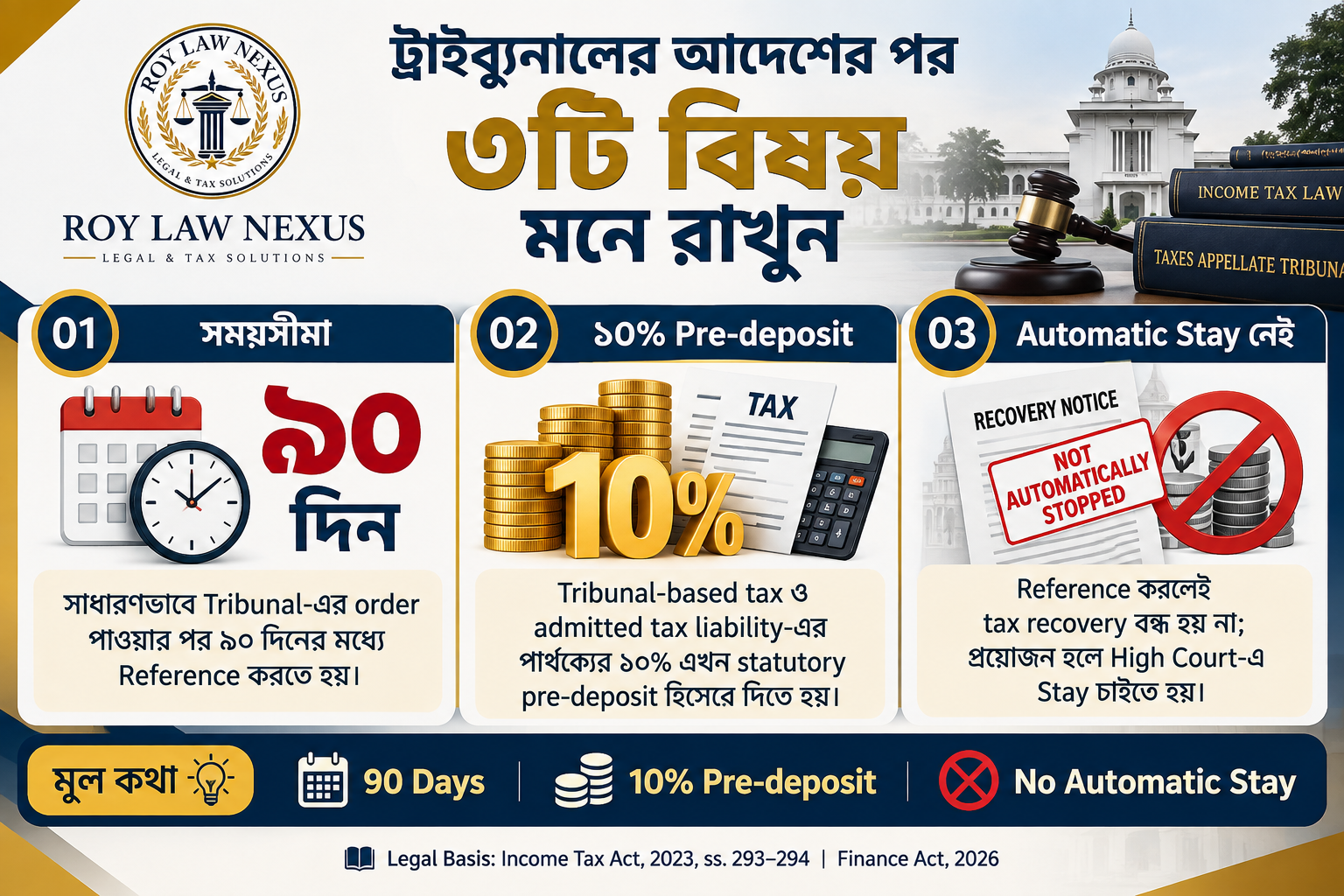
| Limitation | 90 days from receipt of the Tribunal order |
| Statutory application fee | Tk 2,000 where the assessee applies |
| Current pre-deposit | 10% of the relevant tax difference |
| Effective date of new 10% rule | 1 July 2026 |
| Automatic stay of tax recovery? | No |
| Can the High Court grant stay? | Yes |
| Number of Judges | Bench of at least two Judges |
| Further appeal | Appellate Division, subject to certification by the High Court Division |
2. From the Tribunal to the High Court Division: Process Flow
A reference is a focused statutory proceeding on a question of law. The record should be organised as soon as the Tribunal order is received because the ordinary filing period is 90 days.
Receive the Tribunal order
Record the actual date of receipt.
Identify the question of law
Separate legal error from factual disagreement.
Calculate statutory payments
Confirm admitted tax liability, 10% payment and Tk 2,000 fee.
Prepare the record
Compile the application and certified documents in triplicate.
File and seek protection
File within time and apply separately for stay where recovery is threatened.
Hearing and consequential order
The High Court answers the law question; the Tribunal implements the judgment.
What Happens After Filing?
The statutory process can be understood as follows:
| Stage | What Happens |
|---|---|
| 1 | Tribunal delivers its order |
| 2 | Applicant identifies question(s) of law |
| 3 | 90-day limitation is calculated |
| 4 | Statutory fee and 10% payment are made |
| 5 | Reference Application and certified documents are prepared in triplicate |
| 6 | Application is filed before the High Court Division |
| 7 | Respondent may file written reply |
| 8 | Stay may be sought separately where necessary |
| 9 | Reference is heard by a Bench of at least two Judges |
| 10 | High Court answers the question(s) of law |
| 11 | Judgment is transmitted to the Taxes Appellate Tribunal |
| 12 | Tribunal passes the necessary consequential order |
Section 293(5) further provides that, after receiving notice of the hearing date, the respondent is to submit a written reply at least seven days before the hearing, specifically admitting or denying whether the formulated question of law arises from the Tribunal's order.
3. Legal Basis and a Sustainable Question of Law
The controlling provision is section 293 of the Income Tax Act, 2023. It authorises the assessee or Commissioner to refer a question of law arising from a Tribunal order—not to reopen the entire case as a second factual appeal.
What Is an Income Tax Reference?
An Income Tax Reference is different from an ordinary appeal.
Section 293 provides that an assessee or the Commissioner may, within the prescribed period, refer to the High Court Division a question of law arising out of an order of the Taxes Appellate Tribunal.
This distinction is fundamental.
The High Court Division is not normally asked to conduct the entire tax assessment again or simply decide whether it would have reached a different factual conclusion from the Tribunal.
The central inquiry is:
Examples may include interpretation of a provision of the Income Tax Act, application of the wrong statutory test, taxation without legal authority, disregard of a mandatory provision, or another legally identifiable error arising from the Tribunal's decision.
By contrast, a mere disagreement over the weight of evidence, estimation of sales, quantum of expenses or another purely factual conclusion will not ordinarily be sufficient.
Which Law Governs an Income Tax Reference in Bangladesh?
The principal provisions are contained in Part 20, Chapter II of the Income Tax Act, 2023:
| Provision | Subject |
|---|---|
| Section 291 | Appeal to the Taxes Appellate Tribunal |
| Section 292 | Disposal of appeal by the Tribunal |
| Section 293 | Reference to the High Court Division |
| Section 294 | Decision of the High Court Division |
| Section 295 | Appeal to the Appellate Division |
Sections 293–295 therefore create the statutory route from the Taxes Appellate Tribunal to the Supreme Court.
The procedure should also be read together with the Income-tax Rules, 1984 where those rules remain consistent with the 2023 Act.
Section 344(2)(c) of the Income Tax Act, 2023 preserves rules, orders, directions, notifications, policies and other legal instruments made under the repealed Income-tax Ordinance, 1984, so far as they remain consistent with the new Act and until they are repealed or amended.
Rule 29 of the Income-tax Rules, 1984 contains the traditional form for an application for reference to the High Court Division. The old form naturally refers to former section 160 of the Income-tax Ordinance, 1984, so any present application must be adapted to the Income Tax Act, 2023 and section 293.
What Makes a Good “Question of Law”?
This is often the most important part of the entire Reference Application.
The applicant should not merely restate the grounds previously argued before the Tribunal. Each proposed question should identify a legal issue arising from the Tribunal's order.
A question may potentially arise where the Tribunal:
| Possible Legal Issue | Example |
|---|---|
| Misinterprets a statutory provision | Applies a section in a manner inconsistent with its wording |
| Applies the wrong legal test | Determines deductibility under an irrelevant statutory standard |
| Taxes an amount without statutory authority | Treats a receipt as taxable although no applicable charging provision permits it |
| Ignores a mandatory provision | Fails to apply a statutory exemption, condition or limitation |
| Applies an incorrect legal principle to established facts | Facts are accepted, but their legal consequence is wrongly determined |
| Makes a finding attacked as legally perverse | Material evidence is disregarded or the conclusion is alleged to have no rational evidentiary foundation |
The drafting should connect the legal question directly with the relevant portion of the Tribunal's decision.
Is an Income Tax Reference the Same as a Writ Petition?
No.
A Reference under section 293 is a specific statutory remedy arising from an order of the Taxes Appellate Tribunal and is confined to questions of law arising from that order.
A writ petition under Article 102 of the Constitution belongs to a different constitutional jurisdiction.
In a normal tax dispute that has proceeded through the statutory appellate system to the Tribunal, the existence and scope of the statutory reference remedy should therefore be carefully examined before considering any other proceeding.
Whether constitutional jurisdiction is available in an exceptional case depends on the particular jurisdictional, procedural or public-law issue involved and requires separate legal analysis.
4. The 2026 Change: 10% Pre-deposit and Filing Cost
The consolidated statute records that the 10% rule, deletion of the former higher tier and deletion of the former waiver provision took effect on 1 July 2026 under section 145 of the Finance Act, 2026.
The Major 2026 Change: Pre-Deposit Reduced to 10%
The most important recent development is the amendment made by the Finance Act, 2026 (Act No. 96 of 2026).
Before the amendment, section 293 required:
- 15% of the relevant tax difference where the tax demand did not exceed Tk 10 lakh; and
- 25% where the tax demand exceeded Tk 10 lakh.
The former law also allowed the NBR, upon application, to modify or waive the payment requirement, except the statutory application fee. The official Authentic English Text published in 2025 records that previous position.
Section 145 of the Finance Act, 2026 changed this framework with effect from 1 July 2026. The current law now requires payment of:
The former clause prescribing the 25% rate was deleted, and former section 293(2), which contained the NBR waiver/modification power, was also deleted.
Previous Law vs Current Law
| Issue | Previous Law | Current Law from 1 July 2026 |
|---|---|---|
| Tax demand not exceeding Tk 10 lakh | 15% of relevant difference | 10% |
| Tax demand exceeding Tk 10 lakh | 25% of relevant difference | 10% |
| Separate higher rate for large demands | Yes | No |
| NBR could reduce/waive pre-deposit | Yes, except Tk 2,000 fee | Provision deleted |
| Statutory application fee | Tk 2,000 | Tk 2,000 |
| Limitation | 90 days | 90 days |
| Reference restricted to question of law | Yes | Yes |
The amendment substantially reduces the immediate financial burden in many higher-value tax disputes, although removal of the former NBR waiver power is also significant.
What Is “Admitted Tax Liability”?
Understanding this term is necessary because the 10% deposit is not calculated on the entire amount of tax appearing in the Tribunal's order.
Section 2(89A) defines “admitted tax liability” as the payable income-tax liability computed under section 173, 174 or 181, as applicable, on the basis of the return or revised return filed by the taxpayer.
The basic calculation under the current section 293 is therefore:
Tax determined on the basis of Tribunal order – Admitted tax liability = Relevant tax difference
The assessee must then pay:
10% × Relevant tax difference
and also pay the Tk 2,000 statutory application fee.
How Much Does It Cost to File an Income Tax Reference?
For clients, it is useful to distinguish between statutory filing requirements and other professional or procedural expenses.
Statutory Amount
| Component | Amount |
|---|---|
| Application fee | Tk 2,000 |
| Tax pre-deposit | 10% of the relevant tax difference |
| Professional legal fees | Not fixed by section 293 |
| Certified copies, affidavit, photocopying and incidental filing expenses | Variable |
The 10% payment should not be confused with a lawyer's fee or an ordinary court fee. It is a statutory tax payment required as a condition for an assessee's reference.
Examples under the Current Law
| Tribunal-based Tax | Admitted Tax Liability | Difference | 10% Deposit | Tk 2,000 Fee | Minimum Statutory Outlay |
|---|---|---|---|---|---|
| Tk 8,00,000 | Tk 2,00,000 | Tk 6,00,000 | Tk 60,000 | Tk 2,000 | Tk 62,000 |
| Tk 20,00,000 | Tk 5,00,000 | Tk 15,00,000 | Tk 1,50,000 | Tk 2,000 | Tk 1,52,000 |
| Tk 50,00,000 | Tk 10,00,000 | Tk 40,00,000 | Tk 4,00,000 | Tk 2,000 | Tk 4,02,000 |
| Tk 1,00,00,000 | Tk 40,00,000 | Tk 60,00,000 | Tk 6,00,000 | Tk 2,000 | Tk 6,02,000 |
These examples exclude advocates' professional fees and other variable expenses.
Example of the Effect of the 2026 Amendment
Suppose the Tribunal-determined tax is Tk 50 lakh and admitted tax liability is Tk 10 lakh.
The relevant difference is therefore Tk 40 lakh.
Under the previous 25% regime, where the higher threshold applied:
Tk 40 lakh × 25% = Tk 10 lakh
Under the current regime:
Tk 40 lakh × 10% = Tk 4 lakh
The statutory pre-deposit in this example is therefore reduced by Tk 6 lakh, although the Tk 2,000 application fee continues separately.
5. Limitation, Documents and Filing Requirements
Section 293 requires filing within 90 days from receipt of the Tribunal order, permits an application under section 5 of the Limitation Act, 1908, and requires the application and specified certified records in three sets.
What Is the Deadline for Filing?
A Reference Application must ordinarily be filed within 90 days from the date of receipt of the Tribunal's order communicated under section 292.
This makes the date on which the Tribunal order was actually received extremely important.
Section 333 also provides rules for calculating limitation. In particular:
| Limitation Issue | Rule |
|---|---|
| Day on which the order was served | Excluded |
| Copy not supplied with notice | Time reasonably required for obtaining the copy is excluded |
| Last day falls on a holiday | Application may be filed on the next working day |
Can Delay Be Condoned?
Yes.
Section 293(7) expressly applies section 5 of the Limitation Act, 1908 to a Reference Application.
Accordingly, where the 90-day period has expired, an applicant may seek condonation by establishing sufficient cause for the delay.
However, limitation should never be treated casually. The safer approach is to calculate the filing deadline immediately upon receipt of the Tribunal order and prepare the reference within the statutory period.
What Documents Are Required?
Section 293(3) expressly requires the application to be submitted in three sets.
The statutory documentation is as follows:
| Required Document | Requirement |
|---|---|
| Reference Application | Three sets |
| Tribunal order giving rise to the legal question | Three certified copies |
| Order that was challenged before the Tribunal | Three certified copies |
| Other documents relevant to the legal question and previously produced in the tax proceedings | Three certified copies |
| Proof of Tk 2,000 fee | Required |
| Proof of 10% statutory payment | Required for assessee's reference |
| Delay-condonation application | Where filed outside limitation |
| Stay application | Where protection from recovery is required |
The documents relied upon should normally come from the existing tax record. A Reference Application is not intended to become an entirely new evidentiary trial.
Who Should Be Made Respondent?
Section 293(4) expressly deals with the parties.
Where the assessee is the applicant, the Commissioner is the respondent.
Where the Commissioner is the applicant, the assessee is the respondent.
Therefore, an ordinary statutory reference under section 293 should not be drafted simply as though the Taxes Appellate Tribunal itself were the opposing party.
The relevant Commissioner of Taxes should be correctly identified from the assessment and appellate record.
6. Stay, Hearing, Judgment and Further Remedies
A reference does not itself suspend collection. A separate stay request should be considered immediately where recovery action is likely. The statutory route may continue to the Appellate Division only where the High Court Division certifies the case as fit for appeal.
Does Filing a Reference Automatically Stop Tax Recovery?
No.
This is one of the most important practical points for taxpayers.
Section 294(4) expressly provides that notwithstanding the filing of a reference, tax remains payable in accordance with the assessment unless recovery has been stayed by the High Court Division.
Therefore:
Filing the Reference Application ≠ automatic stay of tax recovery.
Where recovery proceedings, bank attachment or other enforcement action is possible, the taxpayer should consider whether a separate application for stay is necessary.
The grounds for stay will depend on the particular facts, including the legal question raised, the balance of convenience, recovery circumstances and potential prejudice.
How Does the High Court Decide the Reference?
Section 294 requires a Reference Application to be heard by a Bench consisting of not fewer than two Judges.
The High Court Division determines the questions of law raised, provides reasons for its decision and sends the judgment to the Appellate Tribunal.
The Tribunal must thereafter make the orders necessary to dispose of the tax matter in conformity with the High Court Division's judgment.
The High Court therefore answers the legal controversy; the consequential implementation returns to the Tribunal.
Costs of the reference are within the discretion of the Court.
Can the Case Go to the Appellate Division?
Yes, but not as an unrestricted automatic appeal.
Section 295 provides for an appeal to the Appellate Division from a judgment delivered under section 294 where the High Court Division certifies that the case is fit for appeal.
The broad litigation route can therefore be illustrated as:
Tax Assessment → First Appeal → Taxes Appellate Tribunal → High Court Division Reference → Appellate Division, where legally available
Another Important 2026 Development: ADR After a Tribunal Order
The Finance Act, 2026 also amended sections 297 and 298 concerning Alternative Dispute Resolution (“ADR”).
The amended language now expressly extends the statutory ADR framework to a tax-assessment dispute after an order of the Taxes Appellate Tribunal, subject to the provisions governing ADR.
Where a tax dispute is already pending before a Division of the Supreme Court, section 298 requires permission of the Court before an ADR application is made. A dispute already brought through a writ petition is excluded from ADR under that provision.
This means that after the 2026 amendments, a taxpayer considering a High Court Reference should also examine, where appropriate, whether the statutory ADR framework offers a commercially sensible alternative.
ADR and a Reference are nevertheless fundamentally different procedures: one seeks negotiated statutory resolution, while the other asks the High Court Division to determine a question of law.
7. Recent High Court Division Guidance
Recent decisions published by the Supreme Court of Bangladesh reinforce the distinction between a factual disagreement and a genuine legal question. The cases should be read for that jurisdictional principle, not as the source of the current 10% rule.
What Does Recent High Court Division Case Law Show?
Several Income Tax Reference judgments uploaded by the Supreme Court in September 2026 illustrate the boundary between a question of fact and a question of law.
These cases arose principally under the former Income-tax Ordinance, 1984. They should therefore not be used for the current section 293 pre-deposit requirement. They remain instructive, however, regarding the judicial nature and scope of an Income Tax Reference.
Selected Recent Decisions
| Case | Principle Relevant to a Reference |
|---|---|
| BBC Bangladesh Limited v Commissioner of Taxes, Income Tax Reference Nos. 316/2018 and 317/2018 | Ordinary disallowance of expenditure was treated as factual, but the Court separately examined whether there was legal authority for treating foreign currency invested as share-money deposit as income. |
| Zen International Limited v Commissioner of Taxes, Income Tax Reference Nos. 303/2018 and 304/2018 | Expense disallowance and estimation are generally factual; however, an estimate unsupported despite verifiable evidence may present a materially different issue. |
| Hatil Complex Limited v Commissioner of Taxes, Income Tax Reference No. 48/2018 and 02/2023 | Chartered Accountant certification does not eliminate the need for primary and verifiable evidence; expense disallowance and estimation of sales were regarded as factual matters. |
| Alltex Industries Limited v Commissioner of Taxes, ITR No. 258/2015 | Disallowance of expenses and estimation of gross profit were treated as factual matters not ordinarily disturbed in reference jurisdiction. |
| Commissioner of Taxes v Confidence Cement Ltd., ITR Nos. 123–125/2019 | The Court addressed a genuine statutory interpretation issue concerning tax deducted at source while declining to reopen purely factual expense and sales findings. |
The practical lesson is important:
The strength of a Reference Application often depends less on how many grounds are stated and more on whether a precise and sustainable question of law can be identified.
8. Pre-filing Checklist
Practical Checklist Before Filing
Before proceeding with an Income Tax Reference, the legal team should confirm the following matters:
- the certified Taxes Appellate Tribunal order;
- exact date on which the order was received;
- relevant assessment year;
- assessment order and demand;
- first appellate order;
- Tribunal grounds and submissions;
- taxpayer's return or revised return;
- admitted tax liability;
- tax determined on the basis of the Tribunal order;
- calculation of the 10% payment;
- proof of statutory payment;
- Tk 2,000 application fee;
- precise question or questions of law;
- certified copies of all documents required by section 293(3);
- whether a delay-condonation application is necessary; and
- whether immediate stay of tax recovery should be sought.
The quality of the Tribunal record is important because documents relied upon for the reference should generally already form part of the tax proceedings.
9. How Roy Law Nexus Can Help
Roy Law Nexus provides coordinated tax-litigation support from the first review of the Tribunal order through filing, stay strategy and the hearing record.
Tribunal-order review
Review the Tribunal order, assessment record and limitation date to identify whether a sustainable question of law arises.
Question-of-law drafting
Frame precise questions linked to the Tribunal's findings and the controlling statutory provisions.
Payment and filing audit
Check admitted tax liability, the 10% statutory payment, Tk 2,000 fee, certified copies and triplicate filing set.
Reference and stay applications
Prepare the Reference Application, affidavit, delay-condonation application where required, and a separate stay application where recovery is threatened.
Representation and strategy
Assist with written submissions, hearing preparation, ADR assessment and any legally available further proceeding.
10. Frequently Asked Questions
Can I appeal directly to the High Court against a Taxes Appellate Tribunal order?
The statutory proceeding is technically a Reference to the High Court Division under section 293, rather than an ordinary further appeal. It must involve a question of law arising out of the Tribunal's order.
What is the time limit?
Normally 90 days from receipt of the Tribunal order. Section 5 of the Limitation Act, 1908 applies, so condonation may be sought where sufficient cause for delay can be established.
How much tax must now be deposited?
From 1 July 2026, the requirement is 10% of the difference between the tax determined on the basis of the Tribunal's order and the admitted tax liability.
Is there also a court fee?
Section 293 requires an assessee to pay Tk 2,000 with the application, in addition to the 10% statutory payment.
Can NBR waive the 10% payment?
The former section 293(2), which expressly allowed the Board to modify or waive the payment requirement except the application fee, was deleted by the Finance Act, 2026. The current section 293 does not contain an equivalent waiver power.
Does filing stop tax recovery?
No. Tax remains payable unless the High Court Division grants a stay.
Can I challenge the Tribunal merely because its factual conclusion is wrong?
A Reference is primarily concerned with questions of law. Recent High Court decisions repeatedly distinguish ordinary factual findings from genuine legal errors.
Who is the respondent when a taxpayer files the Reference?
Under section 293(4), the relevant Commissioner of Taxes is the respondent.
How many copies are required?
The application is required to be filed in triplicate, together with the certified copies specified in section 293(3).
How many Judges hear the case?
Section 294 requires a Bench of at least two Judges.
Is appeal to the Appellate Division possible?
Yes, where the High Court Division certifies under section 295 that the case is fit for appeal to the Appellate Division.
11. Key Legal Sources
Income Tax Act, 2023 — section 293
Current requirements for limitation, fee, 10% payment, triplicate records, parties and written reply.
Income Tax Act, 2023 — consolidated text
Sections 291–295, limitation provisions, admitted tax liability and the ADR framework.
Finance Act, 2026
Official NBR copy; sections 145–147 contain the relevant 2026 amendments.
NBR Income Tax Acts
Official access point for the 2023 Act and its authentic English text.
Supreme Court of Bangladesh judgments
Official judgment database for the cited Income Tax Reference decisions.
12. Conclusion
The Income Tax Reference procedure is the principal statutory mechanism for obtaining determination by the High Court Division of a question of law arising from an order of the Taxes Appellate Tribunal.
The Finance Act, 2026 has materially changed the financial condition for accessing this remedy. From 1 July 2026, the previous 15% and 25% pre-deposit structure has been replaced by a uniform 10% requirement, calculated on the difference between the Tribunal-based tax and the taxpayer's admitted tax liability. At the same time, the former statutory power of the NBR to modify or waive that payment has been removed.
For taxpayers and businesses, four matters deserve immediate attention after receiving an adverse Tribunal order:
the 90-day limitation period, correct calculation of the 10% statutory payment, identification of a genuine question of law, and the need for a separate stay application where tax recovery is threatened.
Recent decisions of the High Court Division also demonstrate that the Reference jurisdiction is not designed to reopen every factual disagreement. The stronger cases are generally those where the Tribunal's decision raises a clear statutory interpretation issue, applies an incorrect legal standard or otherwise contains an identifiable legal error.
Careful analysis of the Tribunal order before filing is therefore essential.
About the Author

Sawdip Roy Sajib
Advocate, Supreme Court of Bangladesh
Member, Dhaka Bar Association and Dhaka Taxes Bar Association
Legal Disclaimer: This article provides general legal information based on primary official sources reviewed on 30 September 2026. Maintainability, limitation, transitional questions, statutory payments and entitlement to stay depend on the record and procedural history of the particular case. It is not a substitute for advice on a specific tax dispute and does not create a lawyer-client relationship.