

Contents
1. Quick Answer: Section 138 at a Glance
| Legal question | General position in Bangladesh |
|---|---|
| Principal statute | Negotiable Instruments Act, 1881, as amended |
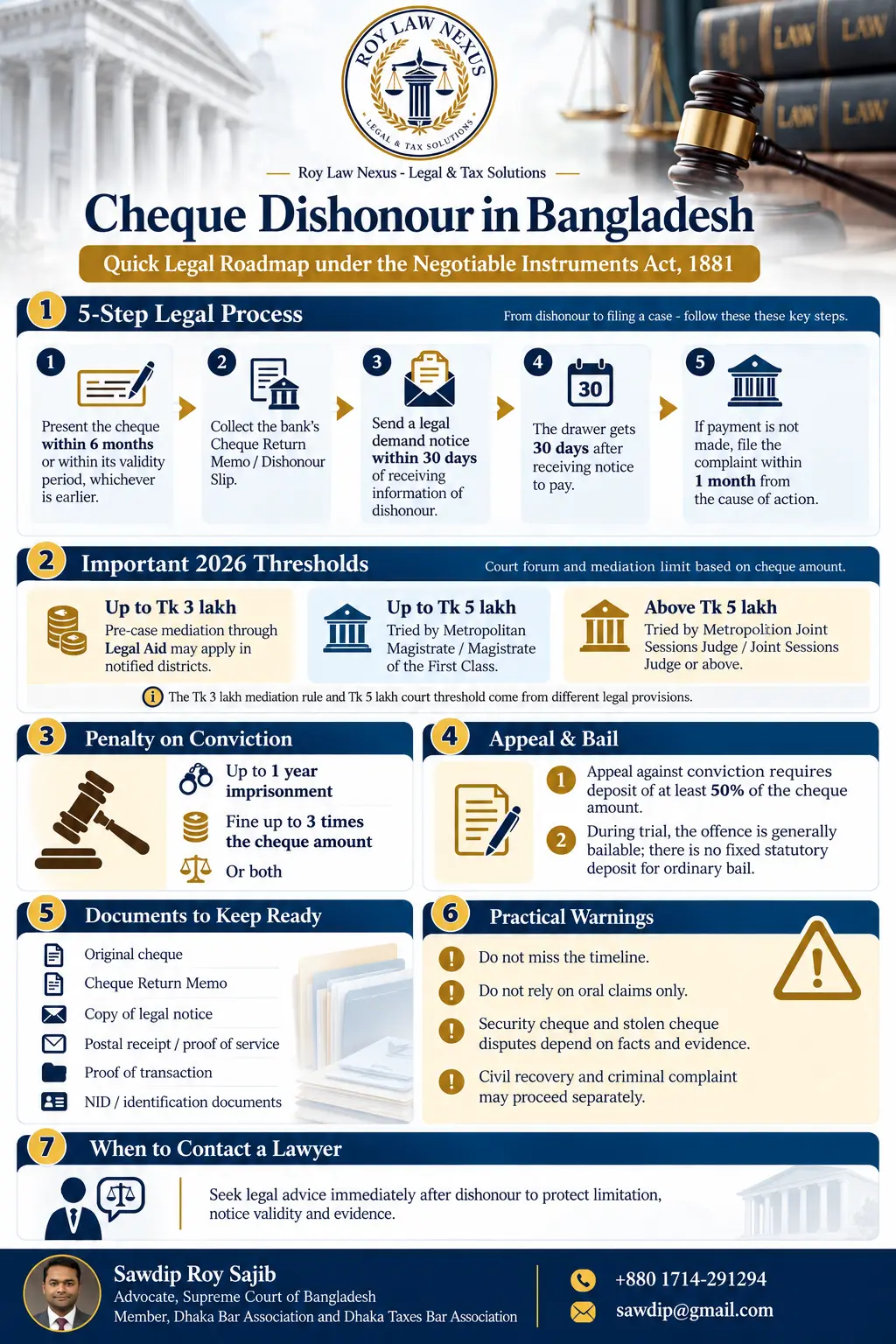
| Offence and maximum sentence | Section 138: up to one year's imprisonment, a fine up to three times the cheque amount, or both |
| Last date to present a cheque | Within six months of its date or its shorter validity period, whichever expires first |
| Deadline for statutory demand notice | Within 30 days of receiving the bank's information of dishonour |
| Time allowed to the drawer after notice | 30 days from receipt of the demand notice |
| Filing deadline | Within one calendar month after the cause of action arises; special exclusion applies to qualifying pre-case mediation |
| Complaint by whom? | The payee or a holder in due course, through a written complaint |
| Trial court for cheque of Tk 5 lakh or less | Metropolitan Magistrate or Magistrate of the First Class |
| Trial court for cheque above Tk 5 lakh | Metropolitan Joint Sessions Judge / Joint Sessions Judge or a competent higher court |
| Pre-case mediation | Required for cheques of Tk 3 lakh or less in areas where the relevant 2026 provisions have been brought into force |
| Deposit before appeal against sentence | At least 50% of the dishonoured cheque's face value, deposited in the sentencing court before filing the appeal |
Important: Bangladesh provides 30 days, not 15 days, for payment after receipt of notice. Section 139 of Bangladesh's NI Act was omitted in 2000. Indian law and articles applying its section 139 presumption must not be treated as a statement of current Bangladeshi law.
2. Cheque Dishonour Timeline, Decision Flow and Calculator
Start with this sequence. Record every date and item of service evidence separately; informal discussions or payment promises do not automatically suspend statutory limitation.
Present the cheque
Within six months of its date or its shorter validity period, whichever ends first.
Preserve the return memo
Keep the original cheque, bank return memo and evidence of presentment.
Serve written demand
Demand the cheque amount within 30 days after receiving the bank’s dishonour information.
Allow time to pay
The drawer receives 30 days after receipt of notice to make payment.
File the complaint
If unpaid, file within one month after cause of action, subject to applicable pre-case mediation.
Cheque Amount Decision Tool
Enter the face value of the dishonoured cheque. The tool shows arithmetic and value-based thresholds only; dates, territorial mediation and case merits still require legal review.
This is not a filing-fee, limitation or outcome calculator. The 50% figure applies before an appeal against sentence, not to ordinary bail during trial.
3. When Section 138 Applies
Under section 6 of the NI Act, a cheque is a bill of exchange drawn on a specified banker and payable on demand. The person signing and issuing the cheque is the drawer; the named beneficiary is usually the payee; and the bank asked to pay is the drawee bank.
A cheque may be returned for insufficient funds, exceeding an agreed overdraft arrangement, closure of the account, a stop-payment instruction, a signature discrepancy, expiry, or defects in completion. But not every bank return reason automatically satisfies section 138. The statutory language expressly addresses insufficiency of funds and sums exceeding the bank arrangement; disputes involving other return reasons require attention to the relevant facts and judicial decisions. A stale cheque, for example, raises a distinct statutory-presentment problem.
The normal section 138 process requires proof of a cheque drawn on the relevant account, lawful presentation within its validity, dishonour, a demand notice within the stipulated period, and failure to pay within 30 days after the notice is received. The separate filing requirements are in section 141. A case may fail for a defective procedural step even where an underlying commercial dispute exists.
4. Notice, Service, Mediation and Complaint Filing
Step 1 — Present the cheque within its validity
Verify the date, number, bank, payee, numerical and written amounts, and apparent signature before depositing the cheque. Under the proviso to section 138(1)(a), it must be presented within six months from its date or within its shorter period of validity, whichever is earlier. A post-dated cheque should not be presented for payment before the date written on it. Preserve the deposit acknowledgement and relevant bank correspondence.
Step 2 — Obtain and preserve the bank's return memo
Ask the bank for the original Cheque Return Memo, Dishonour Slip or equivalent documentary confirmation. Record the cheque details, date of presentment, date the bank informed you of dishonour, and the bank's stated reason. Keep the original cheque safely. The complaint and subsequent evidence should be consistent with these records.
Step 3 — Serve a written statutory demand notice within 30 days
Section 138(1)(b) requires the payee or holder in due course to demand the cheque amount in writing within 30 days from receiving information from the bank that the cheque has been returned unpaid. This is not necessarily the same date printed on the bank memo.
The notice should accurately identify the drawer and payee, cheque number and date, bank and branch, face value, date and reason for dishonour, and a clear demand for payment of the cheque amount. It should explain that the drawer has 30 days after receiving the notice to make payment and that the statutory remedy may be pursued if payment is not made.
Section 138(1A) recognizes service by (a) delivery to the drawer, (b) registered post with acknowledgement due to the drawer's usual or last-known address of residence or business in Bangladesh, or (c) publication in a widely circulated national daily Bangla newspaper. Keep copies and evidence of the chosen mode of service. A lawyer's involvement is advisable for drafting and preserving proof, though the statute does not require every notice to be signed by an advocate.
Step 4 — Allow the drawer the full 30-day payment period
Section 138(1)(c) allows the drawer 30 days after receipt of notice to pay. If the full cheque amount is paid in that period, the statutory non-payment condition for the relevant dishonour is not met. If it is not paid, the cause of action under section 138 arises after expiry of the period. A complaint brought before that event is vulnerable as premature. Keep reliable evidence of service and receipt; where service is contested, its legal effect may need judicial determination.
Step 5 — Check whether mandatory pre-case mediation applies
Before preparing the court complaint, assess the value of the cheque and the district in which the case would be brought. Under the 2026 amendments to the Legal Aid Services Act, 2000, qualifying cheque-dishonour disputes not exceeding Tk 3,00,000 must first be brought to the Legal Aid Office for an attempt at pre-case mediation in districts where the relevant provisions have commenced. It is the attempt at mediation, not an obligation to reach settlement, that is prescribed. The statutory report following unsuccessful mediation must accompany the subsequent case as required by law.
Step 6 — File a written complaint in the appropriate court
Section 141(a) allows cognizance only on a written complaint by the payee or holder in due course. Under section 141(b), it must ordinarily be filed within one calendar month from the cause of action arising under section 138(1)(c). Where mandatory pre-case mediation applies, section 21B(4) of the amended Legal Aid Services Act excludes the time spent in that process when calculating limitation. Ordinary private negotiations do not automatically suspend statutory limitation.
The matter is commonly registered as a CR (Complaint Register) case. CR does not mean “Criminal Revision.” Filing/cognizance procedure should also be distinguished from the trial court designated under the amended section 141(c). A police general diary alone is not a substitute for a section 141 written complaint.
Step 7 — Prove the complaint and respond to the defence
Court proceedings involve applicable summons, appearance, evidence and cross-examination under criminal procedure. Relevant issues include the cheque and signature, bank presentation and dishonour, the demand notice and service, the limitation dates, and questions about consideration, lawful possession, fraud or prior payment. A dishonoured cheque is significant evidence, but conviction is not automatic.
5. 2026 Court Jurisdiction, Court Fees and Procedure
The Tk 5 lakh threshold: Which court tries a cheque dishonour case?
The Negotiable Instruments (Amendment) Act, 2026 (Act No. LXV of 2026), dated 10 April 2026, replaced section 141(c). For a cheque with a face value exceeding Tk 5,00,000, the offence must be tried by a court not inferior to that of a Metropolitan Joint Sessions Judge or Joint Sessions Judge, as applicable. Other section 138 offences are triable by a Metropolitan Magistrate or Magistrate of the First Class. The earlier Ordinance No. 34 of 2026 was repealed with a saving provision.
This is a trial-jurisdiction rule. The administrative procedure for initially lodging and taking cognizance of a complaint can involve the applicable magistracy and case-allocation rules; it should not be confused with who ultimately tries the case.
The Tk 3 lakh threshold: Where is Legal Aid Office mediation compulsory?
The Legal Aid Services (Amendment) Act, 2026 (Act No. XLV of 2026) introduced section 21B into the Legal Aid Services Act, 2000. Schedule item 7 covers section 138 cheque-dishonour complaints involving cheques not exceeding Tk 3,00,000. In districts notified by the Government, an aggrieved party must first apply to the Legal Aid Office for mediation; if unsuccessful, the prescribed report must be filed with the court. Section 21B(4) excludes the mediation period for limitation purposes. Under section 21C, a properly signed and certified mediation agreement has the statutory effect prescribed for enforceable settlements.
According to the official legislative note on S.R.O. No. 288-Law/2026 of 30 July 2026, the relevant provision commenced on 31 July 2026 in these 30 districts: Faridpur, Mymensingh, Rangpur, Dinajpur, Satkhira, Kushtia, Cumilla, Noakhali, Rangamati, Sylhet, Moulvibazar, Sunamganj, Munshiganj, Chapainawabganj, Joypurhat, Kurigram, Narsingdi, Jhenaidah, Magura, Lakshmipur, Bogura, Thakurgaon, Patuakhali, Bhola, Natore, Jashore, Shariatpur, Cox's Bazar, Panchagarh and Tangail. Further government notifications should be checked for later territorial expansion.
The two thresholds are different: Tk 3 lakh concerns mandatory mediation in notified districts; Tk 5 lakh concerns which criminal court conducts the trial. One does not replace the other.
A criminal cheque-dishonour complaint is not subject to a percentage-of-claim filing deposit of 5%, 10% or 50%. Its filing costs should not be confused with the separate deposit required after conviction for an appeal, nor with the ad valorem court fees potentially relevant to a distinct civil recovery suit.
The Court-fees (Amendment) Act, 2010, Schedule II, identifies, subject to the conditions of the respective entries:
| Item | Statutory fixed amount |
|---|---|
| Ordinary relevant criminal complaint petition (Schedule II, Article 1(b)) | Tk 10 |
| Vakalatnama presented in a subordinate civil/criminal court (Article 8(a)) | Tk 30 |
| Applicable bail bond or other covered instrument of obligation (Article 6) | Tk 25 |
These are document-specific fees, not a universal combined fee payable by the complainant. Additional practical costs can include process charges, service and registered post, document copying, drafting of demand notices, advocate's professional fees and court appearances. Confirm current local filing and stamp requirements before presenting documents.
6. Evidence, Defences and Key Supreme Court Decisions
Security and post-dated cheques — Mohammad Alauddin
In Mohammad Alauddin and others v. The State and others, Criminal Appeal Nos. 11–17 of 2017 and connected matters; 24 BLC (AD) 139 (24 October 2017), the Appellate Division held that a cheque is not automatically exempt from section 138 merely because it was issued as security or was post-dated. The facts and terms of the underlying arrangement still matter; allegations of fraud, unauthorized completion or inflated amounts may require evidence. “It was only a security cheque” is therefore not, by itself, a conclusive defence.
Presumption of consideration is rebuttable — Abul Kaher Shahin
In Md. Abul Kaher Shahin v. Emran Rashid and another, 14 SCOB [2020] AD 96, Criminal Appeal Nos. 63–66 of 2017 (18 February 2020), the Appellate Division explained the interaction of sections 43 and 118(a). When execution is admitted or proved, the law raises a presumption of consideration; nevertheless, it may be rebutted by a credible or probable defence, including failure of conditions fundamental to the claimed payment. The legal analysis cannot end merely at the signature.
A comparative caution is essential: in Bangladesh, the 2000 amendments removed the phrase concerning the discharge of a debt or other liability from section 138 and omitted section 139. Indian section 138/139 decisions must not be copied as if those provisions were identical in Bangladesh. Equally, omission of that wording does not abolish the continuing relevance of sections 43 and 118(a), lawful possession, fraud or contractual conditions.
A signature does not end the evidential inquiry — Lokman v. Ayub Ali
In Lokman v. Ayub Ali and the State, Criminal Appeal No. 6094 of 2016 (High Court Division, 9 July 2017), the Court examined material contradictions about when the alleged payment had been made, the absence of reliable proof of the claimed transaction, a bank endorsement of “Signature Differs”, and defence evidence about how the cheque had been obtained. The accused's acknowledgement of the signature did not dispose of the real evidential dispute, and the acquittal was maintained. The decision illustrates the operation of the rebuttable presumption and the need to examine whether a claimant is entitled to enforce the instrument; it does not mean a drawer can defeat every complaint merely by denying a debt.
Lost, stolen or misused cheques — Md. Muksedur Rahman Badal
In Md. Muksedur Rahman Badal v. The State and another, 1 SCMB [2015] HCD 59 (related appeals decided in November 2014), the High Court Division examined an allegation that signed cheques had been removed or misused by a person with access to the drawer's business records. Contemporary police diary entries, bank records, account books and defence witnesses formed part of the evidential assessment. A stolen cheque is not necessarily a lawful instrument in the hands of the person who misappropriated it: sections 9 and 118(g) become particularly important when title is alleged to have been obtained through an offence or fraud. The allegation of theft must, however, be supported by persuasive evidence; making a GD does not itself guarantee an acquittal.
Blank cheques and writing inserted by another person
There is no safe general rule that a cheque becomes invalid simply because the amount, date or payee's name appears in handwriting different from the drawer's signature. The question is whether the instrument was lawfully issued or completed within authorization, and whether there was a material alteration, fraud or other legally effective defence. Section 87 addresses material alteration; section 20 concerns particular incomplete stamped instruments and should not be treated as unlimited authority to fill every signed blank bank cheque. The six-month validity rule is also distinct from these issues.
Joint bank accounts and the actual cheque signatory — Rouson Ara Mia
In Rouson Ara Mia v. The State and another, Criminal Miscellaneous Case No. 31800 of 2023 (High Court Division, 30 April 2026), the Court considered whether a non-signatory joint account holder could automatically incur section 138 liability because another account holder signed and issued the cheque. Mere joint account ownership was not treated as sufficient on those facts. Verify who drew and signed the cheque and distinguish individual from company liability under section 140.
Presentment, service of notice and procedural evidence
A complainant should also examine Md. Moslem v. The State and another, 20 SCOB [2025] HCD, for the importance of proving the statutory steps, including presentment and proper service of notice. The demand notice, proof of dispatch and relevant service records should not be treated as routine formalities.
7. Bail, Appeal, Civil Recovery and Settlement
Bail while a case is pending
The offence under section 138, carrying a statutory maximum of one year of imprisonment, is generally classified as bailable under the Code of Criminal Procedure, 1898 and its classification for offences under other laws. The applicable bail-bond and surety requirements depend on the procedural stage and court order. There is no general rule that an accused awaiting trial must deposit 50% of the cheque amount in cash merely to obtain bail. A sum written in a personal or surety bond is not automatically a cash deposit. See, in particular, the CrPC provisions on bailable offences and bail bonds.
Deposit before appeal against conviction
Section 138A is different and mandatory. Before an appeal against a sentence under section 138(1) may be filed, the appellant must deposit not less than 50% of the dishonoured cheque's face value in the court that imposed the sentence. This is a statutory appeal precondition, not the court fee for filing the original complaint and not a guarantee of bail or of success on appeal.
In Pubali Bank Limited v. Chowdhury Shamim Hamid and another, Criminal Petitions for Leave to Appeal Nos. 1059–1061 of 2024 (11 June 2024), the Appellate Division held that the statutory 50% prerequisite could not be bypassed by granting the convicted person temporary bail merely to assemble the money before filing the appeal. This ruling should not be misread as imposing the same deposit on every accused person during the original trial.
May a civil loan-recovery case and a cheque-dishonour prosecution proceed together?
They may, subject to their own statutory requirements. A civil recovery claim seeks enforcement of a monetary obligation; a prosecution under section 138 addresses the separate statutory offence of dishonouring a cheque after non-compliance with the demand-notice procedure. The Appellate Division's decision in Monzur Alam (Md.) v. The State and another, 55 DLR (AD) 62, is frequently relied upon for the principle that pending civil proceedings concerning a transaction do not automatically bar criminal proceedings arising from it. The High Court Division addressed the separate remedies in Md. Monjurul Islam v. Bangladesh Bank and others, Writ Petition No. 1791 of 2025 (15 December 2025).
This is not automatically a constitutional prohibition against double criminal punishment: an ordinary civil money claim is not a second criminal prosecution for the same offence. Nevertheless, sums already recovered must be appropriately accounted for. A claimant cannot legitimately obtain double recovery of the same debt.
Does conviction guarantee the cheque holder will recover all the money?
No. Section 138(1) provides a possible criminal sentence and fine, but section 138(2) permits payment to the holder out of fine actually realized, up to the cheque's face value and to the extent covered by that realization. Under section 138(3), the holder preserves the right to establish a civil claim for any remaining unpaid amount, subject to applicable limitation, procedure and credit for sums recovered. A ceiling of three times the cheque amount on the offender's fine does not mean the holder automatically receives triple the cheque amount.
Is a compromise automatically effective to terminate a prosecution?
Not automatically. The offence under section 138 is not generally designated compoundable in the manner familiar from Indian NI Act section 147. Bangladeshi courts have considered voluntary settlement and repayment at different procedural stages, but decisions are sensitive to the relief sought, the stage of the proceedings and the controlling precedent. Do not represent a private settlement as automatically quashing a criminal complaint. The certified pre-case mediation agreement under section 21C of the amended Legal Aid Services Act has its own statutory consequences.
8. Pre-Filing and Defence Checklist
Documents a cheque holder should preserve
- Original cheque and legible copies; cheque number and date.
- The bank's original return memo and proof of presentment.
- Written statutory demand notice and a complete record of its contents.
- Registered-post receipt and acknowledgement, direct-service proof, or the newspaper publication used for statutory service.
- Invoices, contracts, account statements, money receipts, correspondence or other evidence relevant to the disputed transaction.
- Where applicable, the prescribed Legal Aid Office mediation report.
What if you receive notice or are accused under section 138?
Check the cheque's execution and provenance, relevant bank records, whether any amount has already been paid, the notice dates and mode of service, the claimed consideration, and whether the payee obtained the instrument lawfully. Preserve contracts, transaction records, messages, bank transfers and police reports. Cross-examination or expert evidence may be appropriate in a genuine dispute over authorization, signature or alteration, but no single line of defence guarantees acquittal. An allegation of forgery or theft should not be made without an honest factual and evidential basis.
What if a signed cheque book leaf is lost or stolen?
Notify the bank promptly in writing, ask for appropriate stop-payment safeguards, make a timely police general diary if warranted, retain dated acknowledgements and relevant account records, and answer any legal notice with a properly supported explanation. A stop-payment instruction or GD is not a blanket immunity from a valid section 138 claim.
9. How Roy Law Nexus Can Help
Roy Law Nexus provides focused representation and preventive advice for cheque holders, drawers, businesses, financial institutions and individuals facing a section 138 dispute.
Timeline and merits audit
Review the cheque, bank memo, transaction, service history, limitation dates, court and any applicable Legal Aid mediation requirement.
Demand notice and service
Draft a precise statutory demand, select a lawful service method and organise dispatch, acknowledgement or publication evidence.
Complaint and evidence file
Prepare the complaint, affidavit and supporting record; coordinate original cheque, bank witness, transaction and service evidence.
Defence, bail and warrant response
Assess execution, consideration, authorization, prior payment, theft, alteration, limitation and procedural defences; assist with appearance and bail.
Settlement and civil recovery
Structure lawful negotiation or mediation while protecting limitation and coordinating any separate civil recovery claim.
Appeal, revision and 50% deposit
Advise after judgment on the statutory deposit, sentence suspension, appeal or revision and the correct record for the higher court.
10. Frequently Asked Questions
Can a section 138 case be filed as soon as the bank returns the cheque?
No. The written demand notice, lawful service, the drawer’s 30-day payment period and the one-month complaint deadline must be handled in sequence.
Is the drawer’s payment period 15 days or 30 days in Bangladesh?
The current Bangladesh statute allows 30 days after receipt of the demand notice. The notice itself must be given within 30 days after the payee receives the bank’s dishonour information.
Does every dishonoured cheque automatically create criminal liability?
No. Section 138 has specified statutory conditions, and the reason for return, presentment, notice, service, timing and evidence all matter.
Which court tries a cheque for exactly Tk 5 lakh?
Under the 2026 section 141(c), a cheque of Tk 5 lakh or less is triable by a Metropolitan Magistrate or Magistrate of the First Class.
Is Legal Aid mediation compulsory for every section 138 case?
No. The current rule concerns cheques not exceeding Tk 3 lakh and operates in the districts brought under the relevant 2026 commencement notification. Check the current territorial position.
Must an accused deposit 50% to obtain ordinary bail during trial?
No general 50% cash-deposit rule applies to ordinary trial bail. Section 138A requires at least 50% of the cheque amount before an appeal against sentence.
Can a security or blank cheque support a complaint?
Potentially. The label security cheque is not conclusive. Authorization, lawful possession, consideration, alteration, payment and the surrounding agreement may determine the result.
Can criminal proceedings and civil recovery continue together?
They may proceed as distinct remedies if their separate legal requirements are satisfied, but payments must be credited and double recovery is not lawful.
12. Conclusion
A cheque-dishonour matter is won or lost on disciplined dates, lawful service and credible documents. Preserve the cheque and return memo, calculate the two 30-day periods and the one-month filing window correctly, verify the 2026 mediation and court thresholds, and obtain case-specific advice before a deadline or evidential gap becomes irreversible.
About the Author

Sawdip Roy Sajib
Advocate, Supreme Court of Bangladesh
Member, Dhaka Bar Association and Dhaka Taxes Bar Association
Legal Disclaimer: This article provides general legal education based on primary official sources reviewed through 11 October 2026. It is not advice for a particular cheque, complaint, defence, settlement or appeal. Facts, service evidence, territorial commencement, limitation computation and later legal changes may alter the correct course.