
Key points at a glance
/transfer-of-property-amendment-2026-bangladesh-lifetime-usufruct-hiba
Bangladesh's Parliament has approved a significant amendment to the Transfer of Property Act, 1882 creating a specific statutory form of family gift under which the ownership of property may be transferred while the donor reserves the right to enjoy that property throughout the donor's lifetime.
The Transfer of Property (Amendment) Bill, 2026 — Bill No. 105/2026 was officially published on 27 August 2026 and passed by the Jatiya Sangsad on 6 September 2026. It introduces new sections 122A and 122B.
Its central concept is:
The mechanism is available for specified close-family transfers involving parents and children, grandparents and grandchildren in either direction, and spouses. For immovable property, a registered instrument is required. If the donee dies first, the donor's lifetime usufruct continues even though title devolves to the donee's heirs.
Most importantly for the present public debate, the amendment also expressly states that this is a distinct mode of transfer and that it does not invalidate or restrict existing gifts, Heba, or other legally recognised modes of transfer.
The core framework is already open. Select any larger topic below to read its connected guidance together.
A Necessary Legal-Status Note
As of the evening of 7 September 2026, the Government Press database still clearly identifies the officially published text as Bill No. 105/2026, and Parliament has confirmed passage on 6 September. I have not yet located a separately published final presidentially assented Amendment Act in the Government Press or an updated consolidated section 122A/122B on Bangladesh Laws.
Under Article 80 of the Constitution, a Bill passed by Parliament becomes law after presidential assent or deemed assent according to the constitutional procedure.
Accordingly, this article analyses the Parliament-passed amendment and the officially published Bill text, while the final gazetted Act should be checked before a deed is executed in reliance upon the new provisions.
This qualification is important because Parliament's standing committee considered the Bill before passage, although contemporary reporting indicates no significant substantive alteration to the property amendment's central scheme.
How the New Family-Gift Structure Works
The Existing Law of Gift Before Section 122A
Section 122 of the Transfer of Property Act, 1882 already recognises a gift as a voluntary transfer of existing movable or immovable property without consideration, made by a donor and accepted by or on behalf of a donee.
Acceptance must occur during the donor's lifetime and while the donor remains capable of giving.
For immovable property, section 123 requires a registered instrument, signed by or on behalf of the donor and attested by at least two witnesses. Bangladesh law also expressly addresses declarations of Heba under Muslim law within the registration framework.
The problem identified by the Government was therefore not the absence of a law governing gifts generally.
The perceived gap was more specific:
there was no express statutory family-gift mechanism under the Transfer of Property Act allowing title to be transferred while formally reserving lifetime enjoyment to the donor.
Sections 122A and 122B are intended to fill that gap.
Section 122A: The Core Innovation
The section is headed:
The text supplied from Bill No. 105/2026 states in subsection (1):
This is the operative heart of the amendment.
There are three important elements in that sentence.
1. There is an immediate transfer by gift
The mechanism is not structured as a will taking effect only after death.
The ownership interest is transferred during life.
2. The donor reserves a different right
The donor reserves lifetime enjoyment or usufruct, rather than retaining the full ownership already transferred.
3. The provision begins with a strong overriding clause
The words:
are legally significant.
They are intended to remove uncertainty that might otherwise arise from provisions dealing with absolute interests, conditions attached to transfers, possession or ordinary gift principles.
“Lifetime Possession” Is Useful Everyday Language—but “Usufruct” Is More Accurate
Public discussion has largely described the reform as allowing parents to retain আজীবন ভোগদখল or lifetime possession.
That description communicates the idea well, but the statutory expression is broader and more precise:
“lifetime enjoyment (usufruct rights)”.
Usufruct may potentially encompass more than merely physically living in a house.
Depending on the deed and the nature of the property, it may raise questions concerning:
- residence;
- physical possession;
- use;
- rents;
- crops;
- profits;
- commercial income; and
- management of the property.
The exact content of the usufruct should therefore be expressly defined in the deed rather than leaving the parties to fight later about what “enjoyment” was intended to include.
Who Can Use Section 122A?
Section 122A(2), according to the published Bill text, limits this new mechanism to specified close-family relationships:
| Donor | Permitted donee |
|---|---|
| Parent | Child or children |
| Child | Parent |
| Grandparent | Grandchild or grandchildren |
| Grandchild | Grandparent |
| Husband | Wife |
| Wife | Husband |
The provision is therefore not a universal usufruct-gift device available between any two persons.
A gift between friends, unrelated persons, cousins, business partners or corporations should not be assumed to qualify under section 122A.
The ordinary law of transfer would remain relevant to those cases.
Registered Deed Is Essential for Immovable Property
For immovable property, section 122A(2) expressly links the new transaction to section 17(1)(a) of the Registration Act, 1908, which makes instruments of gift of immovable property compulsorily registrable.
That makes registration fundamental.
A family understanding such as:
is not equivalent to properly creating the statutory interest through the required registered instrument.
For a high-value property, the registered deed should make unmistakably clear:
what ownership passes and what lifetime rights remain.
The Central Property-Law Distinction: Corpus vs Usufruct
The new mechanism makes much more sense when the property is conceptualised as containing two legally distinguishable interests.
Corpus
The underlying ownership or title.
Usufruct
The right to enjoy or benefit from the property.
Under section 122A:
Corpus/title → Donee
while
Lifetime usufruct → Donor
This is why saying that “the donor remains the owner until death” would be legally misleading.
The donor does not ordinarily remain the full owner.
Rather, the donor retains a legally protected interest attached to property whose ownership has been transferred.
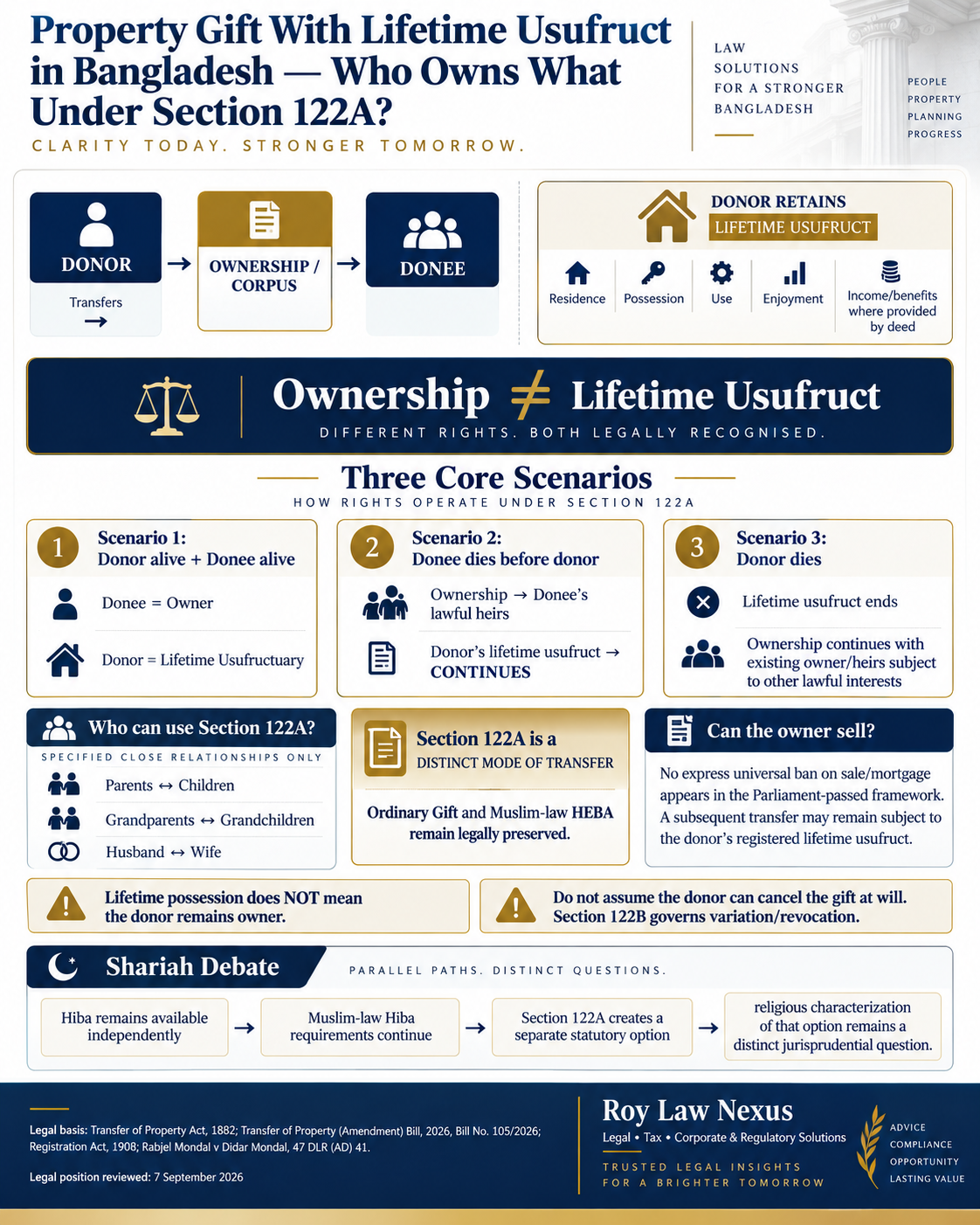
A Simple Example
Assume A, a father, owns a residential house.
A transfers it to daughter B under section 122A and reserves lifetime usufruct.
Immediately thereafter:
| Legal position | Person |
|---|---|
| Registered ownership | B |
| Lifetime usufruct | A |
| Right intended to continue during A's lifetime | A |
| Full enjoyment after A's usufruct ends | B or B's successors |
A can therefore secure ownership in B during his lifetime without necessarily surrendering his own lifetime enjoyment.
That is the practical value of the reform.
What Happens If the Donee Dies Before the Donor?
Section 122A(3) answers this directly.
If the donee dies while the donor remains alive:
the property passes to the donee's heirs according to applicable succession law, but
the donor's right of enjoyment continues and remains attached to the property.
That result has also been confirmed in explanations of the passed Bill.
Suppose B dies before A.
B's heirs may become owners.
But they do not automatically acquire a right to displace A's lifetime usufruct.
This produces an important legal formula:
And equally:
Hiba, Shariah and Inheritance Questions
Section 122A(4): The Provision at the Centre of the Shariah Debate
This subsection deserves to be reproduced because much of the current debate cannot properly be understood without it.
The published text states:
This language has major interpretative consequences.
It means Parliament has deliberately characterised section 122A as:
a distinct statutory transfer, rather than simply rewriting the rules of traditional Hiba.
It also expressly attempts to preserve:
- ordinary gifts;
- Heba;
- and other recognised modes of transfer.
The Law Minister relied on this provision during the parliamentary debate, arguing that the new mechanism is not intended to replace or restrict Muslim-law Heba.
Does the New Law Abolish or Change Muslim Hiba?
On the face of section 122A(4), no.
A Muslim who wishes to make a traditional Hiba may continue to use that mechanism subject to the applicable rules of Muslim law and Bangladesh's statutory registration requirements.
Likewise, the new mechanism is not described as compulsory.
The amendment instead creates an additional choice.
Legally, therefore, it is difficult to characterise section 122A as saying:
“Hiba is no longer valid.”
The text says almost the exact opposite.
That does not, however, dispose of every Shariah objection.
The Real Shariah Question Is More Subtle
Opposition MPs, Islamic organisations and scholars have argued that a gift in which the donor retains lifetime enjoyment may conflict with traditional principles governing Hiba, possession and inheritance. Opposition MPs requested review by Shariah specialists and the Islamic Foundation before the Bill was passed.
That concern should be taken seriously as a jurisprudential argument.
But the question should be framed correctly.
There are actually two separate questions.
Question 1 — Does section 122A abolish traditional Hiba?
The statutory answer appears to be no, because section 122A(4) expressly preserves it.
Question 2 — Is a section 122A transfer itself identical to, or necessarily valid as, a traditional Shariah Hiba?
That is a much more complicated question.
The amendment itself calls section 122A a distinct mode of transfer.
It therefore need not necessarily be characterised as Hiba at all.
Bangladesh Case Law Shows Why the Hiba Debate Is More Nuanced Than It Appears
Bangladesh courts have repeatedly recognised that traditional Hiba involves important requirements including:
declaration by the donor, acceptance by the donee and delivery of possession.
A recent High Court Division decision reiterated that delivery of possession remains an indispensable element for completion of Hiba under Muslim law.
This provides a legitimate doctrinal basis for those asking:
How can a donor retain possession and still say that a Hiba has been completed?
But that is only one part of Muslim property jurisprudence.
Muslim Law Also Distinguishes the Corpus From the Usufruct
Bangladesh's own superior courts have recognised a distinction between the corpus of property and its usufruct.
In Rabjel Mondal v Didar Mondal, 47 DLR (AD) 41, subsequently discussed by the High Court Division, the Appellate Division examined the distinction between Hiba and ariyat and the possibility of limited interests in usufruct.
A later High Court judgment, referring to that Appellate Division authority, summarised the position:
The High Court has also discussed Nawazish Ali Khan v Ali Raza Khan, where the Muslim-law distinction between the corpus and usufruct was central to analysing whether a transaction validly transferred ownership or only a limited right.
Thus the proposition:
“Islamic law recognises no distinction whatsoever between ownership and usufruct”
would be too broad.
The genuine doctrinal dispute is more precise.
It concerns whether the donor has sufficiently divested ownership and dominion over the corpus, while retaining only a permissible benefit or usufruct, or whether the donor has in reality retained such complete possession and control that the purported gift was never perfected as Hiba.
That distinction has occupied Muslim-law courts for decades.
Why Section 122A Changes the Civil-Law Position Even If the Hiba Debate Continues
Section 122A appears deliberately designed to avoid requiring courts to squeeze this new transaction into traditional Hiba doctrine.
It expressly says:
this is a distinct mode of transfer.
Therefore a transaction might potentially be:
valid under section 122A as a statutory civil transfer
without the legislature necessarily declaring that:
the transaction is a classical Hiba under every school or interpretation of Islamic jurisprudence.
This is perhaps the most legally accurate way to understand the amendment.
It also explains why theological criticism and civil-law validity should not automatically be treated as the same question.
Does Providing an Alternative “Undermine” Shariah?
Some critics argue that introducing a parallel civil mechanism beside Hiba suggests that the Shariah system is inadequate.
That is ultimately partly a religious and normative argument, rather than merely a question of statutory interpretation.
From a strictly legal perspective, section 122A(4) does three things:
it preserves Hiba;
it does not compel a Muslim to use section 122A;
and
it makes section 122A available as a separate statutory option.
Bangladesh's Constitution identifies Islam as the state religion while also guaranteeing religious freedom, subject to law, public order and morality, and equal rights in the practice of other religions.
Whether an individual Muslim should religiously choose section 122A instead of Hiba is therefore a different question from whether Parliament has legally abolished the ability to practise Hiba.
The latter claim is difficult to reconcile with subsection 122A(4).
Is This Comparable to the Muslim Family Laws Ordinance, 1961?
The comparison is useful academically—but the two laws are structurally different.
The Muslim Family Laws Ordinance, 1961 (MFLO) expressly applies to Muslim citizens and provides that its provisions operate notwithstanding law, custom or usage. It directly modifies areas such as succession representation, polygamy and divorce procedure.
Section 122A, by contrast:
| MFLO 1961 | Section 122A mechanism |
|---|---|
| Applies specifically to Muslims | Religion-neutral |
| Directly regulates Muslim family law | Creates civil property-transfer option |
| Overrides law/custom in covered field | Creates distinct mode of transfer |
| Alters legal rules applicable to Muslims | Expressly preserves Hiba |
| Includes succession modification | Does not itself rewrite inheritance shares |
Therefore it would be inaccurate to say that the two mechanisms are legally identical.
However, there is an important qualification.
Although section 122A does not expressly amend Muslim succession law, it may have significant practical effects on succession outcomes.
The Major Inheritance Question: Could Section 122A Be Used to Reduce the Estate Available for Faraid?
Yes, this is a serious practical implication.
Inheritance rules operate on property forming part of the deceased person's estate at death.
A genuine lifetime transfer that has already divested ownership may remove the transferred property from that estate.
Section 122A may therefore make lifetime transfers more attractive because donors can transfer title without sacrificing their lifetime enjoyment.
Consider parents who have daughters but no sons.
Under traditional Muslim inheritance rules, the eventual distribution of the estate may involve daughters together with other entitled heirs depending on the family structure.
If the parents validly transfer substantially all relevant property to their daughters during life, ownership may no longer remain in the parents' estate at death.
The amendment does not create the concept of lifetime gifting—that possibility already exists.
What section 122A potentially changes is the incentive structure:
This may make inter vivos estate planning substantially more attractive.
That is a legitimate area for both legal and Islamic scholarly debate.
But Section 122A Should Not Be Marketed as a “Way to Defeat Faraid”
That would be both legally and ethically irresponsible.
A particular lifetime transaction may still raise questions concerning:
- true voluntariness;
- mental capacity;
- coercion;
- undue influence;
- fraud;
- sham transactions;
- creditors;
- ownership of the property;
- statutory restrictions;
- applicable personal law; and
- the actual legal character of the deed.
Moreover, Islamic jurisprudence contains ethical teachings concerning fairness in lifetime gifts to children, separate from the technical civil validity of a deed.
For a reputable law firm, section 122A should therefore be discussed as a family-property and lifetime-security mechanism, not as an inheritance-avoidance product.
Donor Protection, Neglect and Cancellation
Was a New Property Law Necessary When Bangladesh Already Has the Parents’ Maintenance Act, 2013?
This criticism also deserves a serious answer.
The Parents' Maintenance Act, 2013 already imposes duties on capable children to maintain parents, including food, clothing, medical care, accommodation and companionship. Failure may attract a fine of up to Tk 100,000 or imprisonment in default.
Critics therefore ask:
Why amend property law rather than strengthen the maintenance law?
The answer is that the two laws address different legal interests.
Parents' Maintenance Act
Creates personal obligations owed by children to parents.
Section 122A
Creates or preserves a proprietary right attached to the transferred property.
A maintenance prosecution may punish a neglectful child.
It does not necessarily answer the immediate proprietary question:
Can the parent lawfully remain in the very house they have already gifted?
Section 122A addresses that problem directly.
The two regimes are therefore capable of operating complementarily, not exclusively.
The More Serious Weakness: What If the Child Neglects the Parent After the Gift?
This was one of the most important issues raised during parliamentary consideration.
A lifetime usufruct protects the donor's right to use property.
But it does not necessarily solve:
- emotional neglect;
- financial abuse;
- harassment;
- refusal to maintain;
- interference with peaceful enjoyment; or
- pressure to surrender the usufruct.
Independent MP Rumin Farhana proposed an additional safeguard enabling a neglected or abused donor to seek judicial cancellation and also proposed restricting sale or mortgage during the donor's lifetime without written consent. Contemporary reports indicate these proposed clause amendments were not adopted.
This exposes a genuine design limitation:
The Parents' Maintenance Act may address some conduct, but it does not automatically restore ownership.
Section 122B: Can the New Gift Be Cancelled?
Section 122B creates a special framework for revocation or variation of a section 122A transfer.
Available descriptions of the published Bill indicate that registration generally makes the arrangement irrevocable, subject to specified exceptions.
Where genuine necessity arises—reported categories include financial, medical, educational and family necessity—the donor and donee may by mutual agreement and registered instrument vary or revoke the arrangement.
Where meaningful consent cannot be obtained because, for example, a party is a minor, missing or legally incapacitated, an application may be made to the District Judge, who is required to follow procedural safeguards including notice, inquiry and examination of good faith.
This should be read alongside existing section 126 of the Transfer of Property Act, under which gifts cannot ordinarily be made revocable merely at the donor's unilateral will.
A Major Client Warning: Lifetime Usufruct Does Not Mean “I Can Take My Property Back Whenever I Want”
This misconception is likely to become common.
After the section 122A transfer:
the donee is the owner.
The donor retains the lifetime right.
The donor should therefore not execute the deed believing:
That is precisely the distinction the deed must explain.
Sale, Buyers, Market Value, Mutation and Mortgage
Can the Donee Sell the Property During the Donor's Lifetime?
This is another major issue arising from public commentary.
The short answer is:
The Bill does not appear to contain the absolute statutory prohibition on sale or mortgage that some MPs proposed.
In fact, an amendment requiring the donor's written consent before such alienation was specifically proposed during the parliamentary debate. Available reports indicate that proposed clause amendments were rejected.
The existing Transfer of Property Act also generally disfavors an absolute restraint on alienation: section 10 ordinarily renders such a condition void, subject to specified exceptions.
Therefore, the better preliminary analysis is:
The precise operation of this proposition under the final Act will require future judicial interpretation.
Would a Purchaser Be Bound by the Donor's Usufruct?
There is a strong legal basis for saying that a purchaser cannot simply ignore a properly registered lifetime interest.
Section 3 of the Transfer of Property Act provides that where a transaction concerning immovable property is required to be registered and has been properly registered, a person subsequently acquiring the property is generally deemed to have notice of the registered instrument.
Actual possession may itself also operate as notice of another person's title or interest.
This is highly significant for section 122A.
If:
- the donor's usufruct is clearly contained in the registered deed; and
- the donor remains physically in possession,
a later purchaser will face substantial difficulty arguing that the donor's interest was unknown.
Nevertheless, the exact priority and enforcement consequences should await judicial development and the final statutory text.
Will the Market Value Be Lower?
Quite possibly in commercial terms—but that is an economic consequence, not a statutory formula.
A purchaser who cannot obtain vacant possession or full enjoyment until the usufructuary dies is likely to value the property differently from an unencumbered property.
The effect may depend heavily on:
- donor's age;
- nature of the property;
- whether the donor receives rent;
- expected duration of usufruct;
- commercial use;
- ability to mortgage;
- maintenance obligations; and
- marketability.
Therefore:
market price may be affected, but the law does not prescribe a fixed “usufruct discount.”
What About Mutation?
Mutation does not itself create title.
The registered deed and substantive property law determine the rights of the donor and donee.
However, from a land-administration and due-diligence perspective, it would be highly desirable for mutation and digital land records to clearly reflect the existence of the donor's lifetime usufruct.
Otherwise, the land record may show the donee's ownership without making the continuing burden sufficiently visible to ordinary users.
At present, the Bill text available to us does not itself prescribe a standard mutation notation.
This is an important implementation issue for the Ministry of Land and registration authorities.
Can the Donee Mortgage the Property to a Bank?
The same analytical problem arises.
Ownership has transferred to the donee.
But the property remains burdened by the donor's lifetime right.
A bank considering the property as security will therefore need to examine:
Who owns the corpus?
Who is in possession?
Who receives the income?
Can the mortgagee obtain possession on enforcement?
When does the usufruct terminate?
What does the registered deed allow?
This may reduce the property's effectiveness as banking security during the donor's lifetime.
The rejected proposal requiring donor consent for mortgages shows that Parliament was expressly aware of this issue, but apparently did not impose that universal restriction in the passed Bill.
A New Due-Diligence Question for Lawyers, Banks and Buyers
After section 122A becomes operative, asking only:
“Who is the registered owner?”
will no longer be sufficient in every family-gift case.
A proper title investigation should ask:
Does someone else hold a registered lifetime usufruct?
The chain may look like:
Original Owner/Donor
↓ gift under section 122A
Donee becomes owner
\+
Donor retains lifetime usufruct
↓ possible later sale/mortgage/inheritance
Subsequent owner takes title potentially subject to usufruct
This will become relevant to:
- conveyancing;
- mortgages;
- property valuation;
- partition;
- injunctions;
- possession proceedings;
- execution;
- due diligence; and
- succession.
Legal Character, Religious Application and Policy Debate
Section 122A and Existing Sections 10 and 11: An Interesting Doctrinal Issue
Sections 10 and 11 of the Transfer of Property Act contain traditional rules against certain restraints on alienation and restrictions repugnant to absolute interests.
Section 122A, however, begins with:
This is legally significant.
It suggests that Parliament intends the lifetime usufruct itself to remain valid even if an argument might otherwise be constructed that reserving enjoyment is inconsistent with the absolute ownership transferred to the donee.
The statutory structure therefore appears to recognise a form of burdened ownership:
the donee has ownership,
but the donor's legally protected enjoyment survives for life.
Future courts will have to articulate precisely how this interacts with sections 10 and 11.
Is Section 122A a “Life Estate”?
Using common-law terminology, one might be tempted to call the donor's right a “life estate.”
That may not be technically accurate.
The statute deliberately uses:
“right of lifetime enjoyment (usufruct rights)”
rather than transferring a common-law life estate with remainder.
It is safer to use the statutory terminology:
lifetime usufruct.
This matters because Bangladesh property law does not necessarily reproduce the conceptual categories of English land law.
It Is Also Not a Lease
A lease under section 105 involves a transfer of the right to enjoy property for a period, normally in exchange for rent, premium, service or another consideration.
Under section 122A:
- the underlying transaction is a gift;
- ownership passes to the donee;
- the donor reserves enjoyment; and
- no landlord-and-tenant relationship is necessarily created.
The donor should therefore not be described as the “tenant” of their former property.
And It Is Not the Same as a Usufructuary Mortgage
A usufructuary mortgage involves security for a debt.
Section 122A does not.
The donor is not a mortgagee receiving possession to secure money.
Instead, the donor is the former owner who has transferred the corpus while retaining a lifetime beneficial right.
The terminology overlaps, but the legal transactions are fundamentally different.
Does the New Law Apply Equally to All Religions?
The Government has repeatedly stated that the mechanism is religion-neutral and is intended to apply to people of all faiths.
That makes sense structurally because section 122A is situated in the general Transfer of Property Act, not within a personal-law statute applying only to Muslims.
At the same time, subsection 122A(4) preserves specialised personal-law mechanisms including Hiba.
The resulting structure is therefore:
General statutory option
Section 122A.
Existing personal-law options
Continue independently where legally recognised.
Why the Hiba Preservation Clause Is So Important
Without subsection (4), a difficult argument could arise from the opening words of subsection (1):
Someone might contend that section 122A overrides inconsistent personal-law rules.
Subsection (4) appears intentionally designed to answer that concern.
It states affirmatively that the new transfer shall not be construed as:
- limiting;
- derogating from; or
- otherwise affecting
Heba or other recognised transfers.
From a statutory-interpretation standpoint, subsection (1) and subsection (4) should therefore be read together:
122A(1) validates the new transaction notwithstanding possible inconsistency.
122A(4) protects existing alternative transfer regimes from being displaced.
That is a carefully important distinction.
The Debate Should Therefore Not Be Reduced to “Shariah vs Anti-Shariah”
A more useful academic analysis recognises at least four levels.
| Question | Legal position |
|---|---|
| Does Hiba continue to exist? | Expressly yes under s 122A(4) |
| Is section 122A legally distinct from Hiba? | Yes |
| Can Muslim jurisprudence recognise separation of corpus and usufruct? | Bangladesh case law recognises the distinction |
| Is every section 122A transaction necessarily Shariah-compliant? | A separate jurisprudential question requiring scholarly analysis |
This framework allows legitimate religious concerns to be discussed without mischaracterising the text of the amendment.
Why Critics Still Have a Legitimate Point About Possession
The strongest criticism is not that Muslim law has never recognised usufruct.
It is that traditional Hiba jurisprudence places major importance on delivery of possession and divestment by the donor.
Bangladesh's High Court Division has recently reiterated that registration by itself does not necessarily establish completion of Hiba where delivery of possession is absent.
Section 122A deliberately validates a transaction in which the donor may retain lifetime enjoyment.
Thus, for a Muslim donor, the new statutory transfer may produce a result that would require very careful analysis if someone attempted to characterise the same document purely as traditional Hiba.
That is precisely why subsection (4)'s declaration that section 122A is distinct is so important.
Is Section 122A an Indirect Change to Muslim Inheritance?
Formally:
No.
It does not amend the Quranic shares or the statutory rules governing succession.
Functionally:
It can affect the amount of property available for inheritance.
Those propositions are not inconsistent.
Succession operates after death.
Section 122A operates during life.
If ownership has already been validly transferred during life, that property may no longer form part of the donor's estate.
This is why the amendment is likely to become relevant to estate planning, even though it is not itself an inheritance statute.
A Difficult Policy Question Parliament May Eventually Have to Revisit
The donor-protection purpose of the amendment is clear.
But consider the hardest case:
A mother gifts her only house to her son.
She reserves lifetime usufruct.
The son then:
- humiliates her;
- refuses financial support;
- harasses her;
- pressures her to surrender the usufruct; or
- attempts to sell/mortgage the property.
The amendment protects her legal right to enjoyment.
But unless section 122B or another law supplies sufficient relief, she may still lack a simple unilateral mechanism to recover ownership.
That explains why proposals for judicial cancellation based on abuse or neglect deserve serious policy consideration even if they were not incorporated into the Bill passed on 6 September.
Could Strengthening the Parents’ Maintenance Act Have Been an Alternative?
Yes—but not a complete substitute.
A stronger maintenance statute could potentially provide:
- greater penalties;
- compensation;
- faster proceedings;
- protection orders; or
- stronger remedies against abusive children.
But it still addresses the parent-child relationship primarily through personal obligations.
Section 122A addresses property architecture.
A sound legislative approach may eventually use both:
maintenance protection + property-interest protection.
Drafting, Fees and the Practical Ownership Map
Registration Fees and Stamp Duty: An Implementation Issue That Requires Clarification
There is another technical point that has received little public attention.
The Registration Act currently gives a special Tk 100 registration fee for specified declarations of Heba under Muslim Personal Law between certain close relatives. A similar special provision exists for qualifying personal-law gifts by Hindus, Christians and Buddhists.
But section 122A(4) says the new transaction is a “distinct mode of transfer.”
It is therefore unsafe to assume automatically that:
the existing Tk 100 Hiba registration fee will necessarily apply to a section 122A deed.
The Stamp Act's current schedule separately contains concessionary treatment for certain family gifts, but the precise fiscal treatment of the new statutory instrument should be confirmed through the final Act, registration rules or government notification before advising clients on cost.
This is an implementation point that deserves official clarification.
Practical Drafting: What a Section 122A Deed Should Address
A professionally drafted deed should go substantially beyond simply saying:
“The donor retains usufruct.”
For immovable property, the document should clearly address matters such as:
| Issue | Why it matters |
|---|---|
| Nature of ownership transferred | Avoid ambiguity over whether title actually passed |
| Lifetime usufruct | Define exactly what the donor retains |
| Physical possession | Clarify whether donor remains exclusively/in jointly in possession |
| Residence | Important for family homes |
| Rental income | Identify who may collect rent |
| Agricultural produce | Important for agricultural land |
| Commercial income | Relevant for shops/buildings |
| Maintenance and repair | Avoid future disputes |
| Taxes and utility bills | Allocate responsibility |
| Leasing | Clarify authority during donor's lifetime |
| Mortgage/sale | Address permitted dealings subject to law |
| Donee's death | Recognise continuation of usufruct |
| Mutation | Ensure title record is consistent with deed |
| Section 122B procedure | Explain variation/revocation |
| Existing mortgages | Must be disclosed and legally addressed |
Poor drafting could undermine much of the protection Parliament intended to create.
“Who Owns What?” — The Amendment in One Diagram
BEFORE THE GIFT
Donor
→ owns title
→ possesses property
→ enjoys income/use
AFTER SECTION 122A GIFT
Donor
→ lifetime usufruct
Donee
→ ownership/title
IF DONEE DIES FIRST
Donee's heirs
→ ownership/title
Donor
→ lifetime usufruct continues
WHEN DONOR DIES
Lifetime usufruct
→ ends
Owner at that time
→ obtains property free from that particular lifetime usufruct, subject to other lawful interests
Existing Law vs Section 122A: Quick Comparison
| Issue | Ordinary gift under TPA | Section 122A gift |
|---|---|---|
| Transfer during lifetime | Yes | Yes |
| Consideration | None | None |
| Acceptance | Required under gift framework | Should be addressed |
| Ownership passes | Yes | Yes |
| Donor expressly reserves lifetime usufruct | No special statutory mechanism | Yes |
| Limited to specified family | No equivalent s 122A limitation | Yes |
| Immovable-property registration | Required | Required |
| Donee dies before donor | Ordinary law applies | Donor's usufruct expressly survives |
| Special variation/revocation procedure | Section 126 | Section 122B |
| Existing Hiba affected | — | Expressly preserved |
Estate-Planning Choices and Likely Future Disputes
Hiba vs Section 122A vs Inheritance
| Hiba | Section 122A | Inheritance/Faraid |
|---|---|---|
| Lifetime transfer | Lifetime transfer | Operates at death |
| Muslim-law doctrine | General statutory mechanism | Personal succession law |
| Declaration/acceptance/possession jurisprudence relevant | Lifetime usufruct expressly authorised | Determines estate remaining at death |
| Ownership passes during life | Ownership passes during life | Ownership devolves after death |
| Remains independent | Does not replace Hiba | Not expressly amended |
This table captures why many public arguments have become confused: they treat three legally separate processes as if they were one.
Does the New Law Favour Daughters or Particular Children?
The statute itself does not distinguish between sons and daughters.
A parent may use it for qualifying children regardless of sex.
However, the economic effect may be important.
Families who previously avoided lifetime transfers because parents feared losing their home or income may now be more willing to transfer substantial assets during life.
That means section 122A could increase the use of lifetime estate planning.
Whether an individual Muslim donor should use such planning to favour particular heirs is a separate matter of:
- religious conscience;
- Islamic jurisprudence;
- family fairness; and
- legal advice.
It should not be confused with the basic civil validity of section 122A.
Is This Amendment Good Law?
From a policy perspective, it has significant strengths.
It addresses a real risk faced by elderly donors:
losing housing and economic security immediately after transferring property.
It creates a registrable proprietary interest rather than relying on informal family promises.
It preserves Hiba rather than expressly abolishing it.
It protects the donor even if the donee dies first.
But several weaknesses remain:
The donor's right is usufruct, not restored ownership.
There is no clearly established automatic cancellation merely because of later neglect.
The passed Bill apparently does not impose a universal donor-consent requirement for subsequent sale or mortgage.
Implementation through mutation and land records remains unclear.
Fee and registration treatment needs clarification.
The relationship with Muslim-law doctrines will require authoritative judicial development.
A sophisticated assessment should therefore neither dismiss the amendment as inherently unlawful nor describe it as a complete solution to elderly-parent property abuse.
Likely Areas of Future Litigation
Sections 122A and 122B may eventually generate important Bangladesh case law on at least the following questions:
Meaning of “usufruct”
Does it include only residence and physical use, or rents and other economic benefits?
Alienation
What precisely can the donee sell or mortgage during the lifetime of the usufructuary?
Priority
How does the usufruct operate against purchasers, mortgagees and judgment creditors?
Possession
What remedy is available if the donee interferes with the donor's physical occupation?
Revocation
How broadly will courts interpret “genuine necessity” under section 122B?
Abuse
Can fraud, undue influence or subsequent misconduct support rescission outside section 122B?
Hiba
How will courts distinguish section 122A transactions from declarations of Hiba?
Succession
How will courts treat disputes alleging that a section 122A transfer was merely a device intended to defeat expected heirs?
Land records
How should mutation and digital khatian systems represent divided title and usufruct?
These questions will determine the amendment's real jurisprudential significance.
Frequently Asked Questions
Can a father give his house to his child but continue living there?
Under section 122A's scheme, yes, provided the statutory requirements are satisfied and the lifetime usufruct is properly created.
Does the child become owner immediately?
Yes—the basic structure involves transfer of ownership during the donor's lifetime, subject to the reserved usufruct.
Does the father remain owner because he remains in possession?
No. Ownership and usufruct must be distinguished.
Can the donee throw the donor out?
A properly created lifetime usufruct is intended precisely to protect the donor's continuing right to enjoy the property. Interference could give rise to civil remedies, although future case law will clarify enforcement.
What if the donee dies before the donor?
Ownership devolves to the donee's heirs according to law while the donor's usufruct continues.
Does ownership return to the donor?
No—not merely because the donee dies.
Can the donor cancel the gift whenever desired?
No. Section 122B provides a controlled variation/revocation framework; the transaction should not be treated as freely revocable at will.
Can the donee sell it?
The passed Bill does not appear to contain an absolute prohibition on sale. The better preliminary view is that ownership may be transferable subject to the donor's existing usufruct and other applicable law.
Can a purchaser ignore the donor's right?
A properly registered instrument can constitute notice under section 3 of the Transfer of Property Act, and the donor's actual possession may also be legally significant.
Will such property be cheaper in the market?
Possibly, because the purchaser may not receive immediate full enjoyment. But there is no statutory percentage by which its value must be reduced.
Must mutation mention the usufruct?
The available section 122A text does not prescribe a standard mutation endorsement. Administratively reflecting the interest would nevertheless be highly desirable.
Is section 122A Hiba?
The statute calls it a distinct mode of transfer and expressly preserves Hiba separately.
Has Hiba been abolished?
No. Section 122A(4) expressly provides otherwise.
Is the new provision against Shariah?
That cannot responsibly be answered with a one-line yes or no. Some Islamic scholars and MPs have objected, particularly regarding possession and inheritance implications. Bangladesh jurisprudence also recognises distinctions between corpus and usufruct. Whether an individual section 122A transaction is Shariah-compliant should therefore be distinguished from the legal question of whether Hiba remains available—which it plainly does under subsection (4).
Is this the same as the MFLO 1961?
No. The MFLO specifically applies to Muslims and directly regulates Muslim family-law matters. Section 122A is a religion-neutral property-transfer mechanism and expressly preserves Hiba.
Why not simply use the Parents’ Maintenance Act?
That Act protects parents through maintenance obligations and penalties. Section 122A protects a continuing property interest. The two address different problems.
How Roy Law Nexus Can Assist With Lifetime-Usufruct Property Transfers
The legal risk in these transactions is not simply whether the deed is registered.
The real issue is whether the document correctly separates ownership, possession, usufruct, income rights and future dealings.
Roy Law Nexus can assist with:
- legal advice on section 122A and section 122B;
- title verification;
- drafting lifetime-usufruct gift deeds;
- ordinary gift and Hiba documentation;
- comparative advice on Hiba, gift and succession;
- donor-protection clauses;
- property registration;
- mutation and land-record matters;
- review of sale or mortgage rights;
- inheritance and estate-planning implications;
- section 122B variation or revocation;
- District Judge proceedings where applicable;
- injunction and possession disputes;
- fraud, coercion and deed-cancellation litigation;
- due diligence for purchasers and banks; and
- family property dispute resolution.
For an elderly donor, the critical question before signing should be:
That question should be answered in the deed—not left to family expectation.
Discuss Your Property Transfer →Conclusion: A Significant Reform—but Its Importance Goes Beyond “Parents Can Stay in Their House”
The most important contribution of the 2026 amendment is the formal recognition that ownership and lifetime enjoyment do not necessarily have to remain in the same hands.
Section 122A allows qualifying family members to structure a transfer in which:
the donee receives ownership,
while
the donor retains lifetime usufruct.
That may significantly improve the security of parents, grandparents and spouses who want to transfer property during life without becoming dependent solely on family goodwill.
At the same time, the amendment creates important new questions concerning:
Hiba, possession, succession, mortgages, sale, mutation, valuation, revocation and third-party rights.
The Shariah debate should also be presented accurately.
The amendment does not on its face abolish Hiba. Section 122A(4) expressly protects it.
Nor is it accurate to suggest that the idea of separating corpus and usufruct is entirely foreign to Muslim jurisprudence; Bangladesh's own Appellate Division has considered and recognised the distinction.
Nevertheless, because section 122A creates a statutory transfer in which the donor may retain lifetime enjoyment, Muslim scholars may legitimately debate whether electing that mechanism satisfies or departs from particular requirements of classical Hiba.
Those two propositions can coexist.
Perhaps the most important long-term consequence will arise not from the words “lifetime possession” themselves, but from the amendment's effect on inter vivos estate planning. A donor who previously hesitated to transfer property because doing so meant losing control of their home or income may now be far more willing to transfer ownership during life.
That could change the practical relationship between lifetime gifts and inheritance, even though the amendment does not formally rewrite inheritance law.
For lawyers, judges, banks and property professionals, the amendment therefore introduces a new question that should become routine in title investigations:
That distinction is likely to shape an important new chapter of Bangladesh property jurisprudence.
Legal-status disclaimer: This article reflects Bill No. 105/2026 as officially published on 27 August 2026 and the amendment as passed by Parliament on 6 September 2026, together with the law and sources reviewed on 7 September 2026. At the time of this review, a separately published presidentially assented final Amendment Act had not been located in the Government Press/Bangladesh Laws database. The final Gazette should therefore be checked before transaction-specific reliance.
About the Author

Sawdip Roy Sajib
Advocate, Supreme Court of Bangladesh
Member, Dhaka Bar Association and Dhaka Taxes Bar Association
Legal Disclaimer: This article provides general legal information based on Bill No. 105/2026, its parliamentary passage and official materials reviewed to 7 September 2026. It is not transaction-specific legal advice. The final assented and gazetted text, title documents and applicable fees should be checked before executing or registering a deed.